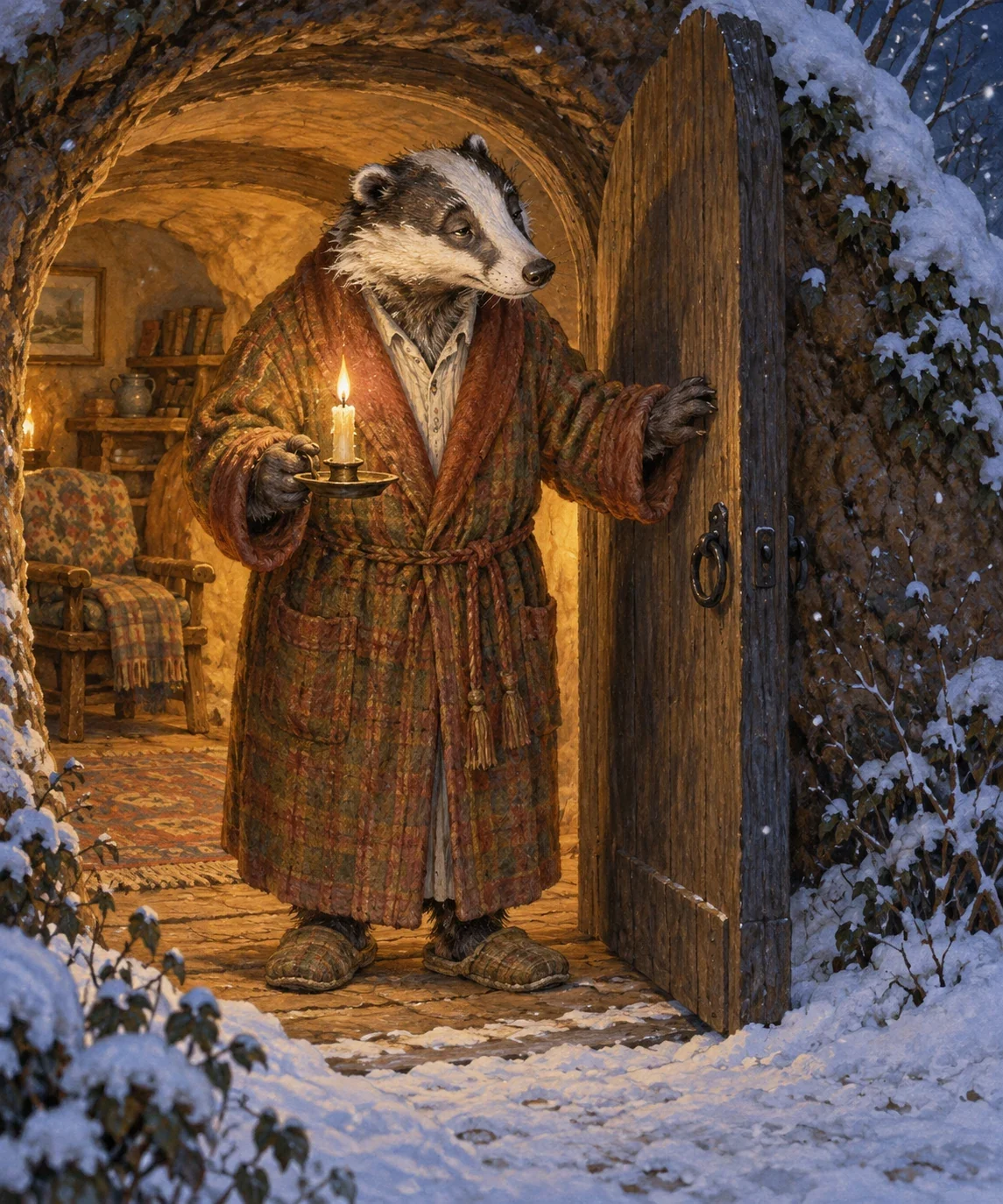
Imagined Badger in a dressing-gown and worn slippers holds a flat candlestick at an open underground door.
Unofficial AI interpretation of Badger welcoming visitors on a snowy night. Long snout, sleepy eyes, dressing-gown, worn slippers and flat candlestick follow the text; face markings, proportions, robe, doorway and light are imagined, without a fixed adaptation likeness. Full-frame display derivative; no upscaling.
Overview
Mr Badger is the secluded Wild Wood resident whose underground home becomes a refuge for Rat and Mole. When the two friends reach his door in the snow, they hear slow footsteps and see a long snout and sleepy eyes. He is wearing a long dressing-gown and badly worn slippers, and carries a flat candlestick in his paw. His first response is kindly and paternal: he pats their heads, says that small animals should not be out on such a night, and leads them towards the kitchen fire and supper. The scene supports a domestic, speaking animal character. The exact facial markings, size, robe fabric and house design are not established by a modern portrait and should remain explicitly imagined in an illustration.
Badger’s dislike of social formalities does not make him inhospitable. He welcomes the hungry visitors without fuss over their table manners and provides the practical comforts they need. His home extends through halls and passages, and his explanation of underground living stresses security, shelter and the ability to alter a dwelling by digging. He contrasts this with floods, broken windows, falling tiles and other difficulties that can affect houses above ground. He also tells Mole about an earlier human city associated with the place. That account belongs to the fantasy’s internal history; it should not be turned into a claim about a particular archaeological site or real national past. His preference for withdrawal is compatible with extensive knowledge of the neighbours and active concern for friends.
This concern becomes forceful when he visits Rat and Mole to organise an intervention over Toad’s motor-car obsession. Badger treats the arrival of another car as an urgent reason to act and expects the others to accompany him. His authority is social and personal rather than a stated legal power. The attempts to restrain Toad do not produce an immediate or final cure, and Toad’s later adventures continue to test the friends’ patience. When Toad Hall has been occupied by the Wild Wood animals, Badger supplies decisive information: Toad’s father had been his close friend and had shown him a secret passage. The father asked him to keep the knowledge from the volatile young Toad unless a real emergency made it useful. Badger now judges that such an emergency has arrived.
Badger leads the plan to regain the house, using the passage and the advantages created by Mole’s earlier visit to the sentries. Afterwards he recognises Mole’s competence and assigns him the preparation of comfortable bedrooms, while the friends share the recovered house’s food and shelter. At the celebration he joins Rat in discouraging Toad’s self-praising songs and exaggerated display, explaining that their friend must be able to live respectably among his neighbours. The ending also rejects a frightening legend about him: mother-weasels threaten naughty children with the terrible grey Badger, but the narrator calls this unfair and says he is rather fond of children. The original thus distinguishes formidable reputation from actual temperament. No supernatural child-taking role, official rulership or later adaptation continuity should be inferred from that teasing threat.
First appearances & development
Kenneth Grahame’s original The Wind in the Willows, retained in the edition whose original title matter says Published October 1913. Selected chapters I–VI and XI–XII support these episodes; adaptation designs and undocumented authorial models are excluded.
Canon & continuity
Original narrative.
Selected bibliography
Documented works and useful reading. This is not a list of every appearance.
- 01
The Wind in the Willows
Selected original chapters.
Family & connections
A source-supported family tree or inspiration record has not yet been compiled for this profile. Related reading below indicates a connection in subject matter, not a proven lineage or creative influence.
References
Sources supporting this profile. Linked pages have their own scope and editorial standards.
- PrimaryThe Wind in the WillowsResearch access: 2026-10-11
- CatalogueGutenberg: The Wind in the WillowsResearch access: 2026-10-11
Image credits
Unofficial modern AI interpretationImagined Badger in a dressing-gown and worn slippers holds a flat candlestick at an open underground door.
Unofficial AI interpretation of Badger welcoming visitors on a snowy night. Long snout, sleepy eyes, dressing-gown, worn slippers and flat candlestick follow the text; face markings, proportions, robe, doorway and light are imagined, without a fixed adaptation likeness. Full-frame display derivative; no upscaling.