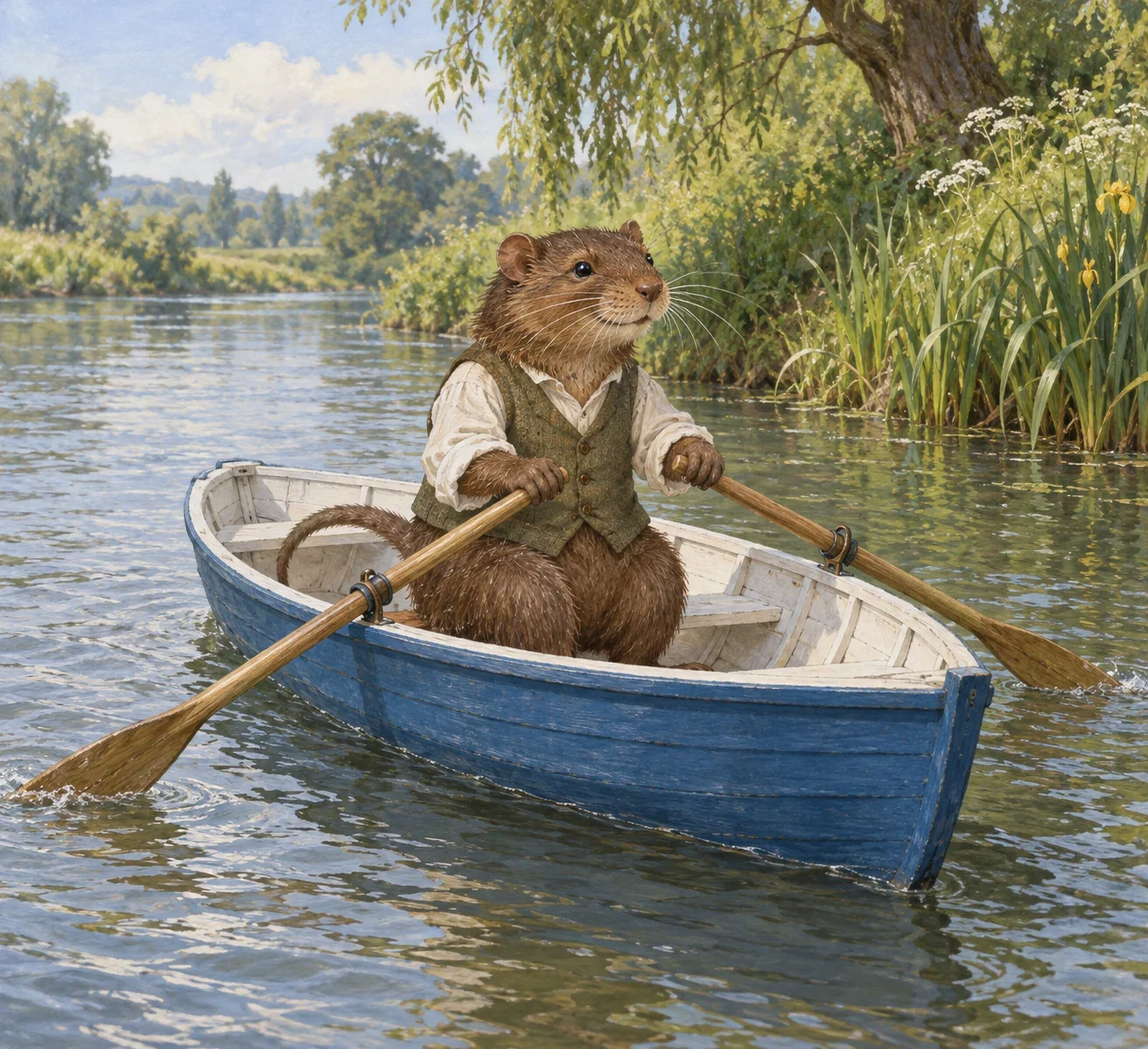
Unofficial AI interpretation of Ratty sculling his blue-and-white boat. Brown round face, small ears, whiskers and silky hair follow the novel; costume, fine anatomy, scale and riverside details are imagined. This is a literary character, not a real species plate.
Unofficial AI interpretation of Ratty sculling his blue-and-white boat. Brown round face, small ears, whiskers and silky hair follow the novel; costume, fine anatomy, scale and riverside details are imagined. This is a literary character, not a real species plate. Full-frame display derivative; no upscaling.
Overview
Rat first appears at a hole above the waterline opposite Mole. The narrator describes a small brown face with whiskers, a grave round face, small neat ears and thick silky hair. Rat crosses in a little boat painted blue outside and white inside, offers Mole his forepaw and introduces him to the river. The profile follows that named literary animal rather than making a precise real species identification. Human conversation, clothing and domestic arrangements belong to the novel’s variable animal society; they are not zoological observations.
His first outing establishes both generous hospitality and fallibility. He provides a substantial picnic, explains the riverside community and later rescues Mole after an unsuccessful attempt at rowing ends in the water. His enthusiasm for boats briefly distracts him enough to collide with the bank. When Mole becomes lost in the Wild Wood, Rat goes after him and helps him reach Badger’s home. His local competence is therefore practical and protective without making him an infallible guardian.
Rat also attends to emotional needs. In the homecoming episode he initially presses on despite Mole’s longing for his old house, then understands the loss and returns with him. He helps make the neglected home welcoming and organises provisions for the visiting field mice. His poems and interest in ducks give him an imaginative life beyond navigation. Later, the travelling Sea Rat’s accounts of distant coasts almost draw him away from everything familiar; Mole stops him and encourages a return to writing. This reversal lets the friend who often supports Mole require support himself.
Rat joins Mole and Badger in trying to restrain Toad’s dangerous motoring, receives the returning fugitive and takes part in recovering Toad Hall. Their friendship includes stern criticism as well as affection. Rat is related to the otter household through the search for the missing Portly, but he is neither an otter nor the travelling Sea Rat. The novel’s river episodes, domestic scenes and Toad’s adventures provide different contexts within one work, not separate invented sequels.
First appearances & development
Kenneth Grahame’s original novel places Rat among speaking animals whose riverbank homes coexist with roads, human institutions and the Wild Wood. The retained 1913 edition reproduces the literary narrative used here. Its edition credits do not establish that any particular modern visual design was prescribed by Grahame.
Canon & continuity
The complete primary novel supports the selected appearance, actions and relationships. Original text is distinguished from the electronic edition and catalogue; source illustrations were not used.
Selected bibliography
Documented works and useful reading. This is not a list of every appearance.
- 01
The Wind in the Willows
Original narrative; retained text is the 1913 Scribner edition. Later adaptations and illustration designs are outside this profile.
Family & connections
A source-supported family tree or inspiration record has not yet been compiled for this profile. Related reading below indicates a connection in subject matter, not a proven lineage or creative influence.
References
Sources supporting this profile. Linked pages have their own scope and editorial standards.
- Primary fictionThe Wind in the Willows — original literary textResearch access: 2026-10-11
- Bibliographic and rights recordProject Gutenberg catalogue: The Wind in the WillowsResearch access: 2026-10-11
Image credits
Unofficial modern AI interpretationUnofficial AI interpretation of Ratty sculling his blue-and-white boat. Brown round face, small ears, whiskers and silky hair follow the novel; costume, fine anatomy, scale and riverside details are imagined. This is a literary character, not a real species plate.
Unofficial AI interpretation of Ratty sculling his blue-and-white boat. Brown round face, small ears, whiskers and silky hair follow the novel; costume, fine anatomy, scale and riverside details are imagined. This is a literary character, not a real species plate. Full-frame display derivative; no upscaling.