A sourced illustration has not yet been added. This gap is included in the coverage record.
Overview
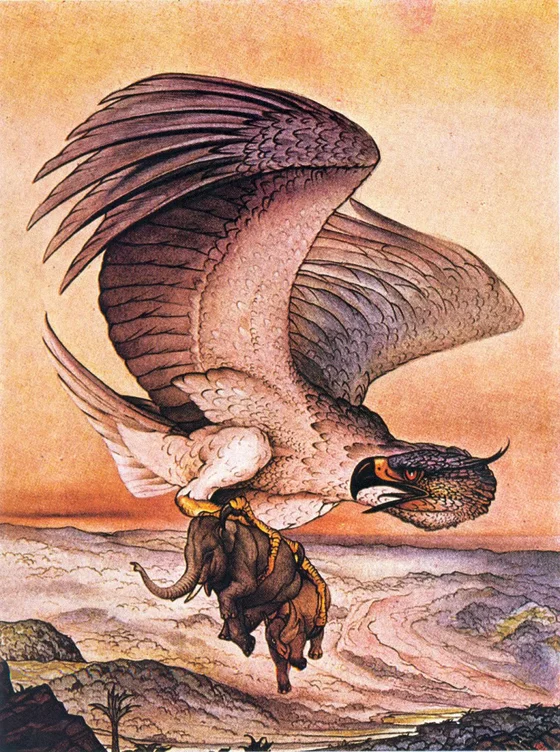
The moa is encountered after the Mauis remove other dangerous beings from ʻEua. It is described as larger than a house and like a mountain of a bird. Atalanga wants his son to drive it toward him, while Kijikiji insists on throwing the stones himself. The first throw grazes the creature and frightens it into flight toward Tonga rather than provoking the attack Atalanga fears.
A second stone injures a leg and wing, and the bird falls into the sea between ʻEua and Tonga. It continues by swimming with the uninjured leg and wing, reaches the beach and dies. The account associates its divided movement with the pattern of breakers at Toloa, thrown stones with shore deposits and its excrement with a hill on ʻEua. Those are narrated landscape explanations, not newly verified geological conclusions. Collocott says the local word is used for ordinary fowl and tentatively compares the legendary bird with New Zealand moa, while admitting he knows no traces of giant birds locally. The profile does not adopt that speculation as a taxonomic identification.
Origins & earliest records
The selected witness is E. E. V. Collocott’s 1921 article in Folklore, volume 32, pp. 45–58. The eHRAF catalogue identifies a Tongan-language missionary journal as the immediate collection context. The English publication dates this witness rather than the oral beginning; that earlier journal text has not been independently collated here.
Records & interpretation
The huge body, wounded leg and wing, sea crossing and landscape explanations are textual evidence. Collocott's tentative New Zealand comparison is expressly separated from the Tongan word and episode, rather than accepted as zoological identification.
Selected bibliography
Documented works and useful reading. This is not a list of every appearance.
- 01
Legends from Tonga. The Maui, pp. 50–51
Selected public primary pages read in full, including continuations. English missionary-era presentation is attributed, and its judgments are not treated as community consensus.
- 02
Legends from Tonga. The Maui
E. E. V. Collocott, Legends from Tonga. The Maui, Folklore32 (1921), pp45–58; proofread Wikisource page transcription inspected, facsimile not independently checked.
Family & connections
A source-supported family tree or inspiration record has not yet been compiled for this profile. Related reading below indicates a connection in subject matter, not a proven lineage or creative influence.
Located primary passages
Specific passages supporting details in this entry, grouped by their published witness.
Legends from Tonga. The Maui, pp. 50–51
E. E. V. Collocott, Legends from Tonga. The Maui, Folklore32 (1921), pp45–58; proofread Wikisource page transcription inspected, facsimile not independently checked.
- Kijikiji wounds the enormous moa; it swims to Tonga and dies. Collocott’s extinct-bird comparison is conjecture.
Printed45–57 selected narrative pages inspected; sacred descendant catalogue and ceremonial formula excerpts excluded. No uninspected original informant identity or facsimile verification claimed. No global public-domain claim. Author died1970, independently verified in Australian Dictionary of Biography / National Library of New Zealand. Underlying1921 text treated conservatively as protected; site footer is not proof of globally free underlying copyright. Shared article budget24 words including duplicate short quotations/evidence in both outputs; no further excerpts.
References
Sources supporting this profile. Linked pages have their own scope and editorial standards.
- Primary textLegends from Tonga, Folklore 32 (1921), printed p. 50Research access: 2026-10-05
- Primary textLegends from Tonga, Folklore 32 (1921), printed p. 51Research access: 2026-10-05
- ReferenceeHRAF catalogue: Legends from Tonga, 1921, collection contextResearch access: 2026-10-05
Image credits
A sourced illustration has not yet been added. This gap is included in the coverage record.