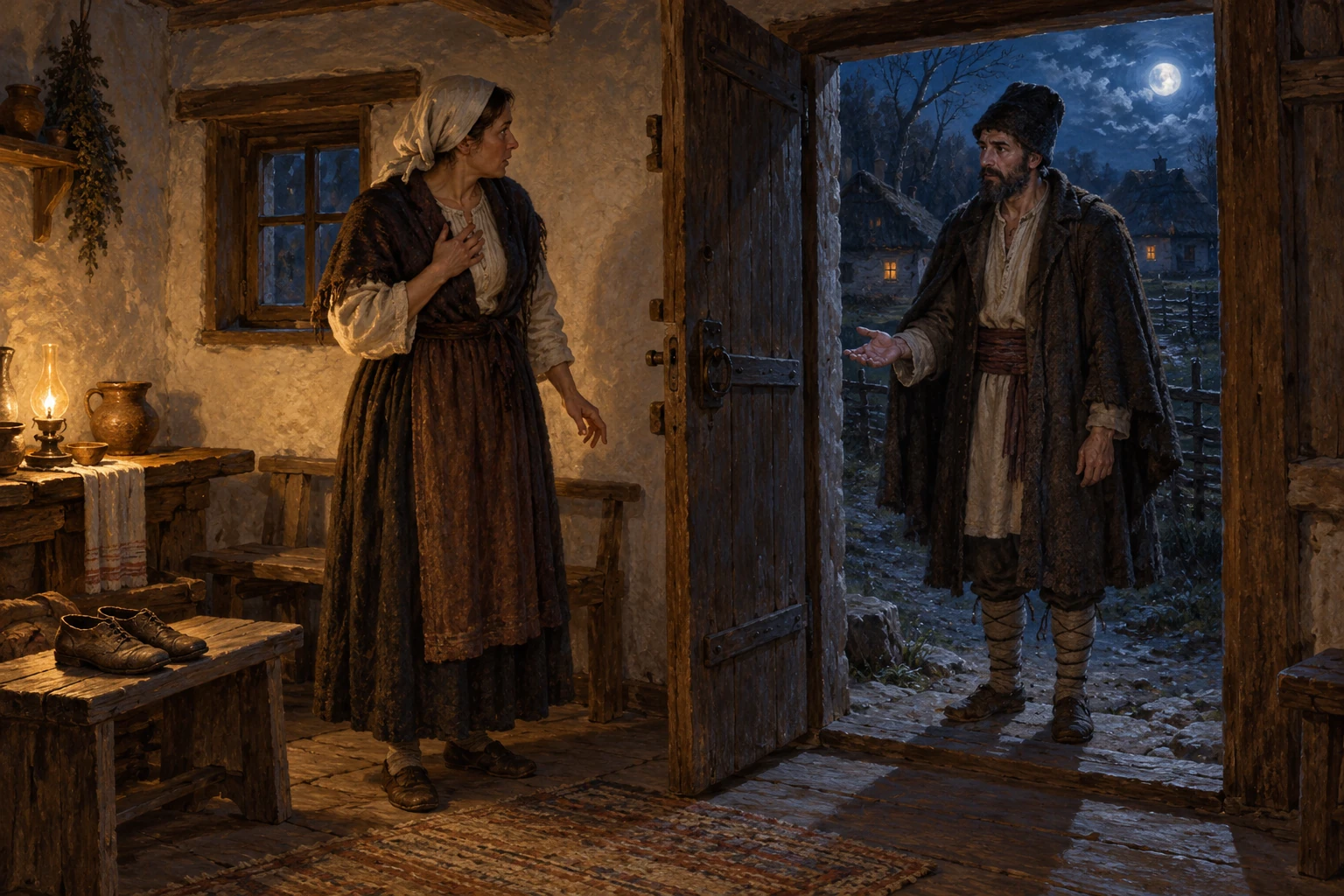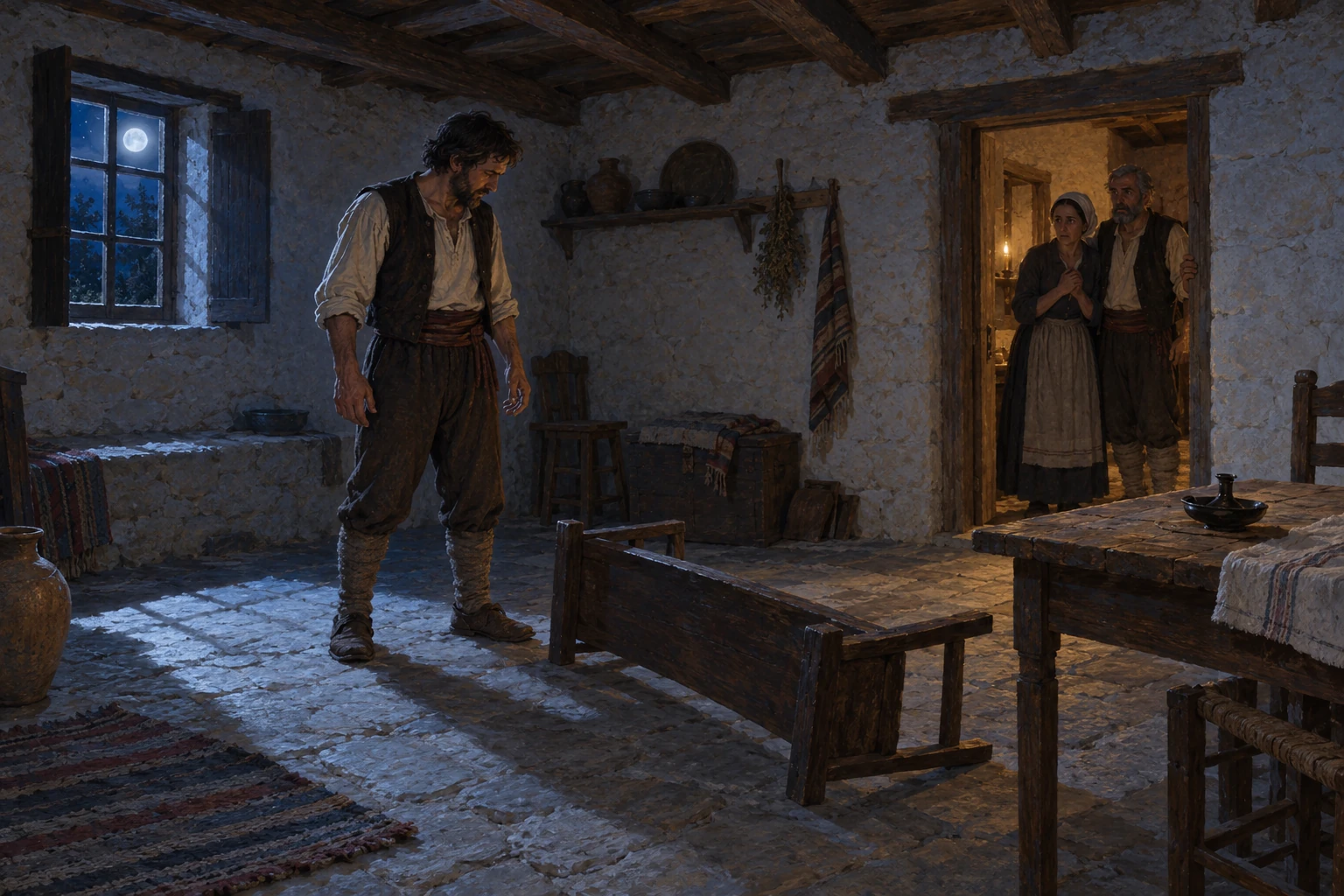
AI-generated interpretation of reported nocturnal disturbances in Calmet’s quotation of Tournefort’s Micon account. The overturned furniture and extinguished lamp follow the allegations; faces, clothes, house and exact arrangement are imagined. The traveller’s observations of other events do not authenticate this imagined night scene.
A modern illustration of an attributed report, not a verified apparition, portrait or universal revenant appearance.
Overview
Calmet’s Phantom World quotes Pitton de Tournefort at length about an unnamed peasant of the island called Micon in this English witness. The peasant has been killed by an unknown person and buried in a town chapel. Rumours then describe him returning at night, overturning furniture, extinguishing lamps and grabbing people from behind. The account’s subject is a suspected vroucolaca, not a named vampire with a verified biography. It does not initially describe blood-drinking or a series of deaths caused by the visitor.
Complaints lead local authorities, clergy and principal inhabitants to arrange an exhumation. Tournefort’s quoted party observes a strongly decayed, offensive-smelling corpse; other spectators interpret alleged warmth, blood and vapour as signs of animation. The narrator disputes those readings and attributes the vapour in part to incense. The episode preserves a conflict over what observers think they see. It does not independently establish either a returning corpse or a modern diagnosis of the community.
Removing and burning the heart fails to end the complaints. People report broken doors and windows, torn clothes and emptied bottles; families take beds to the market-place or leave town. Further processions and ceremonial changes also fail. Tournefort says his party urges a night watch and that some vagabonds are arrested, connecting at least part of the disorder with theft. His assertion does not prove that every incident had the same cause. The narrative also records arguments about the order of ceremonies and the suitability of different swords, without demonstrating their supernatural effectiveness.
The authorities eventually order the remaining body burned at the point of the island of Saint George. The quoted account explicitly dates that final fire to 1 January 1701 and says the travellers see it while returning from Delos. It then reports no further complaints and a mocking song about the defeated devil. This is the narrator’s stated outcome, rather than proof that burning destroyed an actual supernatural being. The closing passage adds a further consequence: clergy fear penalties for acting without permission, and the community is said to pay Ottoman authorities over the treatment of the corpse.
Calmet marks the end of the long quotation by attributing it to Tournefort. The quoted traveller’s sweeping denunciation of Greeks and descriptions of collective madness remain his historical judgments; they are not adopted as accounts of a whole people, church or current medicine. The neighbouring discussion concerns excommunication and bodily decay, but this peasant is not explicitly identified as excommunicated. The selected episode is therefore kept distinct from those surrounding theological arguments and from later fictional vampire rules.
Origins & earliest records
Calmet’s 1850 English Phantom World transmits a long quotation attributed to Pitton de Tournefort. Its own spellings include Micon, Mico and Maco. This entry does not independently collate Tournefort’s original travel edition or prove the modern place-name identification, first oral origin or historical occurrence of every reported act.
Records & interpretation
Complete volume II chapter XXXII and its note 517 read from the retained root-accepted master; preceding XXXI and note 516 also read. Following XXXIII opening premise read only; no complete reading claim for that next chapter.
Selected bibliography
Documented works and useful reading. This is not a list of every appearance.
- 01
The Phantom World; or, The History and Philosophy of Spirits, Apparitions, &c.
Philadelphia: A. Hart, two volumes in one; volume II XXXII, pp. 304–307, note 517. Preceding XXXI and note 516 and following XXXIII opening inspected for framing.
Family, evolution & connections
Vampire
Calmet’s quoted Micon vroucolaca report is one historical revenant account beside the broader vampire category. Its initial allegations concern house disturbances, not blood-drinking or a series of deaths. Disputed observations, communal responses and the reported cessation of complaints should remain part of the account; the category does not establish a uniform anatomy, power or historical cause.
Peter Plogojovitz in Calmet’s Kisolova account
These two reports in Calmet have different places, allegations and outcomes. Plogojovitz’s Kisolova account attributes deaths and a shoe request to a named returner. Tournefort’s Micon narrative describes an unnamed suspected visitor, contested observations, alleged disorder and later communal repercussions. Neither report authenticates the other or establishes a uniform revenant biology.
References
Sources supporting this profile. Linked pages have their own scope and editorial standards.
- Historical collection quoting an attributed travel narrativeCalmet 1850, volume II XXXII, Vroucolaca Exhumed in Presence of Monsieur de TournefortResearch access: 2026-10-26
Image credits
Modern interpretation of a historical literary accountAI-generated interpretation of reported nocturnal disturbances in Calmet’s quotation of Tournefort’s Micon account. The overturned furniture and extinguished lamp follow the allegations; faces, clothes, house and exact arrangement are imagined. The traveller’s observations of other events do not authenticate this imagined night scene.
A modern illustration of an attributed report, not a verified apparition, portrait or universal revenant appearance.