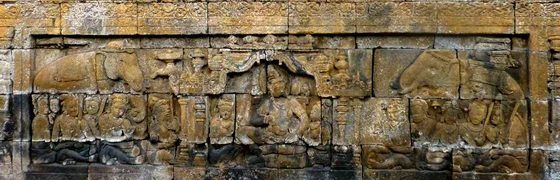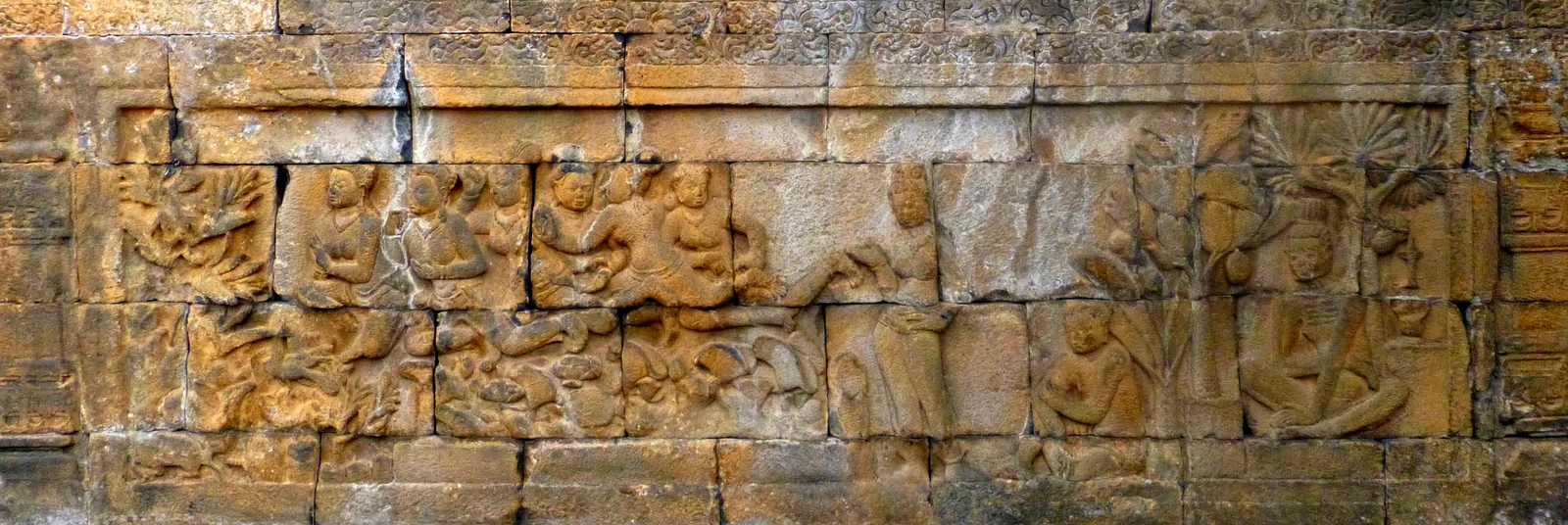
Long stone relief with flying or raised human-form maidens at left, a lotus pond below, and a captive woman, crouching hunter and ascetic beneath trees at right.
Borobudur, level1 inner wall,panel5. Foucher identifies Manoharā at the hunter’s noose and her companions fleeing over the lotus pond. The kinnaris are depicted in human form; wings are not inferred.
Overview
Manoharā, daughter of the kinnari king Druma, bathes with five hundred companions in the Brahmasabhā pool. Phalaka captures her with the Amogha-chain and obtains the head jewel that enables her heavenly flight. He presents her to Prince Sudhana, whom she marries. This translation describes a beautiful feminine body without specifying wings or avian legs; familiar bird-woman imagery should therefore not be treated as its bodily inventory.
When an enemy of Sudhana arranges a rite requiring her death, the prince’s mother restores her flight jewel and she escapes. Manoharā leaves a ring and directions with a forest ascetic so that Sudhana can follow. At Druma’s city the ring reveals his arrival. After he passes strength trials, he must recognize her among a thousand similar kinnaris; his declaration of truth brings her forward. Reunited, she carries him home through her kinnari power.
Origins & earliest records
Indian Buddhist narrative preserved in Tibetan translation
Records & interpretation
Complete chapter V and its footnotes directly read in the digitized 1906 edition.
In the literature
“speeding onwards through the air by Kinnarī power”
V Sudhana Avadāna, hosted printed-page marker73 · W.R.S.Ralston, English from Schiefner’s German Tibetan translation
The reunited couple return together; the English source gives their mode of travel without describing wings.
Selected bibliography
Documented works and useful reading. This is not a list of every appearance.
- 01
Tibetan Tales Derived from Indian Sources
V, Sudhana Avadāna, pp. 53–74; chapter footnote cites Kah-gyur ii. 202–209
- 02
Tibetan Tales Derived from Indian Sources — V Sudhana Avadāna
Tibetan Tales Derived from Indian Sources, London: Kegan Paul, Trench, Trübner & Co., 1906, title-page transcription independently checked. Tibetan Kah-gyur to German by F. Anton von Schiefner, then German to English by W.R.S.Ralston. CompleteV44–74 and all notes independently read: Janmachitra rescue, Manoharā capture/escape, Pānchika intervention, quest, Druma tests and airborne return. Editor’s explicitly obscure route passage retained as uncertain; original manuscripts not collated.
Family, evolution & connections
Druma and Manoharā in the Sudhana Avadāna
Schiefner/Ralston English translation, actual 1906 edition, story V; named parentage pp. 54 and 71–74.
Scroll sideways to see all branches. With a keyboard, focus the tree and use the arrow keys.
Repeated explicit father–daughter identifications support this single branch. Kah-gyur ii. 202–209 is the translator’s edition locator; the Tibetan original has not been independently collated. Attendants and identical Kinnarīs are not assigned kinship. Sudhana’s father-address to Druma is affinal; marriage is not a descent edge.
Sudhana in the Sudhana Avadāna
Manoharā identifies Sudhana as her husband; Druma later gives her to him after recognition and skill tests. His address to Druma as father is affinal, not evidence that Druma biologically fathers Sudhana.
Primary records and illustrations
Schiefner/Ralston, Tibetan Tales Derived from Indian Sources (London, 1906)
V, Sudhana Avadāna. pp. 53–74
Entire chapter pp. 44–74 and footnotes read; chapter note cites Kah-gyur ii. 202–209. Edition title page checked. Primary witness of the historical translation; original Tibetan not independently checked. Translator’s uncertain river-name conjectures excluded.
Located primary passages
Specific passages supporting details in this entry, grouped by their published witness.
Tibetan Tales Derived from Indian Sources
Tibetan Tales Derived from Indian Sources, London: Kegan Paul, Trench, Trübner & Co., 1906, title-page transcription independently checked. Tibetan Kah-gyur to German by F. Anton von Schiefner, then German to English by W.R.S.Ralston. CompleteV44–74 and all notes independently read: Janmachitra rescue, Manoharā capture/escape, Pānchika intervention, quest, Druma tests and airborne return. Editor’s explicitly obscure route passage retained as uncertain; original manuscripts not collated.
- Manoharā, Druma’s Kinnarī daughter, comes with companions to bathe and make music. Phalaka captures her with the Amogha-chain and takes the flight-enabling head jewel; he then presents her to Sudhana. When the prince leaves for war and a priest plots her death, Sudhana’s mother returns the jewel because her life is endangered. Manoharā flies away, leaves a ring and conditional route directions with the hermit, and returns to her father. Sudhana later signals arrival with that ring. After trials and recognition, they reunite and travel back by Kinnarī power.
German-mediated English narrative; Sanskrit/Tibetan originals and listed parallel versions not independently collated. Route names/fluvial interpretation explicitly uncertain in translator note8. Printed markers from transcription. Coercive marriage, captivity and sacrifices remain historical narrative framing, not endorsed. No rite, spell, sacrificial preparation, medical recipe, devotional formula or verse copied.
References
Sources supporting this profile. Linked pages have their own scope and editorial standards.
- Historical translation of Buddhist narrativeSchiefner/Ralston, Tibetan Tales (1906), V, pp. 53–74Research access: 2026-10-05
Image credits
Photograph of historical narrative reliefLong stone relief with flying or raised human-form maidens at left, a lotus pond below, and a captive woman, crouching hunter and ascetic beneath trees at right.
Borobudur, level1 inner wall,panel5. Foucher identifies Manoharā at the hunter’s noose and her companions fleeing over the lotus pond. The kinnaris are depicted in human form; wings are not inferred.