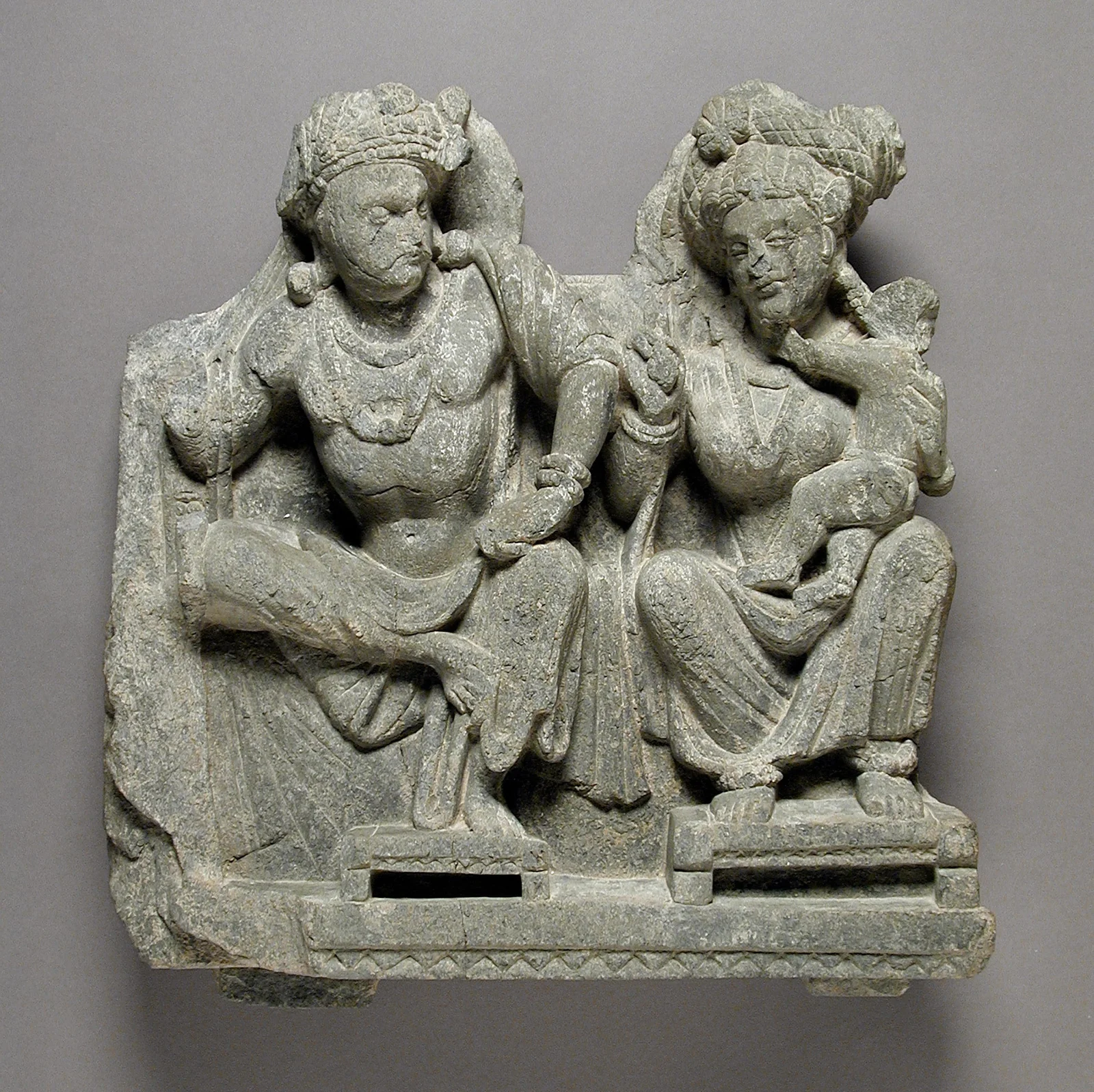
Grey schist relief of seated Panchika at left, wearing a turban and moustache, and Hariti at right with a child embracing her neck; both have halos, draped garments and individual footstools.
Gandhara, ca.100–150. Panchika and Hariti appear together as protective deities, with a child on Hariti’s knee. The damaged objects once held in their hands are not all securely identified; the museum qualifies the proposed cup and pomegranate.
Overview
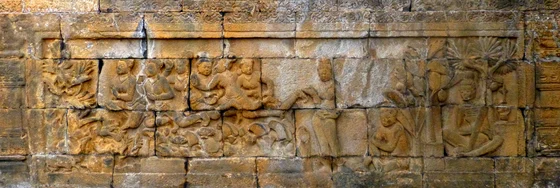
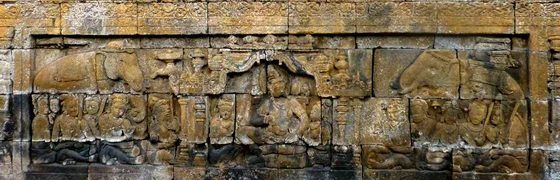
The great king Vaiśravaṇa recognizes Sudhana as a Bodhisattva and sends the yaksha commander Pānchika to help him subdue rebellious mountaineers without injury. Pānchika produces an army whose men are as tall as palms, whose elephants resemble mountains and whose horses are elephant-sized; its chariots resemble divine palaces.
The spectacle and its noise break the defenders’ resistance, and they surrender without a battle. Their explanation attributes the revolt to fear of the king’s officials. The enormous bodies belong to the conjured army, not to an anatomical description of Pānchika. His command is presented within a Buddhist sacred narrative, rather than as evidence for an independent monster species.
Origins & earliest records
Indian Buddhist narrative preserved in Tibetan translation
Records & interpretation
Complete chapter V and its footnotes directly read in the digitized 1906 edition.
In the literature
“men of the stature of palm trees”
V Sudhana Avadāna, hosted printed-page marker59 · W.R.S.Ralston, English from Schiefner’s German Tibetan translation
The phrase describes the conjured host, distinct from Pānchika’s own physical anatomy.
Selected bibliography
Documented works and useful reading. This is not a list of every appearance.
- 01
Tibetan Tales Derived from Indian Sources
V, Sudhana Avadāna, pp. 58–60; chapter footnote cites Kah-gyur ii. 202–209
- 02
Tibetan Tales Derived from Indian Sources — V Sudhana Avadāna
Tibetan Tales Derived from Indian Sources, London: Kegan Paul, Trench, Trübner & Co., 1906, title-page transcription independently checked. Tibetan Kah-gyur to German by F. Anton von Schiefner, then German to English by W.R.S.Ralston. CompleteV44–74 and all notes independently read: Janmachitra rescue, Manoharā capture/escape, Pānchika intervention, quest, Druma tests and airborne return. Editor’s explicitly obscure route passage retained as uncertain; original manuscripts not collated.
Family & connections
A source-supported family tree or inspiration record has not yet been compiled for this profile. Related reading below indicates a connection in subject matter, not a proven lineage or creative influence.
Primary records and illustrations
Schiefner/Ralston, Tibetan Tales Derived from Indian Sources (London, 1906)
V, Sudhana Avadāna. pp. 58–60
Entire chapter pp. 44–74 and footnotes read; chapter note cites Kah-gyur ii. 202–209. Edition title page checked. Primary witness of the historical translation; original Tibetan not independently checked. Translator’s uncertain river-name conjectures excluded.
Located primary passages
Specific passages supporting details in this entry, grouped by their published witness.
Tibetan Tales Derived from Indian Sources
Tibetan Tales Derived from Indian Sources, London: Kegan Paul, Trench, Trübner & Co., 1906, title-page transcription independently checked. Tibetan Kah-gyur to German by F. Anton von Schiefner, then German to English by W.R.S.Ralston. CompleteV44–74 and all notes independently read: Janmachitra rescue, Manoharā capture/escape, Pānchika intervention, quest, Druma tests and airborne return. Editor’s explicitly obscure route passage retained as uncertain; original manuscripts not collated.
- When Vaiśravaṇa’s chariot is delayed above Sudhana’s expedition, he recognizes the prince and orders his Yaksha commander Pānchika to help without battle or injury to living beings. Pānchika conjures enormous troops, animals and chariots; their uproar and power break the mountaineers’ walls. Alarmed defenders open the gates and receive Sudhana, who appoints chiefs, fixes taxes and takes hostages. The episode has coercive intimidation but no narrated battlefield slaughter.
V Sudhana Avadāna, complete44–74; Vaiśravaṇa/Pānchika intervention58–60; Kah-gyurii.202–209
German-mediated English narrative; Sanskrit/Tibetan originals and listed parallel versions not independently collated. Route names/fluvial interpretation explicitly uncertain in translator note8. Printed markers from transcription. Coercive marriage, captivity and sacrifices remain historical narrative framing, not endorsed. No rite, spell, sacrificial preparation, medical recipe, devotional formula or verse copied.
References
Sources supporting this profile. Linked pages have their own scope and editorial standards.
- Historical translation of Buddhist narrativeSchiefner/Ralston, Tibetan Tales (1906), V, pp. 58–60Research access: 2026-10-05
Image credits
Historical sculpture photographGrey schist relief of seated Panchika at left, wearing a turban and moustache, and Hariti at right with a child embracing her neck; both have halos, draped garments and individual footstools.
Gandhara, ca.100–150. Panchika and Hariti appear together as protective deities, with a child on Hariti’s knee. The damaged objects once held in their hands are not all securely identified; the museum qualifies the proposed cup and pomegranate.