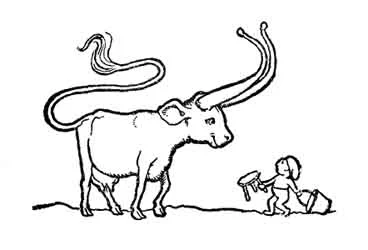
John D. Batten’s Little Bull-Calf and small boy, tailpiece to Jacobs’s tale
Batten’s tailpiece pairs an exaggerated long-horned calf with a small boy carrying an axe. It is a decorative interpretation attached to the named tale, not a literal account of the calf’s death: the story has the dragon kill the calf, while the boy later uses its promised gift. The horns and scale are the illustrator’s choices.
Overview
The boy feeds and shares food with his calf, but his stepfather threatens to kill it. They leave to seek fortune. At the wilderness the calf predicts that it will overcome the surrounding beasts yet die fighting the dragon, and instructs the boy to remain above the danger in a tree. Its prediction comes true. The calf tells the boy to inflate its bladder after its death and use it as a weapon: anything struck with it will die. The boy carries out this instruction, preserving the helper’s gift after its body has been lost.
The boy encounters a princess fastened down as the dragon’s intended victim. The approaching monster spits fire, roars audibly over miles and has a tongue likened to a spear. The calf’s gift allows the boy to kill it, although he loses a finger in the encounter. The dragon’s tongue and the princess’s ring subsequently establish his claim when other men bring false proofs. Jacobs’s narrator uses conspicuously mixed wilderness fauna and a reference to newspapers; these are features of the transmitted story rather than a historically coherent account of ancient English ecology. The calf’s solidarity with the abandoned child, not a fully specified supernatural species, defines this particular helper.
Origins & earliest records
Jacobs’s note attributes the tale to Gypsy Lore Journal volume III, among narratives told to John Sampson in a tent. He states that he respelled the story and euphemised the calf’s bodily gift. This attributed Romani collection history is distinct from the book’s general English title and its remote-age opening.
Records & interpretation
The calf’s speech, foreknowledge and effective posthumous gift belong to the tale’s literary evidence. No anatomical material survives for testing, and the listed wild animals are not historical distribution records. Its supernatural helper role is separate from real cattle natural history.
In the literature
“the fiery dragon killed the little bull-calf”
The Little Bull-Calf; The foretold battle in the wilderness
The calf's help continues through its instructed bodily legacy after its death.
Selected bibliography
Documented works and useful reading. This is not a list of every appearance.
- 01
More English Fairy Tales
Complete “The Little Bull-Calf” and its source note inspected. Preface acknowledges rewritten and combined sources.
- 02
More English Fairy Tales — The Little Bull-Calf
Joseph Jacobs, More English Fairy Tales; first publication1894, selected Gutenberg14241 witness explicitly Fourteenth Impression, undated. Jacobs’s preface acknowledges rewriting, combined sources and altered incidents. Exact heading/anchor used; no invented print pagination.
Family & connections
A source-supported family tree or inspiration record has not yet been compiled for this profile. Related reading below indicates a connection in subject matter, not a proven lineage or creative influence.
Located primary passages
Specific passages supporting details in this entry, grouped by their published witness.
More English Fairy Tales — The Little Bull-Calf
Joseph Jacobs, More English Fairy Tales; first publication1894, selected Gutenberg14241 witness explicitly Fourteenth Impression, undated. Jacobs’s preface acknowledges rewriting, combined sources and altered incidents. Exact heading/anchor used; no invented print pagination.
- A boy leaves an abusive stepfather with the calf inherited from his father. The speaking calf predicts victory over wild beasts but death against a fiery dragon, instructing the boy to hide in a tree, take its bladder after its death and use it as a fatal weapon. It fights as predicted and is killed.
The Little Bull-Calf; Inherited companion predicts its death and protective legacy
- The boy takes the bladder, finds a princess staked for the dragon and kills it with a blow, losing his forefinger to its final bite. Its tongue and the princess's ring later identify him against false claimants; he marries her and rejects the stepfather's belated claim.
The Little Bull-Calf; Weapon, rescued princess and identifying tokens
Complete selected tale and its source note read. Jacobs’s edited narrative is distinct from direct oral transcription. No song or ritual-formula excerpts; no invented print page or earliest date.
Primary source witness
Joseph Jacobs, More English Fairy Tales; first publication1894, selected Gutenberg14241 witness explicitly Fourteenth Impression, undated. Jacobs’s preface acknowledges rewriting, combined sources and altered incidents. Exact heading/anchor used; no invented print pagination.
- Jacobs cites Gypsy Lore JournalIII and tales told in a tent to John Sampson, admitting respelling and euphemising the bladder. The selected edition reports this collection chain; it does not identify an individual narrator or precise collection place here.
This verifies what Jacobs reports and changes; listed earlier works and informant claims are not independently verified by this note alone.
References
Sources supporting this profile. Linked pages have their own scope and editorial standards.
- Primary textJacobs, More English Fairy Tales: The Little Bull-Calf and editorial noteResearch access: 2026-10-05
- ReferenceUniversity of Pennsylvania Online Books Page: Joseph Jacobs bibliographic listResearch access: 2026-10-05
Image credits
Historical illustrationJohn D. Batten’s Little Bull-Calf and small boy, tailpiece to Jacobs’s tale
Batten’s tailpiece pairs an exaggerated long-horned calf with a small boy carrying an axe. It is a decorative interpretation attached to the named tale, not a literal account of the calf’s death: the story has the dragon kill the calf, while the boy later uses its promised gift. The horns and scale are the illustrator’s choices.