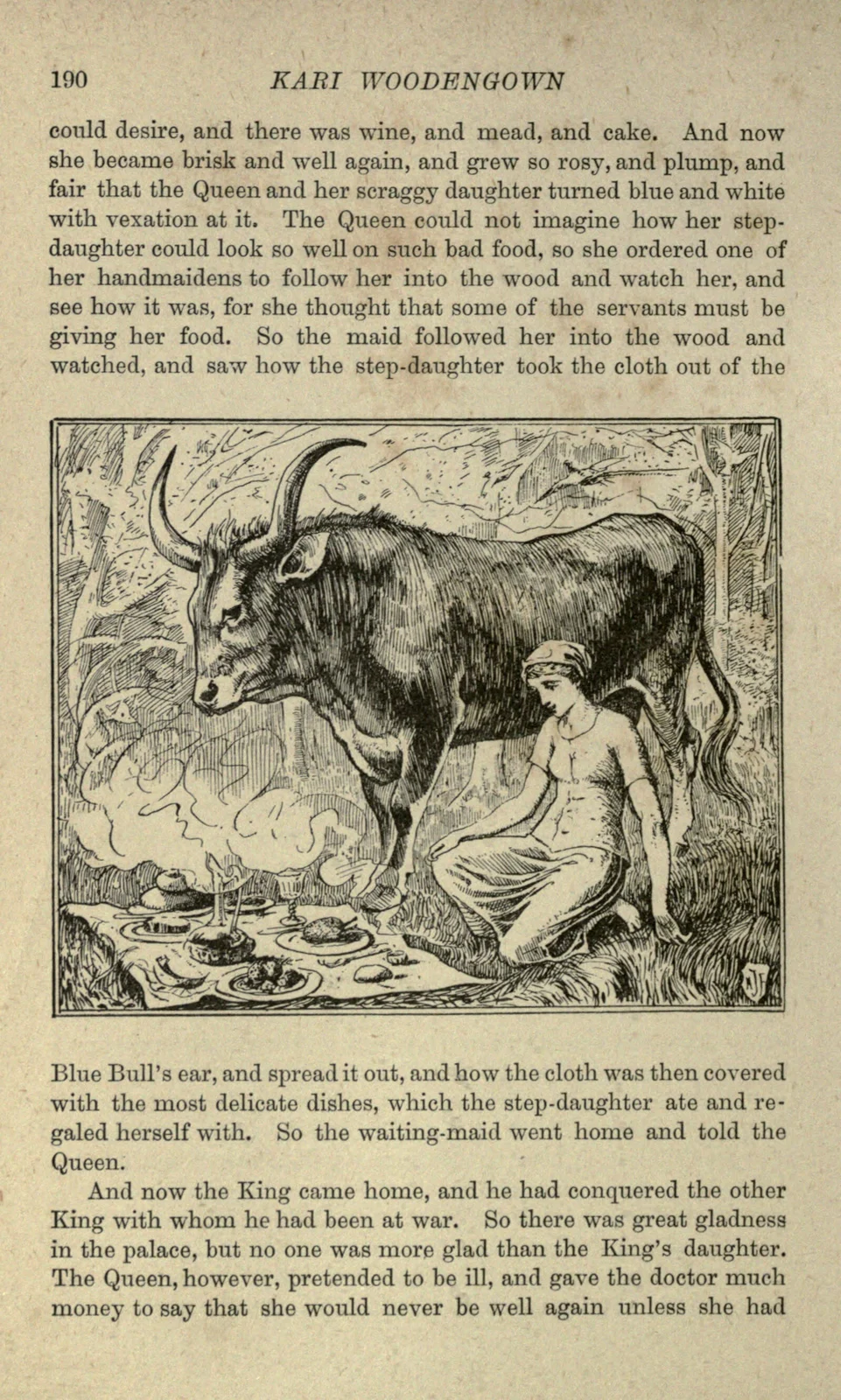
The bull and Kari beside the feast supplied by his ear cloth, H. J. Ford, 1890
Ford shows the bull beside Kari and the food produced by his ear cloth. Lang’s 1890 Kari Woodengown adaptation calls this helper the Blue Bull, whereas the selected Dasent witness calls him dun. The image records that related telling rather than establishing a single fixed coat colour.
Overview
When a jealous stepmother starves and beats the princess, a sleek dun bull becomes her confidant. A cloth in his left ear produces rich food and drink when spread out. The stepmother learns the secret and arranges a false illness requiring his flesh. He warns that their lives are both threatened and carries the girl away before the planned slaughter.
Their route crosses woods made of copper, silver and gold. A displaced leaf or apple summons each wood's troll owner, with three, six and nine heads. The bull fights increasingly exhausting battles and recovers through ointment from the defeated trolls. The nine-headed owner is especially difficult: surviving heads revive a defeated one, and the struggle lasts a week. At the final destination he asks the princess to preserve his hide and the metallic keepsakes beside a rock. That place supplies her later clothing and mounts; this version never explains him as a restored prince.
Origins & earliest records
The dun bull appears in Katie Woodencloak, a Norwegian tale collected by Asbjørnsen and Moe and translated by Dasent in a collection first published in 1859. The inspected electronic version includes a second-edition notice but no securely identified print year. This attestation concerns one animal helper within a Cinderella-related tale, not the motif's first oral occurrence.
Records & interpretation
Speech, the food-producing ear cloth, protective travel and three battles are explicit in the narrative. The preserved hide is connected with later assistance from a man emerging at a rock, but the text does not explain that man's identity. Evidence for a magical helper should therefore not become a fabricated claim of bovine-human transformation or zoological proof.
In the literature
“in my left ear lies a cloth”
Tale L, Katie Woodencloak; Bull offers food to the starving princess · George Webbe Dasent
The talking helper identifies the source of the cloth that supplies meals.
Selected bibliography
Documented works and useful reading. This is not a list of every appearance.
- 01
Katie Woodencloak (Popular Tales from the Norse)
Inspected named tale L. Electronic witness includes a notice to the second edition; its exact print date is unresolved.
- 02
Popular Tales from the Norse — Katie Woodencloak
Dasent historical English translation of Asbjørnsen and Moe; hosted PG8933 includes a Second Edition notice, but its exact selected print edition date and printed pages are unresolved. 1859 is the first English collection context only. Exact observed chapter anchors and episode locators used.
Family & connections
A source-supported family tree or inspiration record has not yet been compiled for this profile. Related reading below indicates a connection in subject matter, not a proven lineage or creative influence.
Located primary passages
Specific passages supporting details in this entry, grouped by their published witness.
Popular Tales from the Norse — Katie Woodencloak
Dasent historical English translation of Asbjørnsen and Moe; hosted PG8933 includes a Second Edition notice, but its exact selected print edition date and printed pages are unresolved. 1859 is the first English collection context only. Exact observed chapter anchors and episode locators used.
- The Dun Bull comforts the mistreated princess and supplies a cloth from his left ear that produces food. After the stepmother bribes a doctor to demand the Bull’s flesh, he carries the girl away at night.
Tale L, Katie Woodencloak; Secret feeding cloth and flight from threatened slaughter
- Unintentional plucking provokes the owners of three metal woods. The Bull defeats Trolls with three, six and nine heads, suffering progressively worse wounds and being restored with each attacker’s ointment; the last heads revive one another during a week-long fight.
- Near the distant castle, the Bull tells her to adopt the wooden cloak and requires her to behead and flay him. She stores hide with copper leaf, silver leaf and gold apple under the rock, where knocking later summons clothes and horses that support her marriage quest.
Tale L, Katie Woodencloak; Bull’s requested death and instructions for future aid
Complete named tale read. The later man at the rock is not explicitly identified as the Bull and is not treated as a proved identity. Exact selected print date, page numbers and earliest attestations are not inferred.
References
Sources supporting this profile. Linked pages have their own scope and editorial standards.
- Primary textPopular Tales from the Norse — Katie Woodencloak (tale L)Research access: 2026-10-05
Image credits
Historical illustrationThe bull and Kari beside the feast supplied by his ear cloth, H. J. Ford, 1890
Ford shows the bull beside Kari and the food produced by his ear cloth. Lang’s 1890 Kari Woodengown adaptation calls this helper the Blue Bull, whereas the selected Dasent witness calls him dun. The image records that related telling rather than establishing a single fixed coat colour.