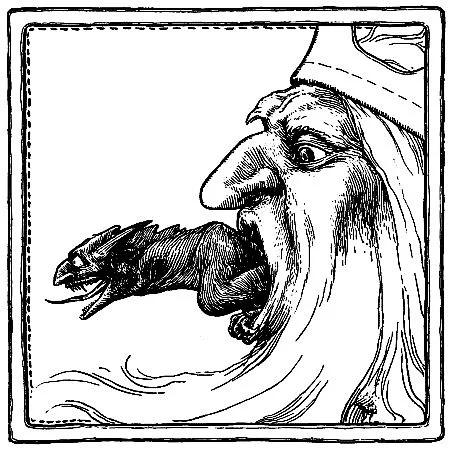
Batten: Lawless Beast emerging from the king’s mouth
Exact printed caption identifies the Lawless Beast and its emergence from the king’s mouth; animal-like head and body visible. John Dickson Batten (1860–1932) credited by title page. Selected title-page edition 1895.
Overview
Jacobs’s condensed story says the creature has lived within Cathal for a year and a half, bringing a consumption of animals, bread and ale so excessive that it threatens Munster’s resources. The scholar MacConglinney challenges the king through a provocative display and secures a promise to refrain from eating. He later describes an extravagant imagined food landscape, with milk waters, butter structures, meat craft and edible clothing, while displaying savoury portions. The monster’s appetite becomes inseparable from the satire’s lavish verbal invention.
As the recital continues, the beast emerges far enough to lick its lips and then leaps from Cathal’s throat toward the offered food. MacConglinney attempts to contain it and the house catches fire, but the creature springs to the roof and vanishes rather than being explicitly killed. Cathal wakes relieved of the craving and rewards the scholar with continuing status at his table. The episode personifies an affliction and mocks abundance, while providing little stable anatomy for the beast. It should not be converted into a diagnosis of real excessive appetite, a parasite description or a treatment recommendation. The imagined food figures are parts of the scholar’s nested vision, not independently encountered species.
Origins & earliest records
Jacobs credits Alfred Nutt’s condensation from Meyer’s 1892 edition, whose two source versions come from fourteenth- and sixteenth-century manuscripts. The inspected selected print witness is 1895. Those manuscript dates concern transmission, while neither establishes the historical king’s possession or the satire’s oral beginning.
Records & interpretation
The throat emergence, food-seeking leap and escape are literary evidence from a satirical vision. They do not verify supernatural disease causation or medical treatment. The source’s personification is retained as a narrative device, and the monster’s departure is distinguished from death.
In the literature
“a lawless evil beast, that afflicted him with hunger that ceased not”
The Vision of MacConglinney; p.67, the narrator introduces Cathal’s affliction
A lawless beast dwells inside King Cathal and causes unceasing hunger for three half-years, threatening to ruin Munster through his consumption. Scholar Anier MacConglinney comes seeking opportunity and a way to help. The selected tale describes internal appetite without specifying the creature’s shape or mode of entry.
Selected bibliography
Documented works and useful reading. This is not a list of every appearance.
- 01
More Celtic Fairy Tales: The Vision of MacConglinney
Full selected episode and relevant editorial source note inspected; cited earlier collections remain attributed, not falsely claimed as newly read.
- 02
More Celtic Fairy Tales — The Vision of MacConglinney
Joseph Jacobs, More Celtic Fairy Tales, New York:G.P.Putnam’s Sons; London:D.Nutt,1895. Selected dated title and named complete tale independently read. Compiler adaptations and indirect source credits retained.
Family & connections
A source-supported family tree or inspiration record has not yet been compiled for this profile. Related reading below indicates a connection in subject matter, not a proven lineage or creative influence.
Located primary passages
Specific passages supporting details in this entry, grouped by their published witness.
More Celtic Fairy Tales — The Vision of MacConglinney
Joseph Jacobs, More Celtic Fairy Tales, New York:G.P.Putnam’s Sons; London:D.Nutt,1895. Selected dated title and named complete tale independently read. Compiler adaptations and indirect source credits retained.
- A lawless beast dwells inside King Cathal and causes unceasing hunger for three half-years, threatening to ruin Munster through his consumption. Scholar Anier MacConglinney comes seeking opportunity and a way to help. The selected tale describes internal appetite without specifying the creature’s shape or mode of entry.
The Vision of MacConglinney; pp.67–68, royal appetite and public burden
- The scholar wins a promise of overnight fasting, then binds the king and teases him with roast food while recounting an elaborate edible landscape. The food-description and aroma entice the beast outward. This is a literary expulsion plot, not medical guidance or a diagnosis of a real condition.
The Vision of MacConglinney; pp.68–73, fasting, restraint and food vision
- Withdrawing the food makes the beast leap from Cathal’s throat onto the spit. The scholar puts it among embers under a cauldron and orders the emptied house burned; the beast leaps to the rooftree and vanishes. Cathal recovers and rewards the scholar. The text does not explicitly declare the creature killed.
The Vision of MacConglinney; pp.73–74, leap onto the spit and disappearance
Complete tale and corresponding source/comparison note independently read; comparative theories and manuscript descriptions remain attributed. No verse, prayers or ritual formulas reproduced.
Primary source witness
Joseph Jacobs, More Celtic Fairy Tales, New York:G.P.Putnam’s Sons; London:D.Nutt,1895. Selected dated title and named complete tale independently read. Compiler adaptations and indirect source credits retained.
- The note credits Alfred Nutt’s condensation of Kuno Meyer’s1892 edition, reporting a longer Leabhar Breac manuscript version and a shorter Trinity College version. This verifies the1895 compiler’s credit; manuscripts and earlier translations are not independently inspected here. Comparative disease-demon interpretations remain historical criticism.
Verifies1895 source credit and acknowledged editing, not independent manuscript inspection or proposed ancient diffusion.
References
Sources supporting this profile. Linked pages have their own scope and editorial standards.
- Primary textJacobs, More Celtic Fairy Tales: The Vision of MacConglinney and source noteResearch access: 2026-10-05
Image credits
Historical illustrationBatten: Lawless Beast emerging from the king’s mouth
Exact printed caption identifies the Lawless Beast and its emergence from the king’s mouth; animal-like head and body visible. John Dickson Batten (1860–1932) credited by title page. Selected title-page edition 1895.