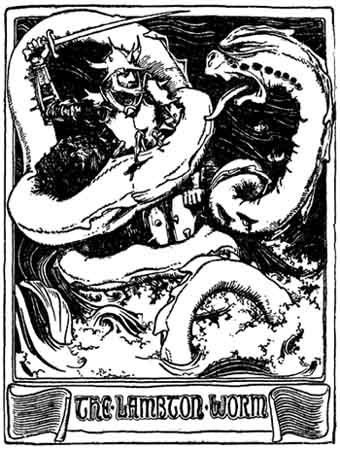
Knight fights the coiling Lambton Worm, Batten
Actual armored knight swings sword at large coiling serpent; printed Lambton Worm title present in the frame.
Overview
Jacobs’s young Lambton fishes instead of attending Sunday worship and hooks a creature with an elf-like head and nine openings on each side of its mouth. Warned by a stranger, he nevertheless throws it into a well. The animal outgrows this confinement and moves into the Wear, spending days coiled around a river rock and nights ravaging livestock and the countryside. Milk from nine cows temporarily diverts it from Lambton Hall. If that ration is short, its tail lashes the estate’s trees; the narrative also makes it coil three times around the local Worm Hill.
Lambton returns after seven years abroad and seeks a wise woman’s counsel. His specially prepared armour injures the monster when it coils around him, and the current carries off its severed portion before the final struggle ends. The wise woman has also required him to kill the first creature greeting him at home. His father rushes out before the intended hound, and killing the dog afterwards cannot repair the broken promise. The ending connects violent deaths over nine generations with that failure. Jacobs acknowledges rewriting Henderson’s account; his suggested prehistoric explanation in the note is speculative and is not adopted here. The episode’s dimensions, local landmarks and family curse belong to a regional legend rather than a reconstructed animal species.
Origins & earliest records
Jacobs’s 1894 collection cites Henderson’s Folk-Lore of Northern Counties, pages 287–289, and explicitly acknowledges rewriting its style. The complete selected story is inspectable, but its crusading setting and genealogical claims do not themselves date its oral beginnings or verify the named family’s deaths.
Records & interpretation
The source documents local legend, its literary reshaping and explanations attached to river and hill landmarks. The supernatural growth and destructive coils are narrative evidence. Neither the note’s prehistoric speculation nor a Worm Well placename supplies zoological remains.
In the literature
“the deeper dug the spear-heads into its sides”
The Lambton Worm; The worm tightens its coils around the armoured Childe
The crushing attack causes the attacker's own wounds.
Selected bibliography
Documented works and useful reading. This is not a list of every appearance.
- 01
More English Fairy Tales
Inspected complete selected episode “The Lambton Worm” and compiler’s editorial source note.
- 02
More English Fairy Tales — The Lambton Worm
Joseph Jacobs, More English Fairy Tales; first publication1894, selected Gutenberg14241 witness explicitly Fourteenth Impression, undated. Jacobs’s preface acknowledges rewriting, combined sources and altered incidents. Exact heading/anchor used; no invented print pagination.
Family & connections
A source-supported family tree or inspiration record has not yet been compiled for this profile. Related reading below indicates a connection in subject matter, not a proven lineage or creative influence.
Located primary passages
Specific passages supporting details in this entry, grouped by their published witness.
More English Fairy Tales — The Lambton Worm
Joseph Jacobs, More English Fairy Tales; first publication1894, selected Gutenberg14241 witness explicitly Fourteenth Impression, undated. Jacobs’s preface acknowledges rewriting, combined sources and altered incidents. Exact heading/anchor used; no invented print pagination.
- Lambton catches a worm with an elf-like head and nine holes on either side of its mouth, then puts it in a well. Grown large, it moves to the Wear, attacks livestock and threatens the hall. Daily milk from nine cows placates it, while a short ration prompts destructive rage.
The Lambton Worm; Unwanted catch, growth and the milk tribute
- After seven years away, Lambton returns and follows a wise woman's advice to stud his armour with spearheads and wait on the river rock. The worm's crushing coils drive the points into its own body. He cuts it in two and the river carries off the severed half; the remainder attacks once more and finally dies.
- The wise woman requires him to kill the first creature meeting him at the hall. Although servants were to release his hound on the success signal, his father runs out first. Killing the hound afterwards does not satisfy the vow; the narrator says nine generations of Lambtons do not die in bed.
The Lambton Worm; Broken first-encounter vow and nine-generation consequence
Complete selected tale and its source note read. Jacobs’s edited narrative is distinct from direct oral transcription. No song or ritual-formula excerpts; no invented print page or earliest date.
Primary source witness
Joseph Jacobs, More English Fairy Tales; first publication1894, selected Gutenberg14241 witness explicitly Fourteenth Impression, undated. Jacobs’s preface acknowledges rewriting, combined sources and altered incidents. Exact heading/anchor used; no invented print pagination.
- Jacobs cites Henderson pp287–289 and says he rewrote its elevated diction. His discussion of pedigree, prehistoric survivors and classical parallels is interpretation, not independently proven history or zoology. The narrative's nine-cow requirement belongs to this Worm; comparative cow counts must be checked against each other tale's body.
Notes and References, LXXXV The Lambton Worm; Jacobs's rewriting and historical speculation
This verifies what Jacobs reports and changes; listed earlier works and informant claims are not independently verified by this note alone.
References
Sources supporting this profile. Linked pages have their own scope and editorial standards.
- Primary textJacobs, More English Fairy Tales: The Lambton WormResearch access: 2026-10-05
Image credits
Historical illustrationKnight fights the coiling Lambton Worm, Batten
Actual armored knight swings sword at large coiling serpent; printed Lambton Worm title present in the frame.