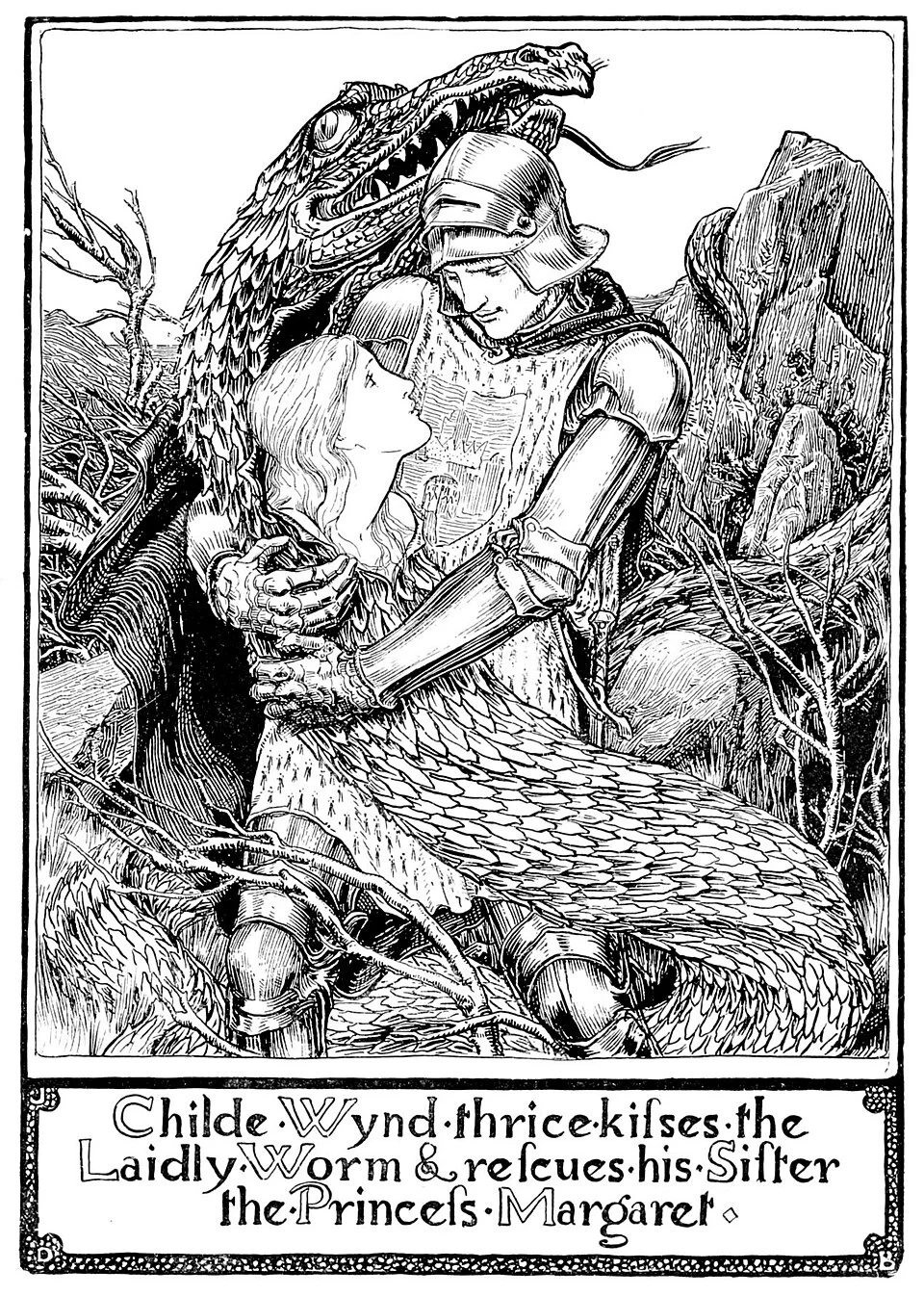
Laidly Worm becomes Princess Margaret after three kisses, Batten
Printed caption states Childe Wynd thrice kisses the Laidly Worm and rescues his sister Princess Margaret. Actual human head emerges within the coiling scaled dragon; transition is the artists representation of the release.
Overview
At Bamborough Castle, admiration for Margaret’s beauty provokes the new queen, a witch, into transforming her stepdaughter overnight. The maidens find a dragon coiled on the princess’s bed, and it moves to Spindleston Heugh. Hunger drives it to devastate the countryside until a warlock identifies the creature and recommends milk from seven cows. This ration prevents further damage while messages summon Childe Wynd. His returning ship has a rowan keel, against which the witch’s familiar imps cannot prevail.
The witch compels the Worm to repel the ship three times, but Wynd lands at another creek. As he approaches with weapons raised, Margaret’s voice asks him to spare her and give three kisses. Only the third restores her human form. Wynd subsequently transforms the queen into a toad by touching her with rowan; the narrator’s claim that it still haunts the castle is part of the ending. Jacobs acknowledges drawing on Lamb’s eighteenth-century ballad as printed by Child, incorporating touches from Kempion and changing a verse’s wording. Thus the selected plot is a conscious literary synthesis, while the localised legend and older related ballads remain distinguishable. Unlike Lambton’s monster, this Worm is explicitly an identifiable transformed woman.
Origins & earliest records
Jacobs’s 1890 collection identifies Lamb of Norham’s eighteenth-century ballad through Child, plus the related Kempion version and an 1890 prose account. Those sources are reported in his note; the selected undated electronic print witness does not establish the original oral date or every earlier variant’s wording.
Records & interpretation
Her transformation, speech and restoration are textually witnessed supernatural events. Neither the castle location nor the reported toad haunt proves a zoological dragon. The profile separates the underlying attributed ballad chain from Jacobs’s inspected composite retelling.
In the literature
“the Laidly Worm lived on the milk of the seven kine”
THE LAIDLY WORM OF SPINDLESTON HEUGH; The villagers follow the warlock’s instruction
Seven cows are specified in this body, regardless of the later Lambton note’s differing comparison.
Selected bibliography
Documented works and useful reading. This is not a list of every appearance.
- 01
English Fairy Tales
Inspected complete selected episode “The Laidly Worm of Spindleston Heugh” and compiler’s editorial source note.
- 02
English Fairy Tales — The Laidly Worm Of Spindleston Heugh
Joseph Jacobs, English Fairy Tales; first collection1890 context, selected PG7439 print date unresolved. Preface explicitly acknowledges rewriting and changed incidents. Named tale and observed anchor used, no invented print pagination.
Family & connections
A source-supported family tree or inspiration record has not yet been compiled for this profile. Related reading below indicates a connection in subject matter, not a proven lineage or creative influence.
Located primary passages
Specific passages supporting details in this entry, grouped by their published witness.
English Fairy Tales — The Laidly Worm Of Spindleston Heugh
Joseph Jacobs, English Fairy Tales; first collection1890 context, selected PG7439 print date unresolved. Preface explicitly acknowledges rewriting and changed incidents. Named tale and observed anchor used, no invented print pagination.
- A new queen envies Margaret’s beauty and turns her into a dragon-shaped Worm. The creature’s hunger threatens the countryside; a warlock identifies Margaret and prescribes all milk from seven cows each evening, which ends the attacks.
THE LAIDLY WORM OF SPINDLESTON HEUGH; Witch stepmother’s jealousy and the seven-cow provision
- The queen sends imps against Childe Wynd’s ship, but its rowan keel protects it. She forces the Worm to prevent his landing three times. He lands at another creek, breaking her control; the Worm then speaks as Margaret instead of attacking him.
THE LAIDLY WORM OF SPINDLESTON HEUGH; Rowan-keel ship and compelled resistance
- Childe Wynd refrains from striking and gives three kisses; only the third restores Margaret. He then touches the queen with rowan, reducing her to a toad said to haunt the keep. The selected story distinguishes the enchanted sister from her punished stepmother.
THE LAIDLY WORM OF SPINDLESTON HEUGH; Three kisses restore Margaret and rowan changes the queen
Complete selected tale and source note read; earlier cited works remain indirect. No song or ritual-formula excerpts. Strange Visitor evidence limited to six words from its narrative presentation; no separate quotation added.
Primary source witness
Joseph Jacobs, English Fairy Tales; first collection1890 context, selected PG7439 print date unresolved. Preface explicitly acknowledges rewriting and changed incidents. Named tale and observed anchor used, no invented print pagination.
- Jacobs identifies a ballad by Reverend Lamb of Norham through Child, with additions from Kempion, and says he changed a line about the bow. His proposed equation of the heroes is comparative interpretation, not independently established biography. The actual selected body repeatedly says seven cows.
Verifies Jacobs’s stated editorial practice; comparative interpretation is not treated as historical proof.
References
Sources supporting this profile. Linked pages have their own scope and editorial standards.
- Primary textJacobs, English Fairy Tales: The Laidly Worm of Spindleston HeughResearch access: 2026-10-05
Image credits
Historical illustrationLaidly Worm becomes Princess Margaret after three kisses, Batten
Printed caption states Childe Wynd thrice kisses the Laidly Worm and rescues his sister Princess Margaret. Actual human head emerges within the coiling scaled dragon; transition is the artists representation of the release.