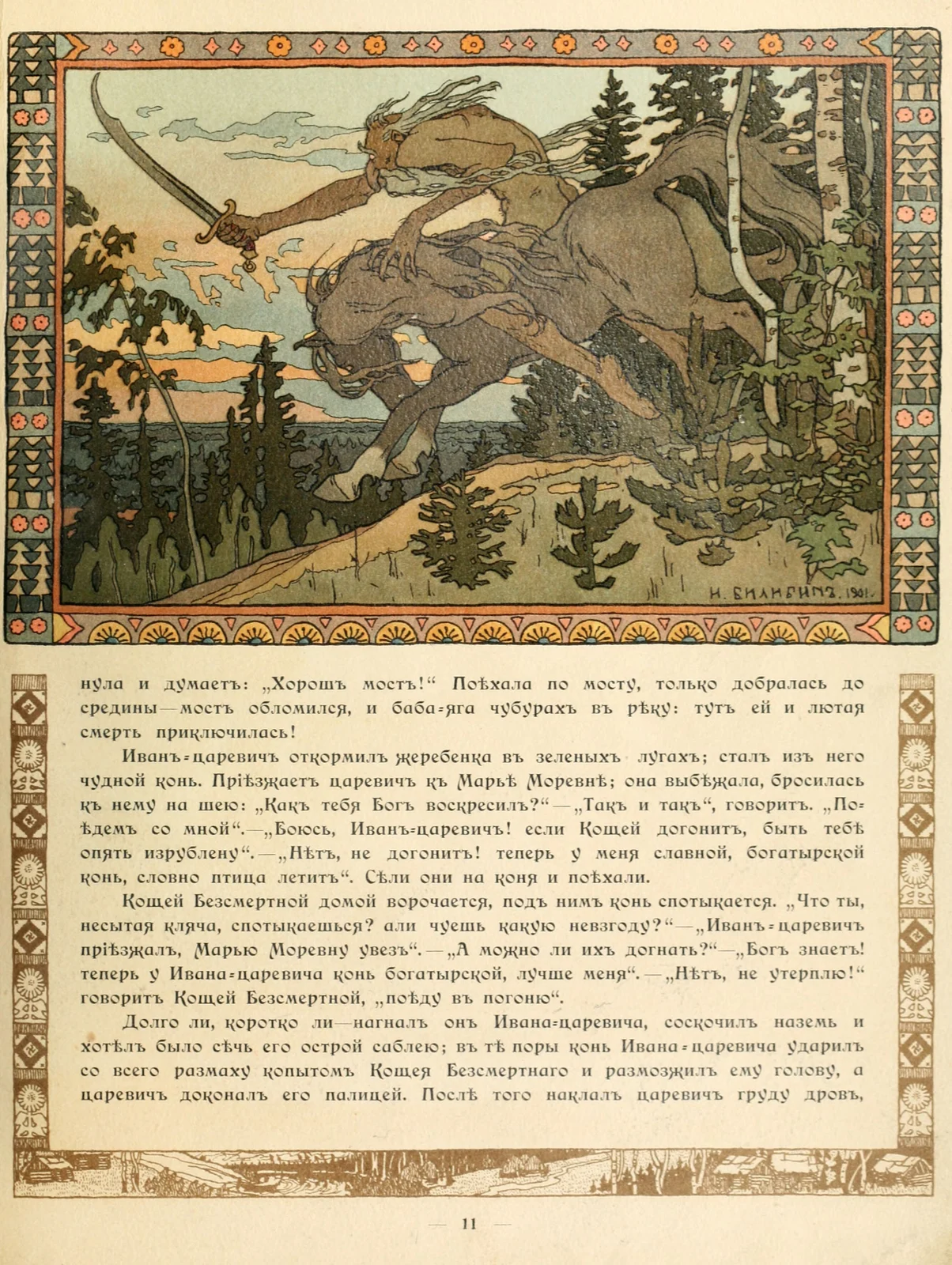
Koshchei pursues Ivan and Marya Morevna on horseback, Bilibin’s illustration signed 1901
Bilibin shows the gaunt, sword-bearing Koshchei rushing through the forest on his pursuit horse. The accompanying Marya Morevna narrative ends with Ivan’s stronger horse striking him down; this scene does not illustrate the separate tale in which his death is concealed in an egg. The painting is signed 1901, while the scanned copy’s title page is missing.
Overview
In Marya Morevna, Prince Ivan discovers Koshchei chained in a forbidden room of his wife’s palace. Koshchei says he has endured ten years without food or drink. Three buckets of water restore his strength, and he breaks all twelve chains, escapes in a terrible whirlwind and abducts Marya Morevna. Ivan repeatedly attempts to recover her. Koshchei’s speaking horse detects each escape and assures him that its speed allows a leisurely pursuit. Twice Koshchei spares Ivan because of the water he supplied, but the third capture ends in Ivan’s dismemberment and a sealed barrel thrown into the sea.
Ivan’s bird-form brothers-in-law recover and restore him. Marya Morevna then learns that Koshchei earned his horse by guarding Baba Yaga’s mares and supplies the means for Ivan to reach her. With help from animals he has spared, Ivan obtains a neglected colt and feeds it into a heroic steed. During the final pursuit that horse strikes Koshchei with its hoof, cracking his skull; Ivan finishes the fight with a club and burns the remains. The couple returns to visit their bird relatives before going home. No external egg is found or broken in this version. The epithet Deathless therefore does not make the same death mechanism mandatory in every tale.
The separate Koshchei the Deathless narrative, attributed by Ralston to the Perm Government, gives the external death. Koshchei abducts a king’s wife, and her youngest son finds both her and another captive princess beyond a difficult mountain ascent. The mother conceals him and draws the secret from her captor: beneath an oak is a casket, containing a hare, containing a duck, containing an egg in which his death resides. Ivan spares a wolf, crow and pike; those helpers later recover the escaping animals and retrieve the dropped egg. Squeezing it makes Koshchei bend double. He begs for friendship and offers shared dominion, but Ivan breaks the egg and he dies.
The second tale continues after that victory. Ivan’s elder brothers cut away his descent route and threaten the rescued women into silence. A ring summons twelve strong youths who carry him down. The captive princess delays marriage to the eldest brother by requesting possessions that Ivan has retained. He eventually appears, marries her, exposes the betrayal and becomes heir while his brothers are banished. Ralston’s surrounding comparisons discuss other containers and weapons, but this full selected version gives an egg without inserting a needle. The captivity, helpers and final family settlement remain part of the account, rather than being reduced to a detached list of immortality rules.
Biggs’s shortened translation from Gliński gives another separately located witness, Princess Miranda and Prince Hero. Here Kosciey rules an underground realm and observes the surface through a telescope. He discovers Miranda’s island and sends its army and inhabitants to sleep with poisonous breath. Miranda alone resists him, turning him briefly to ice with her gaze; he recovers once she leaves and besieges her palace behind an iron wall and a twelve-headed dragon. His proposed marriage is refused. Guided by the sun and Jandza, Hero learns of a coffer buried beneath an oak on the island of Everlasting Life: it holds a hare, with a grey duck beneath it, and the duck contains the life-bearing egg. The wording does not place the duck inside the hare. A fish whom Hero has freed retrieves the egg after it falls into the sea. An invisible self-fighting mace torments Kosciey without killing him; Hero crushes the egg as the enchanter attacks, and Kosciey dies. The sleeping island then wakes and Miranda marries Hero. This Polish-collection English witness is kept distinct from Ralston’s named Russian versions and their different heroes, helpers and final settlements.
Origins & earliest records
W. R. S. Ralston’s Russian Fairy Tales preserves the collected witnesses named in its footnotes. The hosted Hurst title page is undated; Gutenberg’s 1872 header and the separately catalogued London 1873 edition are not assumed to identify one physical edition.
Records & interpretation
Complete selected translated narratives supply the actions and outcomes. Afanasief source numbers are retained as Ralston’s references; the Russian originals are not independently collated here.
Selected bibliography
Documented works and useful reading. This is not a list of every appearance.
- 01
Russian Fairy Tales: Marya Morevna
pp. 97–108. Footnote 101: Afanasief VIII, no. 8. Full tale read through the reunion and return to their realm.
- 02
Russian Fairy Tales: Koshchei the Deathless
pp. 111–118. Footnote 112: Afanasief II, no. 24, attributed to the Perm Government. Full tale read through marriage, brothers’ banishment and Ivan’s succession.
- 03
Polish Fairy Tales: Princess Miranda and Prince Hero, pp. 15–28
Complete shortened English translation. Kosciey spelling and coffer/hare/duck-under-hare/egg arrangement retained; preface cites Wilna 1862 collection, not independently collated.
Family, evolution & connections
Giant Who Had No Heart in His Body
Ralston’s Koshchei tale hides death in an egg inside a duck inside a hare in a casket beneath an oak. Dasent’s giant has a heart-bearing egg in a duck in a well within a church. Both eggs are broken, but the nesting chains and terminology differ; this establishes a motif parallel, not borrowing.
Marya Morevna in Ralston’s Russian Fairy Tales
The titled Koshchei tale ends his life by breaking an external egg. In Marya Morevna, Ivan’s horse cracks Koshchei’s skull and Ivan kills him with a club before burning the remains. The egg mechanism is not inserted into the latter account merely because the same antagonist name occurs.
References
Sources supporting this profile. Linked pages have their own scope and editorial standards.
- Primary translated collected narrativeRussian Fairy Tales: Marya MorevnaResearch access: 2026-10-05
- Primary translated collected narrativeRussian Fairy Tales: Koshchei the DeathlessResearch access: 2026-10-05
- Primary historical shortened literary translationGliński/Biggs 1920: Miranda and HeroResearch access: 2026-10-05
Image credits
Historical illustrationKoshchei pursues Ivan and Marya Morevna on horseback, Bilibin’s illustration signed 1901
Bilibin shows the gaunt, sword-bearing Koshchei rushing through the forest on his pursuit horse. The accompanying Marya Morevna narrative ends with Ivan’s stronger horse striking him down; this scene does not illustrate the separate tale in which his death is concealed in an egg. The painting is signed 1901, while the scanned copy’s title page is missing.