
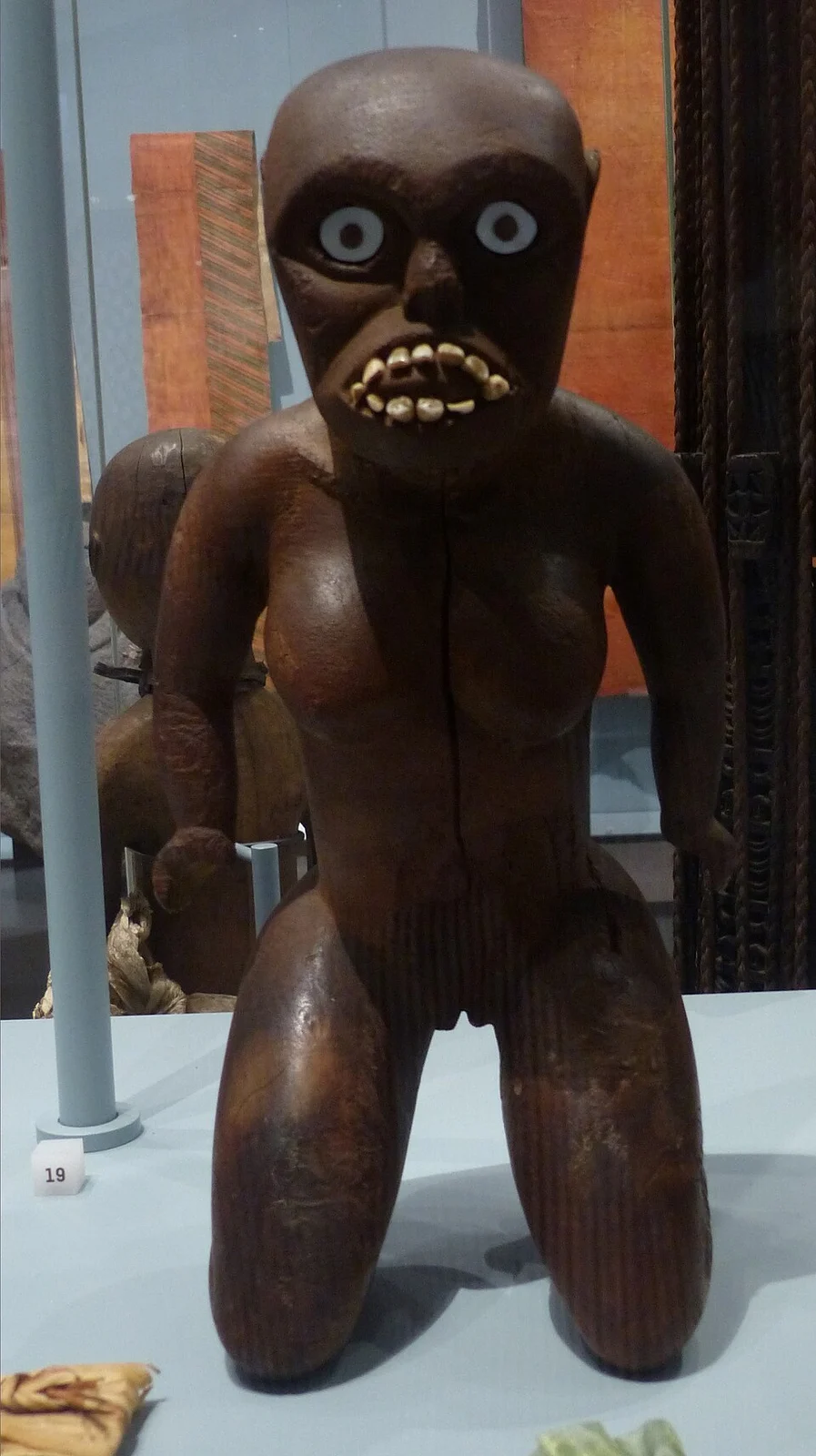
Kihawahine
Image associated with the exact linked encyclopedia article; consult credited file description for its interpretation.
Overview
The selected story places Puna in Kihawahine’s cave household, where he discovers that she can appear in reptilian form. Hinole helps him devise an escape by distracting her with a leaking water vessel. Puna reaches Pele’s domain, and Kihawahine gathers other moʻo to demand his return. Their attempt to overwhelm the crater’s fire is defeated by heat and earthquake, forcing Kihawahine into retreat.
She then pursues Hinole, who enters the sea in fish form. Advice about a trap eventually brings him into her power, but she spares him under a condition concerning that form. The account ends her movements with a pool near Lahaina. These episodes are one collected narrative of a revered figure. They should not replace Kihawahine’s wider historical, genealogical or present religious relationships with an exclusively hostile monster portrait.
The fish-catching episode contains a second deception and a correction. Ounauna first tells Kihawahine to make a basket from the inalua vine, but Hinole remains outside it. When she threatens the adviser, he says that he omitted the bait: crushed sea eggs and crabs must go inside, with the basket’s mouth facing down. The revised attempt catches her brother in his hinalea form. Hinole persuades her to spare him, but she requires him to retain that fish body afterwards. Westervelt connects the sequence with a method of catching hinalea; it is his selected narrative explanation, rather than a complete account of Kihawahine’s wider religious identity.
Origins & earliest records
The selected chapter belongs to Westervelt’s 1915 Legends of Gods and Ghosts. He calls the figure Kiha-wahine and translates moʻo using dragon terminology. This profile treats that wording as editorial mediation, not identity with European dragons. The witness does not establish the first oral account or encompass Kihawahine’s religious history.
Records & interpretation
The inspected chapter directly supports the cave, changing form, pursuit, conflict and water-place associations. Some OCR lines on its opening page are damaged, so detailed claims depend on the legible continuing pages 153–160. This is textual narrative evidence, not a zoological record or an independently verified reconstruction of volcanic events.
In the literature
“The dragons threw their drooling saliva in the pit”
XVI: Puna and the Dragon; printed p.157; paragraph beginning “When she had gathered all the dragons…”
Kiha-wahine gathers island dragons to demand Puna’s return from Pele; their saliva attacks the crater fire while leaving Ka-moho-alii’s place untouched.
Selected bibliography
Documented works and useful reading. This is not a list of every appearance.
- 01
Legends of Gods and Ghosts, XVI: Puna and the Dragon
Selected inspected passages; edited witness, not a comprehensive bibliography.
- 02
Legends of Gods and Ghosts (Hawaiian Mythology)
Boston: Press of Geo. H. Ellis,1915, first edition; University of California Libraries facsimile.
Family & connections
A source-supported family tree or inspiration record has not yet been compiled for this profile. Related reading below indicates a connection in subject matter, not a proven lineage or creative influence.
Located primary passages
Specific passages supporting details in this entry, grouped by their published witness.
Legends of Gods and Ghosts (Hawaiian Mythology)
Boston: Press of Geo. H. Ellis,1915, first edition; University of California Libraries facsimile.
- Kiha-wahine gathers island dragons to demand Puna’s return from Pele; their saliva attacks the crater fire while leaving Ka-moho-alii’s place untouched.
- Pele’s fire destroys many dragons; Kiha-wahine escapes into Loko-aka pond, remains without her husband, and later fails to catch Hinole who transforms into Hinalea fish.
XVI: Puna and the Dragon; printed p.158; paragraph beginning “Then the fire moved…”
Historical English Hawaiian narrative witness as edited by Westervelt; not an original-language transcript or universal account. Scan checked visually because OCR contains spacing errors.
Encyclopedia background
An additional attributed reference, separate from the editorial profile above.
Read the open encyclopedia overview
Kihawahine is a Hawaiian shapeshifting lizard goddess (moʻo). When Kihawahine Mokuhinia Kalamaʻula Kalāʻaiheana, the daughter of the powerful sixteenth-century ruling chief of Māui, Piʻilani, and his wife Lāʻieloheloheikawai, died, her bones were deified, transforming her into the goddess. Kihawahine's home is Mokuhinia, a wetland pond on the island of Mokuʻula.
Text from Wikipedia contributors, “Kihawahine”. CC BY-SA 4.0. Extracted introduction; formatting changed. Retrieved 5 October 2026. The source article may have changed since retrieval.
References
Sources supporting this profile. Linked pages have their own scope and editorial standards.
- Primary textLegends of Gods and Ghosts, XVI: Puna and the DragonResearch access: 2026-10-05
Image credits
Reference illustrationKihawahine
Image associated with the exact linked encyclopedia article; consult credited file description for its interpretation.