A sourced illustration has not yet been added. This gap is included in the coverage record.
Overview
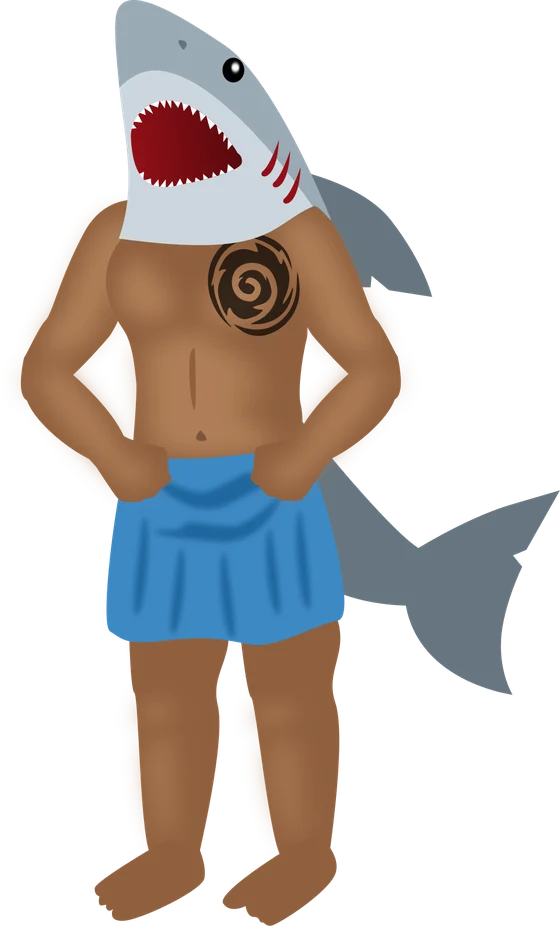
The selected story associates Kamohoaliʻi with deep coastal caves near Waipiʻo and gives him the ability to appear as a handsome man. He courts the skilled swimmer Kalei, marries her and warns that their child will possess a dual nature. His instruction concerning the child’s food anticipates the difficulty of raising a being who can move between human and shark bodies.
When Nanaue’s attacks become known, Kamohoaliʻi expresses grief and orders his son away from Hawaiʻi. He also requires that Kalei and her relatives be protected from persecution because of Nanaue’s conduct. This account presents divine power through obligations and limits as well as danger. It remains one public narrative of a revered Hawaiian figure, rather than a complete account of his genealogy, island relationships or contemporary religious significance.
A separate Westervelt telling, “Lau-ka-ieie” (1915), places Kamohoaliʻi on Kahoʻolawe as host to Makani-kau and Kawelona. He calls shark guardians from the islands to bring prepared food, flowers and gifts, then assigns sharks to escort the travelers toward Hawaiʻi. At Waipiʻo they appear in human bodies while their shark bodies rest in the sea, joining the wedding feast and music. Their return follows the island’s southern side rather than reversing the route. This protective visit complements, without replacing, his distinct paternal role in Nakuina’s Nanaue narrative.
Origins & earliest records
This profile follows Emma Metcalf Nakuina’s contribution to Thrum’s Hawaiian Folk Tales, published in 1907. That witness records a particular English-language presentation of transmitted Hawaiian material. It does not date the deity’s origin, establish the earliest Hawaiian-language account, or make the selected family episode universal across Hawaiian religious traditions.
Records & interpretation
Nakuina’s chapter explicitly separates the father’s authority and protection from Nanaue’s repeated attacks. Cave locations, dialogue and family relationships are evidence of this published narrative and its geography. They are not zoological proof of a shark changing into a man, and spiritual relationships are not reduced to biological classification.
Selected bibliography
Documented works and useful reading. This is not a list of every appearance.
- 01
Hawaiian Folk Tales, XXIV: The Shark-Man, Nanaue
Selected inspected chapter; a dated collected witness, not a comprehensive bibliography.
- 02
Legends of Gods and Ghosts, VI: Lau-ka-ieie, pp. 36–48
Complete chapter read; narrative bodies and journeys kept source-specific.
- 03
Hawaiian Folk Tales: A Collection of Native Legends
Chicago: A.C. McClurg,1907; selected contributor credited.
Family, evolution & connections
Nanaue’s parents in The Shark-Man, Nanaue
Hawaiian Folk Tales XXIV, selected 1907 account; parentage corroborated by Kahoʻiwai.
Scroll sideways to see all branches. With a keyboard, focus the tree and use the arrow keys.
- Kamohoaliʻi and Kalei (joint parents)
Named marriage, expected child and birth explicitly link Kamohoaliʻi and Kalei to Nanaue. Joint-parent node represents two parents, not a separate being. No shark species, additional children or natural reproductive process inferred. Other accounts remain separate.
Pele
Kahoʻiwai identifies Kamohoaliʻi as Pele’s older brother and describes his role in navigating her family from Kahiki to Hawaiʻi. The named cliff at Kīlauea is discussed in relation to their bond. This records a specifically sourced sibling relationship; it does not combine the page’s several listed parental alternatives into one family tree or generalize a selected account to all traditions.
Located primary passages
Specific passages supporting details in this entry, grouped by their published witness.
Hawaiian Folk Tales: A Collection of Native Legends
Chicago: A.C. McClurg,1907; selected contributor credited.
- Kamohoalii inhabits deep sea caves near Waipio and Kohala in this account.
- Kamohoalii courts Kalei in the form of a handsome human man.
- Kamohoalii instructs Kalei never to feed their future child animal flesh.
Documents this credited English collected version, not a universal account of Hawaiian tradition. European terms such as crocodile are historical translator choices, not evidence of native fauna. Collector racial or cultural generalizations are not adopted.
Encyclopedia background
An additional attributed reference, separate from the editorial profile above.
Read the open encyclopedia overview
In Hawaiian religion, Kamohoaliʻi (also Ka-moho-ali’i or Moho) is a shark and steam god and a brother of Kāne Milohaʻi, Pele, Kapo, Nāmaka, and Hiʻiaka. He also fathered Nanaue with Kalei.
Depending on the version of the myth, he was born to either Papahānaumoku and Wakea or to Haumea and Ku-waha-ilo. In both tellings, he is born from his mother's head.
Kamohoaliʻi swam in the area around the islands of Maui and Kahoʻolawe. When a ship was lost at sea, Ka-moho-aliʻi shook his tail in front of the fleet and the kahuna would feed him awa, a narcotic drink, and Kamohoaliʻi would guide the men home. He is sometimes said to have guided the ships of the original inhabitants of Hawaiʻi from the mainland to their island home in this way.
Kamohoaliʻi had the power to take on the form of any fish and is believed to own multiple underwater caves beneath the ocean where he dwells.
He is said to have adopted the little red-haired shark that killed the fierce king shark of Maui.
Kamohoaliʻi is considered among the principal ancestral sharks (manō kumupaʻa), with Kūhaimoana, Kānehunamoku, Kauhuhu, and Kāneikokala.
Text from Wikipedia contributors, “Kāmohoaliʻi”. CC BY-SA 4.0. Extracted introduction; formatting changed. Retrieved 5 October 2026. The source article may have changed since retrieval.
References
Sources supporting this profile. Linked pages have their own scope and editorial standards.
- Primary textHawaiian Folk Tales, XXIV: The Shark-Man, NanaueResearch access: 2026-10-05
- Primary collected narrativeWestervelt, Lau-ka-ieie (1915), pp. 36–48Research access: 2026-10-05
Image credits
A sourced illustration has not yet been added. This gap is included in the coverage record.