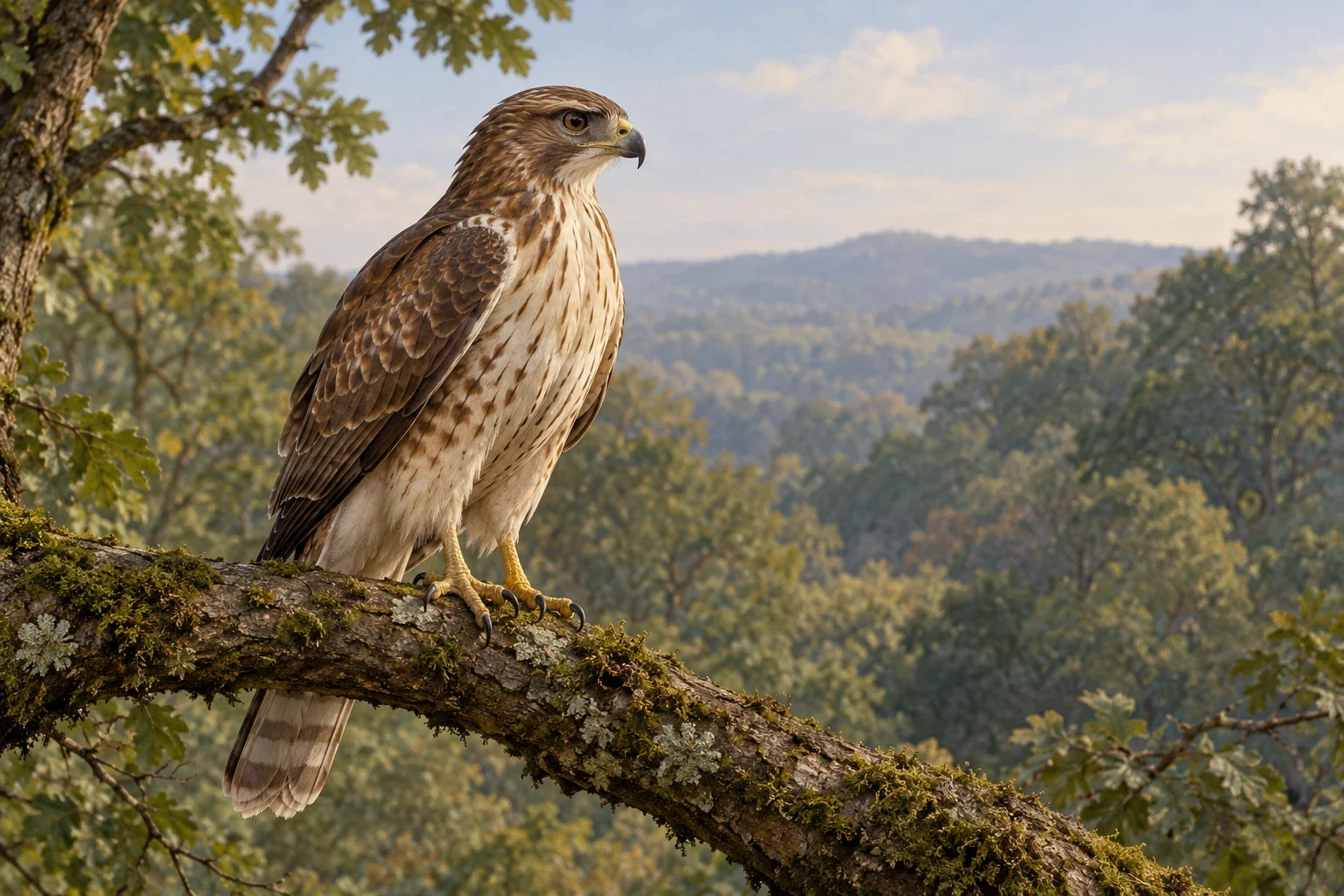
AI-generated interpretation of Ki Ki, the hawk lord.
Original AI interpretation of the individual called a hawk. Exact natural species, brown-and-pale plumage, anatomy, size, age, pose, branch, woodland and lighting are imagined; no species-level identification is claimed.
Overview
Ki Ki arrives late at the royal council with his own retinue and heralds Kapchack’s approach. The assembled hawks make the mouse shrink away, presenting power through predatory bodies rather than armour or a uniform. The text identifies him as lord of the hawks and later calls him a hawk directly, but the selected narrative does not identify a particular natural hawk species. His force is listed as a thousand beaks. That is the council’s military return within the fable, not a verified census of wild birds.
At the council he favours an immediate attack before Choo Hoo’s army grows larger and receives winter visitors as allies. His aggressive position is coupled with support for domestic coercion: when Kapchack talks of controlling the thrushes by killing some of them, Ki Ki approves. He also welcomes the king’s permission to prey on larks who refuse allegiance. His political weight influences the distribution of command. The squirrel explains that Kapchack would prefer the rook general but fears losing Ki Ki’s contingent; the hawk is consequently announced as commander-in-chief.
The council’s end carefully separates a lie about him from his later choice. The weasel tells Kapchack that Ki Ki intends to bargain with Choo Hoo and hand the king over; the narrator explicitly calls this an invention prompted by envy. Kapchack nevertheless plans to supersede the hawk. The mole, acting from his own hostility toward both rivals, tells Ki Ki about that decision. When a royal message cancels the promised advance, the hawk takes it as confirmation. He then really sends an envoy to Choo Hoo, offering to withdraw his troops during battle and expose Kapchack’s centre. The false allegation thus helps produce a genuine act of betrayal; it should not be cited as proof that the original accusation was already true.
Kapchack’s subsequent victory with the rooks threatens Ki Ki’s position. Warned by retainers watching from the air, the hawk leaves his trees before the returning king can reach him. The king’s detour in pursuit of revenge contributes to his missing a warning about danger at the orchard. In the later Palace Secrets report, Ki Ki has returned after Kapchack’s death, proclaimed himself king and gathered a violent following. The squirrel describes the resulting danger in heated terms while rival claimants compete and Choo Hoo advances again. This is the unsettled aftermath reached by the selected evidence, not the novel’s eventual decision about the throne.
First appearances & development
A named animal individual in Richard Jefferies’s authored English fable Wood Magic. The retained transcription identifies a 1907 New Impression, whose historical bibliographical note dates first publication in two volumes by Cassell & Co. to 1881. The profile concerns this literary society, rather than a collected animal tradition or a real historical military leader.
Canon & continuity
Complete IX supplies the hawk identity, council policy, appointment, narrator’s correction of the invented accusation and Ki Ki’s actual subsequent offer. Complete XIV supplies the warning, flight and king’s unsuccessful detour. Complete XV supplies the squirrel’s report of his renewed claim to kingship. The visual brief deliberately leaves species-level identification and all personal plumage details unasserted.
Selected bibliography
Documented works and useful reading. This is not a list of every appearance.
- 01
Wood Magic: A Fable
Complete selected chapters IX, XIV and XV in a retained 1907 New Impression transcription; original date supplied by the historical bibliographical note.
Family & connections
A source-supported family tree or inspiration record has not yet been compiled for this profile. Related reading below indicates a connection in subject matter, not a proven lineage or creative influence.
References
Sources supporting this profile. Linked pages have their own scope and editorial standards.
- PrimaryWood Magic — original English narrative and historical edition frontmatterResearch access: 2026-10-21
Image credits
AI-generatedAI-generated interpretation of Ki Ki, the hawk lord.
Original AI interpretation of the individual called a hawk. Exact natural species, brown-and-pale plumage, anatomy, size, age, pose, branch, woodland and lighting are imagined; no species-level identification is claimed.