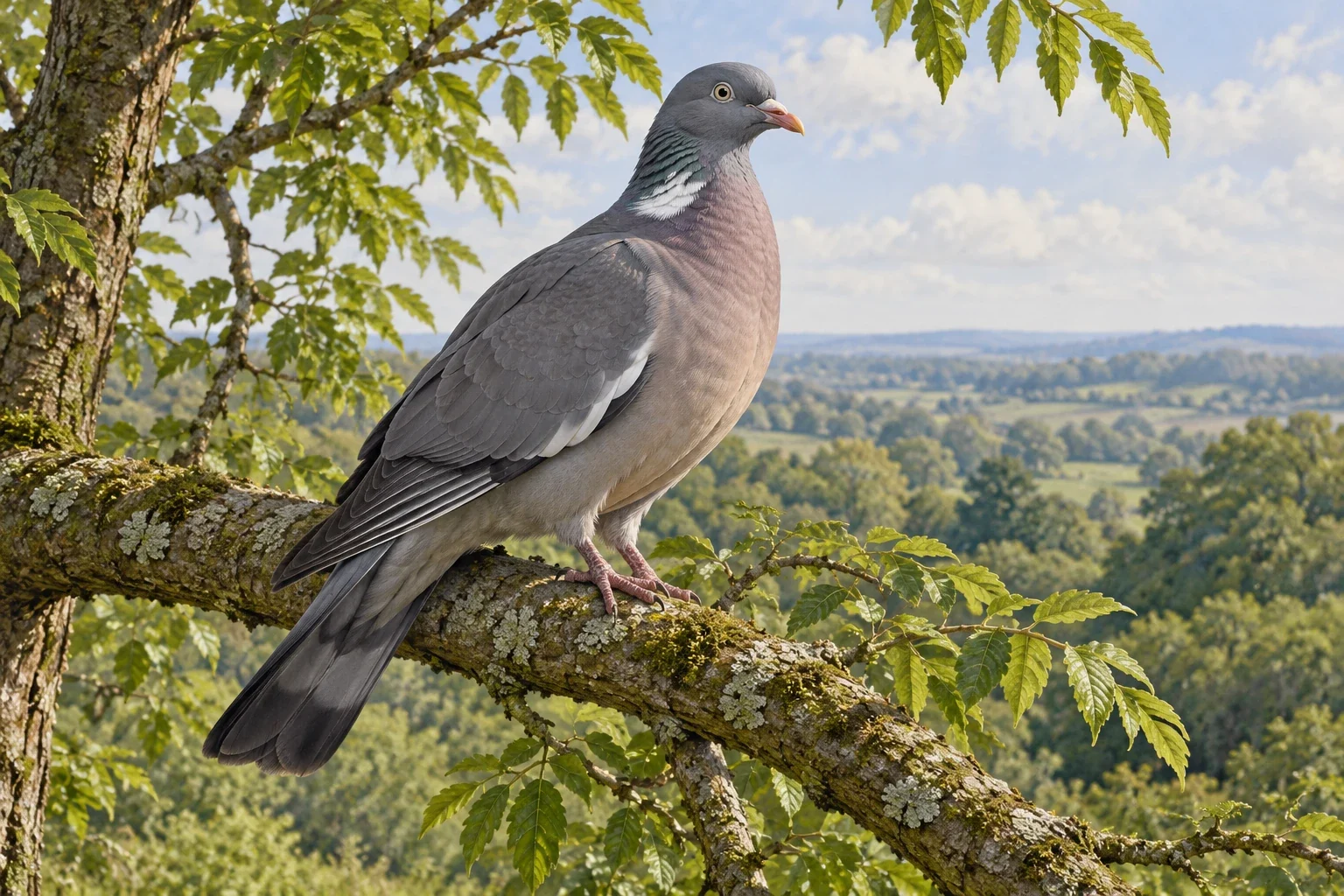
AI-generated interpretation of Choo Hoo, the wood-pigeon emperor.
Original AI interpretation of Choo Hoo as a strong wood-pigeon at his ancestral ash. Gray plumage, white neck patch, iridescence, exact natural anatomy, pose, lighting and woodland arrangement are imagined; the novel’s emperor title does not supply a costume.
Overview
Choo Hoo first reaches Bevis as an exception to the chorus praising Kapchack: the toad calls him the great wood-pigeon and rebel. The squirrel later gives the fuller political story. He describes an adventurer whose only initial property was an ancestral ash tree, but whose opportunity lay in the increasing numbers of pigeons crowded into too little feeding and nesting ground. The squirrel repeatedly calls them barbarians and presents his own society as civilized. Those terms are a partisan speaker’s judgement within the fable, not a neutral description of a real people or a biological property of wood-pigeons.
At first the flocks ignore Choo Hoo’s speeches. Their elders fear reprisals and persecute him when he challenges their authority and raises the question of lost prophecies. Younger pigeons, denied nest sites and marriages by established families, increasingly follow his promise of trees and partners. Kapchack’s attacks strengthen their loyalty: followers shield their leader from the king’s hawks and frustrate attempts to assassinate him. When a general slaughter falls on the pigeons, Choo Hoo leaves rather than remain the immediate cause of their suffering. The squirrel’s account links political persuasion to hunger, unequal opportunity, repression and a leader’s claim to embody the future.
After a year away, Choo Hoo returns with a beautiful bride and is acclaimed emperor. He reports a message from the absent raven, received through a hawfinch, authorizing the struggle against Kapchack. He also brings the rallying cry Koos-takke, said to have been learned in Savernake. The squirrel cannot establish every element of this story and earlier admits uncertainty about the prophecies. What the account does emphasize is the cry’s practical effect: it supplies a shared sign through which immense flocks can act together. Choo Hoo is therefore a leader who organizes belief and coordination, rather than a pigeon shown independently working supernatural spells.
His campaigns have a seasonal rhythm. The flocks fight through autumn and winter, then separate into nesting pairs as spring arrives; he too retires to the ancestral ash with his bride. Winter water is a strategic constraint because a vast host must scatter when ponds and streams freeze. The squirrel fears discovery of his concealed unfrozen spring. In the later Palace Secrets report, Choo Hoo has suffered a great defeat, but news of Kapchack’s death and his enemies’ quarrels lets him rally the survivors and advance again. That is the position reached in the selected chapters, not a claim about the novel’s final political settlement.
First appearances & development
A named character in Richard Jefferies’s authored animal fable Wood Magic. The retained title-page text identifies a 1907 New Impression; its printed bibliographical note dates first publication in two volumes by Cassell & Co. to 1881. This is historical edition testimony retained in transcription, rather than an independently collated first printing.
Canon & continuity
Complete chapter VIII was read for the squirrel’s narrative of organization, persecution, departure, return, prophecy claim, rallying cry and seasonal constraints. Complete chapter V identifies him as the rebel wood-pigeon. Complete chapter XV supplies the reported defeat, retreat, renewed hope and return; the battle itself and the novel’s final settlement are outside the reading claim.
Selected bibliography
Documented works and useful reading. This is not a list of every appearance.
- 01
Wood Magic: A Fable
Selected chapters V, VIII and XV in a transcription of the 1907 New Impression; printed bibliographical note dates original publication to 1881.
Family & connections
A source-supported family tree or inspiration record has not yet been compiled for this profile. Related reading below indicates a connection in subject matter, not a proven lineage or creative influence.
References
Sources supporting this profile. Linked pages have their own scope and editorial standards.
- PrimaryWood Magic — original English narrative and historical edition frontmatterResearch access: 2026-10-21
Image credits
AI-generatedAI-generated interpretation of Choo Hoo, the wood-pigeon emperor.
Original AI interpretation of Choo Hoo as a strong wood-pigeon at his ancestral ash. Gray plumage, white neck patch, iridescence, exact natural anatomy, pose, lighting and woodland arrangement are imagined; the novel’s emperor title does not supply a costume.