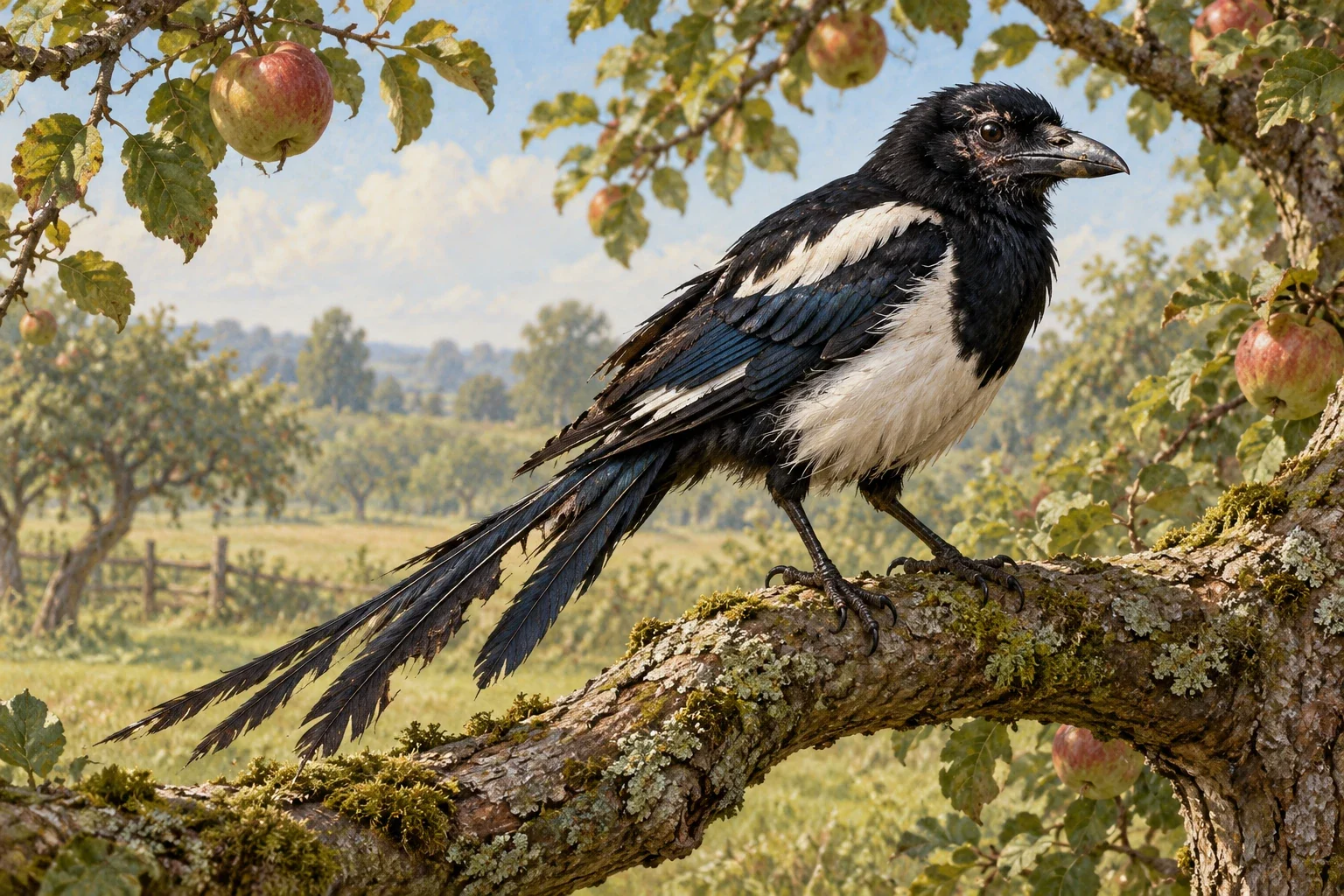
AI-generated interpretation of Kapchack VI in the orchard.
Original AI interpretation of the one-eyed, ragged king described through the toad’s account and the later dynasty explanation. The right-side view leaves the absent left eye mostly hidden. Exact natural anatomy, feather pattern, pose, light and orchard arrangement are imagined.
Overview
Kapchack rules the animal society around Bevis’s home, but the boy first learns about him through gossip rather than a royal audience. News that the king has fallen in love passes from birds to insects, trees and running water. The toad eventually tells Bevis that Kapchack is a magpie and king over the surrounding creatures. His outward declaration of loyalty immediately gives way to whispered criticism. The contrast makes the king’s presence felt through fear, rumour and the care with which subjects regulate their speech.
The toad describes a damaged, apparently ancient bird: one eye has lost its surrounding feathers, the left eye is gone, the beak is worn and chipped, the wings are battered, and the tail has missing feathers. The praise sung by his subjects gives an opposite image of beauty and perfect judgement. According to the same informant, that praise protects nests and families from the king or the predators who enforce his wishes. The profile keeps the toad’s account of cruelty distinct from direct observation, while recognizing that bodily decay and public flattery are deliberately set against each other in the fable.
His palace is a huge nest in an old apple tree within a walled, locked orchard. The human owner guards it and excludes threatening visitors, giving the king an unusual refuge from both natural and political enemies. The toad also explains his method of government through rivalry: hawk, rat, crow and weasel distrust one another, while subjects fear that replacing him would put something worse on the throne. The squirrel’s later account of Choo Hoo adds the external danger. Kapchack answers the pigeon agitator with attempted capture, assassination and a disastrous campaign of slaughter; the rebellion survives rather than simply disappearing under that force.
Palace Secrets changes the meaning of the king’s supposed immortality. After his death, the squirrel tells Bevis that the original Kapchack died forty years earlier and that the recently fallen monarch was the sixth ruler sustaining the deception. Each successor was made one-eyed and ragged to resemble the founder, while tales of the same enduring ruler continued. Kapchack VI’s attempted preparation of his son Tchack-tchack fails because the son has learned the secret and avoids him. His death exposes a fragile dynasty and its inflated reputation for wealth. This entry follows the sixth king in Bevis’s present, rather than merging every deed of the founder and his successors into one immortal individual.
First appearances & development
A named character in Richard Jefferies’s authored animal fable Wood Magic. The retained title-page text identifies a 1907 New Impression; its printed bibliographical note dates first publication in two volumes by Cassell & Co. to 1881. This is historical edition testimony retained in transcription, rather than an independently collated first printing.
Canon & continuity
Chapter V supplies the toad’s account of the current king, appearance, orchard fortress and divided subjects. Chapter VIII supplies the squirrel’s history of the response to Choo Hoo. Complete chapter XV identifies the recently dead king as Kapchack VI and explains the succession fraud; its report of the battle’s aftermath is not claimed as a fresh reading of chapter XIV.
Selected bibliography
Documented works and useful reading. This is not a list of every appearance.
- 01
Wood Magic: A Fable
Selected chapters V, VIII and XV in a transcription of the 1907 New Impression; printed bibliographical note dates original publication to 1881.
Family & connections
A source-supported family tree or inspiration record has not yet been compiled for this profile. Related reading below indicates a connection in subject matter, not a proven lineage or creative influence.
References
Sources supporting this profile. Linked pages have their own scope and editorial standards.
- PrimaryWood Magic — original English narrative and historical edition frontmatterResearch access: 2026-10-21
Image credits
AI-generatedAI-generated interpretation of Kapchack VI in the orchard.
Original AI interpretation of the one-eyed, ragged king described through the toad’s account and the later dynasty explanation. The right-side view leaves the absent left eye mostly hidden. Exact natural anatomy, feather pattern, pose, light and orchard arrangement are imagined.