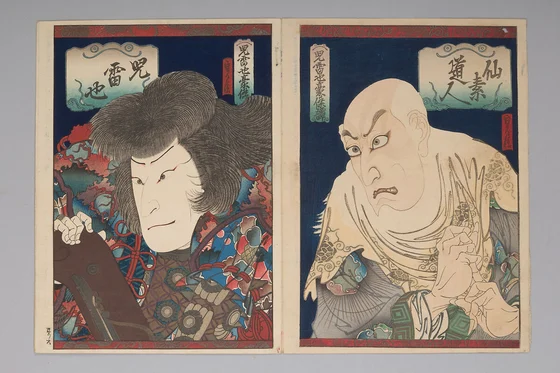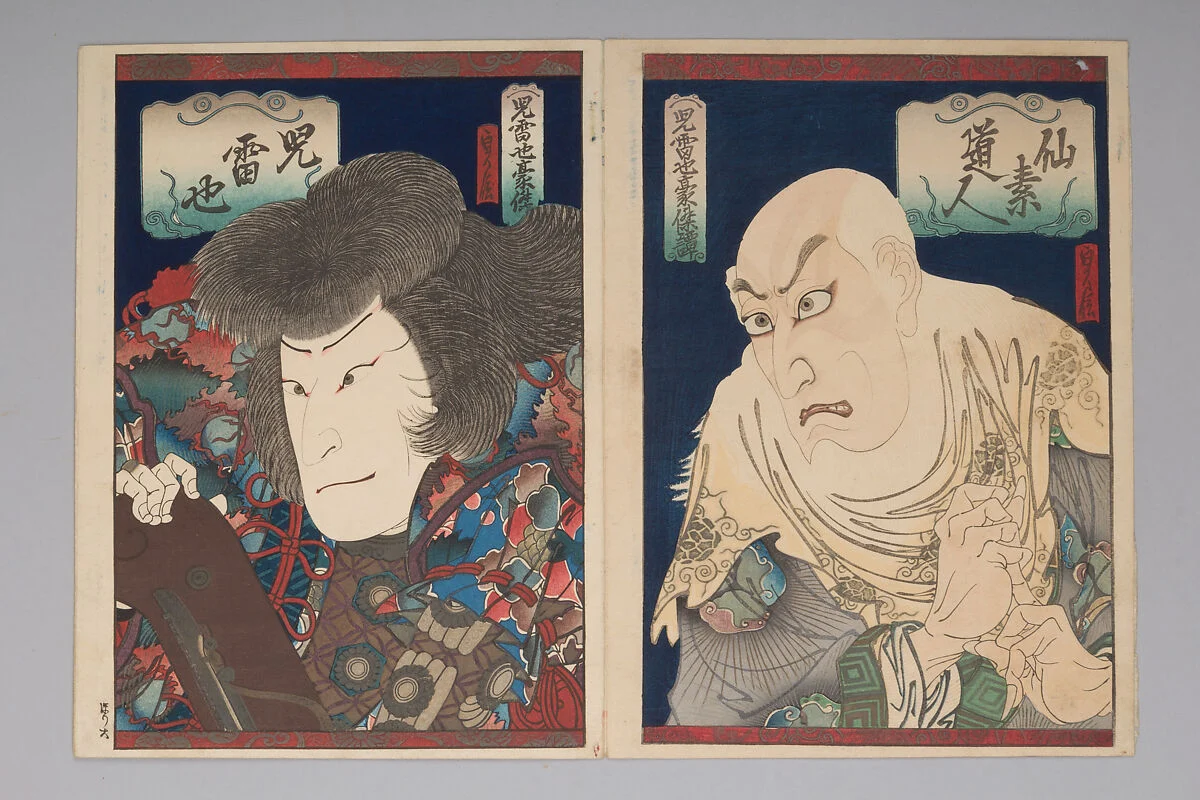
Jitsukawa Ensaburō as Jiraiya at left, paired with Senso Dōjin at right, Sadanobu, 1854
The left-hand print portrays Jitsukawa Ensaburō playing Jiraiya, beside the actor playing his teacher Senso Dōjin. These 1854 Kabuki portraits show their human roles. They are a separate theatrical witness from Griffis’s 1887 retelling and do not illustrate Jiraiya’s frog form or enlarged frog mounts.
Overview
In Griffis’s retelling, Jiraiya is the surviving son of the castle lord Ogata. After becoming a robber he receives instruction from Senso Dojin, a mountain being whose true body is a frog. The resulting power includes both changing his own body and commanding other frogs to grow to enormous size. To cross rivers he may swim as a frog or stand on an enlarged bullfrog’s back; those mounts are not automatically the transformed teacher.
When an innocent merchant faces execution, Jiraiya confesses to the offence in his place and is hanged. That night the narrative explicitly calls the hanging body dead before it becomes a bullfrog and hops away. He later marries Tsunadé, whose snail magic lets them walk together on water. This directly narrated animal form, rather than his human military career alone, is the focus of the entry.
The serpent-transforming Orochimaru subsequently poisons the sleeping couple. They are near death, not already dead, when the young retainer Rikimatsu travels to India using learned flight and brings an elixir that restores them. Later Orochimaru is killed, Jiraiya becomes a lord in Idzu and eventually dies peacefully among descendants. The hanging transformation and later recovery from poisoning are different episodes with different stated conditions; the fictional elixir is not a medical treatment.
Origins & earliest records
Japanese narrative in an English literary collection
Records & interpretation
Full chapter, conclusion and collection preface directly read.
Selected bibliography
Documented works and useful reading. This is not a list of every appearance.
- 01
Japanese Fairy World: Stories from the Wonder-Lore of Japan
XVI, Jiraiya, or the Magic Frog, pp.126–140
Family, evolution & connections
Jiraiya’s named father and unnamed descendants
Opening father-and-son statement, marriage on p. 134 and collective descendants on p. 140.
Scroll sideways to see all branches. With a keyboard, focus the tree and use the arrow keys.
- Ogata (father)
- Unnamed children (collective generation)
- Unnamed grandchildren (collective generation)
The two descendant generations are shown collectively; Tsunade is labelled as wife alongside Jiraiya. No mother of Jiraiya is supplied. Grandchildren are a collective generation, not children of a specified individual child. Magical mentors are not parents; the source gives no descendant names or counts.
Ogata, the castle-lord
The opening identifies Jiraiya as Ogata’s only son. Senso Dojin subsequently teaches him magic; instruction does not make the frog spirit a biological or adoptive parent.
Tsunade, his wife in this telling
Tsunade’s parents consent to her marriage to Jiraiya. Her unnamed snail teacher is a mentor, not a parent. Tagoto is the separately abducted princess, not Jiraiya’s second wife.
His unnamed children and grandchildren
The ending places Jiraiya among children and grandchildren. Counts, personal names, sexes and individual intervening households are not supplied.
Primary records and illustrations
William Elliot Griffis, Japanese Fairy World (1887 edition)
English literary collection. XVI, Jiraiya, or the Magic Frog, pp.126–140
Complete chapter and preface read. The serpent-transforming Orochimaru subsequently poisons the sleeping couple. They are near death, not already dead, when the young retainer Rikimatsu travels to India using learned flight and brings an elixir that restores them. Later Orochimaru is killed, Jiraiya becomes a lord in Idzu and eventually dies peacefully among descendants. The hanging transformation and later recovery from poisoning are different episodes with different stated conditions; the fictional elixir is not a medical treatment.
References
Sources supporting this profile. Linked pages have their own scope and editorial standards.
- Historical English literary retellingGriffis, Japanese Fairy World (1887), XVI, Jiraiya, or the Magic Frog, pp.126–140Research access: 2026-10-05
Image credits
Historical illustrationJitsukawa Ensaburō as Jiraiya at left, paired with Senso Dōjin at right, Sadanobu, 1854
The left-hand print portrays Jitsukawa Ensaburō playing Jiraiya, beside the actor playing his teacher Senso Dōjin. These 1854 Kabuki portraits show their human roles. They are a separate theatrical witness from Griffis’s 1887 retelling and do not illustrate Jiraiya’s frog form or enlarged frog mounts.