
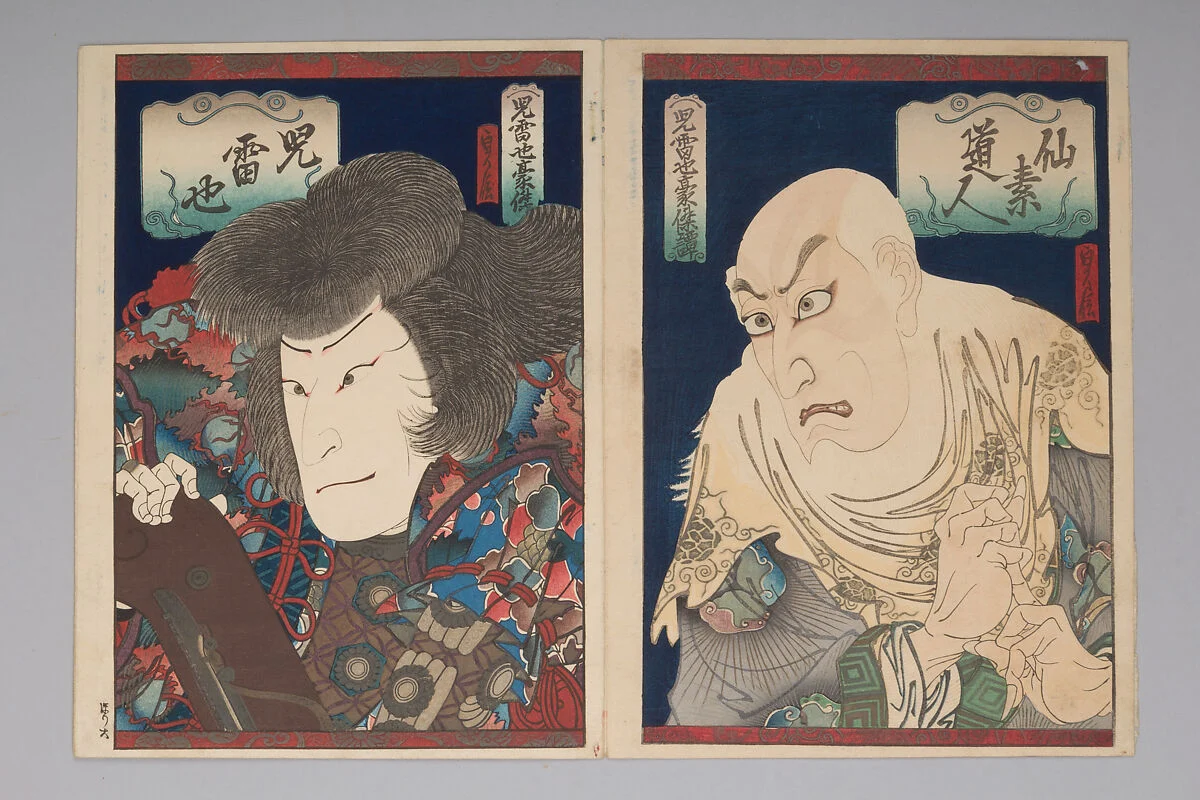
Ichikawa Ebizō V as Senso Dōjin at right, paired with Jiraiya at left, Sadanobu, 1854
The right-hand print portrays Ichikawa Ebizō V playing Senso Dōjin in an Osaka Kabuki performance; Jiraiya appears at left. The Met identifies the hermit as the teacher of toad magic. This is a theatrical representation of his human appearance, a separate witness from Griffis’s retelling; neither portrait shows the frog transformation.
Overview
Jiraiya, then a robber, shelters during a snowstorm in the house of a beautiful woman. He tries to kill his host during the night, but her body immediately becomes that of an old man who breaks his sword. The host identifies himself as Senso Dojin and says that he has lived in the mountains for centuries, although his true body is a huge frog.
Instead of killing the intruder, Senso Dojin accepts him as a pupil. During several weeks he teaches control of wind, rain and water, and the power to command frogs that enlarge enough to carry a person or heavy burdens across rivers. He then instructs Jiraiya to stop harming the poor and use his power against dishonest wealth. At the end of the instruction he becomes a huge frog and hops away.
The woman, old man and departing frog are successive forms of the same named teacher, not three separate beings. The text directly narrates the final frog transformation as well as his statement about his true body. It does not make him Jiraiya’s biological father. The limits of frog magic are retained later in the tale: serpent poison threatens Jiraiya despite his training, and a separate snail teacher supplies complementary magic through Tsunadé.
Origins & earliest records
Japanese narrative in an English literary collection
Records & interpretation
Full chapter, conclusion and collection preface directly read.
Selected bibliography
Documented works and useful reading. This is not a list of every appearance.
- 01
Japanese Fairy World: Stories from the Wonder-Lore of Japan
XVI, Jiraiya, or the Magic Frog, pp.126–140
Family & connections
A source-supported family tree or inspiration record has not yet been compiled for this profile. Related reading below indicates a connection in subject matter, not a proven lineage or creative influence.
Primary records and illustrations
William Elliot Griffis, Japanese Fairy World (1887 edition)
English literary collection. XVI, Jiraiya, or the Magic Frog, pp.126–140
Complete chapter and preface read. The woman, old man and departing frog are successive forms of the same named teacher, not three separate beings. The text directly narrates the final frog transformation as well as his statement about his true body. It does not make him Jiraiya’s biological father. The limits of frog magic are retained later in the tale: serpent poison threatens Jiraiya despite his training, and a separate snail teacher supplies complementary magic through Tsunadé.
References
Sources supporting this profile. Linked pages have their own scope and editorial standards.
- Historical English literary retellingGriffis, Japanese Fairy World (1887), XVI, Jiraiya, or the Magic Frog, pp.126–140Research access: 2026-10-05
Image credits
Historical illustrationIchikawa Ebizō V as Senso Dōjin at right, paired with Jiraiya at left, Sadanobu, 1854
The right-hand print portrays Ichikawa Ebizō V playing Senso Dōjin in an Osaka Kabuki performance; Jiraiya appears at left. The Met identifies the hermit as the teacher of toad magic. This is a theatrical representation of his human appearance, a separate witness from Griffis’s retelling; neither portrait shows the frog transformation.