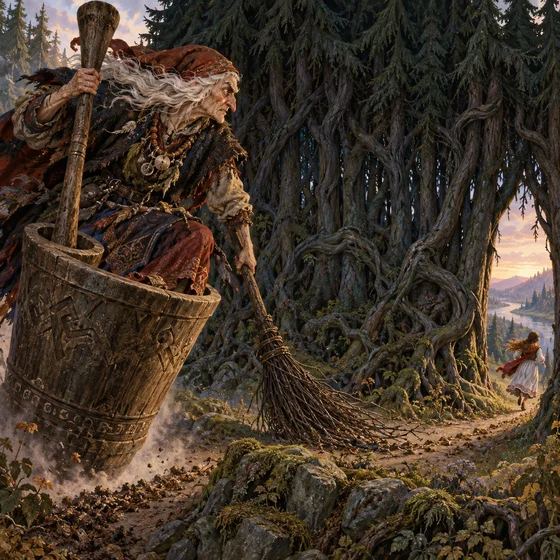
AI-generated interpretation of the witch calling to Ivashko in Ralston’s collected tale. The boy’s white shirt and red girdle follow the text; faces, other clothing, boat and river landscape are imagined. This depicts the initial encounter, before capture and the later acquisition of iron teeth.
A modern illustration of one collected narrative, not a verified historical scene or universal witch appearance.
Overview
Ivashko’s parents allow their small son to fish from a canoe, visiting the bank with a repeated call to bring him back for food and fresh clothing. A witch overhears the words and attempts the same call. Her hoarse voice exposes the deception, and the boy sends his canoe farther out. She then threatens a smith until he forges her a thin voice resembling the mother’s. Returning to the shore at night, she successfully calls Ivashko in, takes his fish and carries him to her house. The danger depends on recognition and an artificially altered voice rather than a general power to impersonate anyone.
She orders her daughter Alenka to heat the stove and bake the captive while she invites guests to the meal. Ivashko pretends not to understand how to sit on the baking shovel and asks for a demonstration. When Alenka sits down, he pushes her into the oven and shuts it, then escapes into a high oak. The returning witch cannot enter through the closed door, climbs through a window and assumes that her daughter has gone out. She serves the baked body to her guests without realising whose it is. This reversal is part of the particular narrated violence; it is not evidence of an ordinary historical household practice.
From the oak Ivashko corrects her boast that she has eaten him, revealing that she has eaten Alenka instead. The witch attacks the tree with her teeth. When two front teeth break, she forces the smith to replace them with iron and resumes gnawing. Ivashko jumps into another tree as the first falls. She breaks two lower teeth on the second tree, obtains another pair of iron replacements and continues. The iron teeth are acquired during this pursuit, rather than an anatomy supplied at her first appearance or a rule for every Russian witch.
Ivashko appeals to passing flocks of geese-swans to carry him home. The first directs him to the middle flock, the second to the birds behind; the third lifts him away and deposits him in his parents’ upper room. Next morning, as his mother divides pancakes and laments his absence, he asks why none are being saved for him. His father investigates and the family is reunited. The story ends with their happy life together. It does not narrate the pursuing witch’s death, capture or subsequent fate.
Ralston’s source note identifies Afanasief’s collection, volume I, number 4a, from the Voroneje Government. His surrounding discussion compares the Witch, or Vyedma, with Baba Yaga, while another note says some tellers replace the witch with a snake. These are variant and comparative observations, not additional features of this character. Other nearby versions give the boy a wooden origin or rescue by sisters and a bribed cat; those events belong to separate witnesses and are excluded from this profile. The main account retains its own parents, daughter, smith, trees and rescuing birds.
Origins & earliest records
A source-specific historical English rendering of a collected Voroneje tale, presented as XXII, The Witch, in Ralston’s Russian Fairy Tales. The Hurst title page is undated; the separate London 1873 edition and the Gutenberg header’s 1872 metadata do not establish the precise printing read here.
Records & interpretation
Complete story, printed pp. 171–176, and direct notes 206–210 read in the cached original. Surrounding collector discussion and variant notes 205, 211–214 also read for distinction. Original Russian and physical print facsimile not independently collated.
Selected bibliography
Documented works and useful reading. This is not a list of every appearance.
- 01
Russian Fairy Tales: XXII, The Witch
Complete pp. 171–176; notes 206–210 identify Afanasief I.4a, Voroneje Government and name/variant details.
Family, evolution & connections
Baba Yaga
Ralston places the unnamed witch of Ivashko beside Baba Yaga in his comparative discussion. Both selected accounts feature a threatened child escaping a predatory household and a pursuing captor. Ivashko’s forged maternal voice, Alenka, acquired iron teeth and rescue by geese-swans remain distinct from the Baba Yaga accounts’ gifts, helpers and magical obstacles. The collector’s comparison does not rename this witch Baba Yaga or establish one universal being.
Witch of Hansel and Gretel
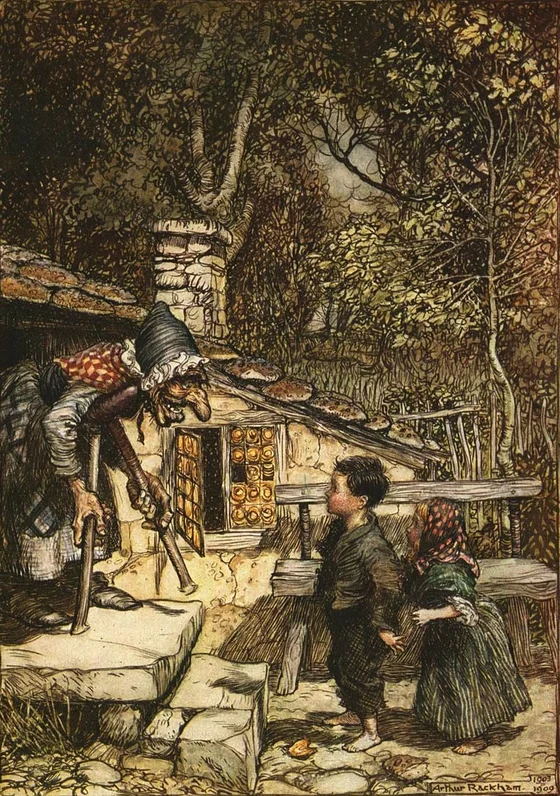
Both selected tales reverse an oven trap through a captive child’s pretended inability to follow instructions, a parallel also named in Ralston’s discussion. Ivashko pushes the witch’s daughter Alenka into the oven, and the witch survives to pursue him. Gretel traps the witch herself and releases Hansel. The distinct victims, endings and collected witnesses should not be merged or treated as proof of direct transmission.
References
Sources supporting this profile. Linked pages have their own scope and editorial standards.
- Collected tale in historical English translationRalston, The Witch, pp. 171–176 and notes 206–210Research access: 2026-10-26
Image credits
Modern interpretation of a historical literary accountAI-generated interpretation of the witch calling to Ivashko in Ralston’s collected tale. The boy’s white shirt and red girdle follow the text; faces, other clothing, boat and river landscape are imagined. This depicts the initial encounter, before capture and the later acquisition of iron teeth.
A modern illustration of one collected narrative, not a verified historical scene or universal witch appearance.