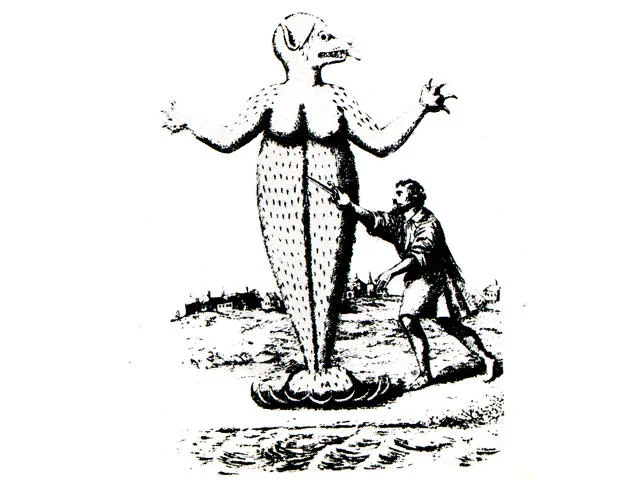
Ipupiara marine monster in a 1576 woodcut
Exact named Ipupiara illustration in the 1576 colonial account; historical reported encounter, not verified zoology. Commons credits the book author; the engraver is not individually identified.
Overview
The University of São Paulo's Brasiliana library brings together early Ipupiara descriptions and images. Gândavo's 1576 history includes the notorious marine-monster illustration; Fernão Cardim's later accounts describe humanlike beings at river mouths, feared for fatal attacks. Their versions should be compared as texts, rather than assembled into a zoological identification or a universal Indigenous water spirit.
Gândavo’s complete chapter dates its São Vicente encounter to 1564. An unnamed enslaved Indigenous woman first sees a roaring creature near the shore and alerts Baltasar Ferreira, who initially dismisses her report. When he blocks its retreat to the sea, it rises on its tail fins; he wounds it with a sword, and other enslaved people arrive at the woman’s calls and carry the nearly dead animal to the settlement. The chronicler describes a hairy body fifteen palmos long and prominent muzzle bristles. His insistence that his illustration corrects other circulating pictures belongs to the account’s claim of authority, not independent verification.
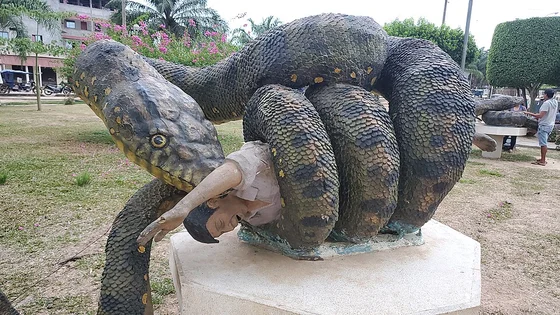
Cardim’s distinct river-mouth chapter describes male and female humanlike beings with deeply set eyes and reports an incident dated 1582 near Jaguaripe. A fisher escapes pursuit on his raft and tells his enslaver, who goes to investigate; the creature pulls that man from his canoe when he leaves a hand outside it. The text separately attributes deaths around Porto Seguro and describes crushing embraces followed by lament-like sounds. These are Cardim’s reported events, not details silently added to Gândavo’s sword-fight creature.
Cardim's account makes a deadly embrace central to the danger, while subsequent writers repeat and reinterpret similar claims. These are colonial reports, not verified observations of a newly discovered animal. The Brasiliana commentary places such images within European expectations, publishing practices and the promotion of colonial resources. Reading the monster alongside that context preserves both its vivid reception history and the limits of the outsiders who recorded it.
Origins & earliest records
Gândavo's História da Província Santa Cruz was published in Lisbon in 1576 and supplies a securely dated illustrated witness. Cardim's writings date from the late sixteenth and early seventeenth centuries. These records do not date the beginnings of the Indigenous narratives their authors claimed to report, or establish a single precolonial form.
Records & interpretation
Gândavo chapter IX was directly read in a transcription identifying the 1576 edition, folios 30v–32v; Cardim’s complete chapter XVI was read in the 1925 edition transcription, pp. 89–90. Cardim’s much earlier composition and the inspected edition date remain distinct. The 1925 editorial notes proposing seals or other animals are not Cardim’s testimony or established identifications. USP’s contextual account remains separately credited; neither colonial writer supplies contemporary Indigenous community confirmation.
Selected bibliography
Documented works and useful reading. This is not a list of every appearance.
- 01
História da Província Santa Cruz a que vulgarmente chamamos Brasil
Chapter IX, complete 1576-text transcription, folios 30v–32v; reported event dated 1564, not 1576.
- 02
Tratados da terra e gente do Brasil
Late-sixteenth/early-seventeenth-century composition; inspected 1925 J. Leite edition, chapter XVI, pp. 89–90. Main text distinguished from later editors’ notes.
Family & connections
A source-supported family tree or inspiration record has not yet been compiled for this profile. Related reading below indicates a connection in subject matter, not a proven lineage or creative influence.
References
Sources supporting this profile. Linked pages have their own scope and editorial standards.
- ResearchUSP Brasiliana: Crendices zoológicas e primeiros registros da fauna brasileiraResearch access: 2026-10-05
- Primary textPero de Magalhães Gândavo: complete located water-monster chapterResearch access: 2026-10-05
- Primary textFernão Cardim: complete located water-monster chapterResearch access: 2026-10-05
Image credits
Historical illustrationIpupiara marine monster in a 1576 woodcut
Exact named Ipupiara illustration in the 1576 colonial account; historical reported encounter, not verified zoology. Commons credits the book author; the engraver is not individually identified.