Cobra-grande
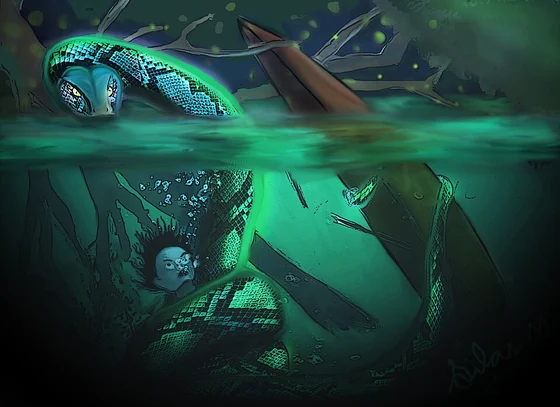
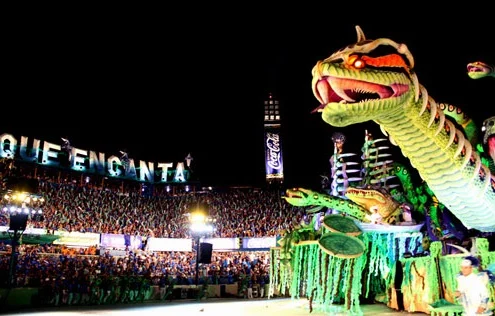
Image associated with the exact linked encyclopedia article; consult credited file description for its interpretation.
Overview
The Centro Nacional de Folclore e Cultura Popular describes Cobra-grande as an Amazonian being living in the deepest river water. Its passing furrows become smaller waterways, and torchlike eyes frighten fishers. The institutional thesaurus places Boiúna and Cobra-norato under this heading, without proving that all stories using those names have one plot. A much fuller historical appearance occurs in Santa-Anna Nery's 1889 Folk-lore brésilien. In chapter IV he explicitly translates a night-creation story from Couto de Magalhães's O Selvagem. Cobra-Grande is the parent of a woman married to a human man, and possesses the night, which is initially asleep beneath the water. The daughter will not sleep with her husband in endless daylight and sends his three servants across the river to obtain it from her parent.
In Nery's translated story, Cobra-Grande gives the servants a tightly sealed tucumã kernel and forbids them to open it. During the canoe journey they hear the sounds of crickets and little frogs inside. Curiosity defeats the warning: they light a fire, melt the sealing resin and open the kernel. Darkness spreads at once. Objects lying in the forest become animals and birds, and objects in the river become ducks and fish; the narrative specifically transforms a basket into a jaguar and a fisherman, canoe and paddles into a duck. At the morning star's appearance, Cobra-Grande's daughter separates day from night and creates birds whose calls announce the appropriate hours. The three servants are changed into monkeys, with the resin accounting for marks on their bodies. This specific story makes the serpent a keeper and giver of night, rather than only a threat to boats. Raul Bopp's 1931 Cobra Norato belongs to a separate modernist literary reception; its authorship and date are verified, while its complete poetic narrative has not been read for this profile.
Rodrigues records a different Rio Solimões family episode in “A cobra grande, ou Serpentario” (1890,233–235). Here the serpent is a woman’s child, rather than the parent of a bride. His Portuguese translation calls the impregnating being a demon, while a note gives a broader gloss involving a harmful or invisible presence. The growing serpent follows his mother everywhere until she sends him up a sorveira tree and escapes. His grandmother says she does not know where his mother is. He flies to the sky, asking her to answer when he calls. She sleeps through his calls and wakes as the third fades. Lizards, snakes and trees answer instead, accounting in the tale for their renewal of skin or bark while people lack it. The close says he remains visible in the sky; it does not narrate reunion with his mother.
A separate Solimões Uacauan tale (187–189) gives a threatening forest serpent. Its foul emission makes a lost hunter’s hair fall out, but hearing him call the bird Uacauan grandfather prompts it to release him under a secrecy condition. The man discloses its hiding place; he and the bird cut wood and roast it. Neither this serpent nor the celestial child is identified with Nery’s keeper of night. Rodrigues’s wider conjectures about Asian transmission and American serpent traditions are not adopted as proven common origins.
The Rio Negro version of Boia Uaçu (239–243) has another cause and ending. A woman taken into a married man’s household as a spinner receives no food and secretly drinks eggs. The man places human hair inside two curassow eggs; after she consumes them, her belly swells and a voice speaks from within. In the forest, the serpent emerges from her and climbs a sorveira tree. The man prepares an emptied fruit filled with saliva, and the woman puts the serpent’s tail into it before fleeing with him. The saliva answers the serpent’s calls in place of its mother. At home, the man conceals her in a pot covered with earth. The pursuing serpent searches the river, finds no sufficiently deep place and ascends to the sky. Addressing the man as grandfather, it tells him to answer its calls and weed his garden when it appears, marking the beginning of summer in the text. That address does not independently establish his biological paternity. Unlike the Solimões account, this ending concerns a seasonal agricultural signal; it does not repeat the missed calls explaining human mortality.
Origins & earliest records
Nery's 1889 French collection explicitly credits his own translation of a night-creation narrative in Couto de Magalhães's O Selvagem. This is a historical printed transmission chain, not a newly collected unnamed interview. The CNFCP reference and Bopp's 1931 poem supply distinct later records; none establishes the first oral Cobra-grande story.
Records & interpretation
The complete night-creation episode was directly read in Nery's original French OCR, chapter IV. Couto de Magalhães's original text remains indirect, and the facsimile pagination was independently visually checked: pp. 55–58 include a page misprinted 37. The CNFCP record independently supports river channels, luminous eyes and indexed names. Bopp's poem is verified as literature, not treated as a transcription of this episode. Rodrigues’s complete187–189 and233–235 provide separately located predatory and celestial-child accounts, not a single harmonized genealogy. The separate Rio Negro Boia Uaçu239–243 was read in full from original pages; grandfather address remains a dialogue relation rather than inferred biological ancestry.
In the literature
“Mon père possède la nuit”
ChapterIV; p55; daughter’s explanation · F.-J. de Santa-Anna Nery, French rendering of Couto de Magalhães
The serpent’s married daughter explains that her father possesses night. Three servants fetch a sealed tucuman nut; opening it against warning releases darkness. The narrative attributes animal origins and differentiated bird-song times to the ensuing transformations and the daughter’s actions. The father is not himself shown transforming into an animal.
Selected bibliography
Documented works and useful reading. This is not a list of every appearance.
- 01
Tesauro de Folclore e Cultura Popular — Cobra-grande
Institutional description and controlled-vocabulary treatment of related names.
- 02
Cobra Norato
Modernist poem; verified literary reception, not a transcription of all oral versions.
- 03
Folk-lore brésilien
Chapter IV, pp. 55–58; complete night-creation narrative explicitly translated from Couto de Magalhães. Facsimile's intervening page is misprinted 37 between 56 and 58; original Magalhães remains indirect.
- 04
Poranduba amazonense, ou Kochiyma-uara porandub
Complete XIV Uacauan,187–189, and IX A cobra grande, ou Serpentario,233–235, both labelled Rio Solimões, including associated footnotes. Collection-level dates1872–1887 do not date individual tellings. Separate XI Boia Uaçu,239–243, Rio Negro: complete interlinear/Portuguese account and all notes inspected, including saliva substitution and agricultural ending.
Family & connections
A source-supported family tree or inspiration record has not yet been compiled for this profile. Related reading below indicates a connection in subject matter, not a proven lineage or creative influence.
Located primary passages
Specific passages supporting details in this entry, grouped by their published witness.
Folk-lore brésilien
F.-J. de Santa-Anna Nery, Folk-lore brésilien, Paris Perrin et Cie,1889 per IA/BnF catalogue metadata. Original title inspected; its damaged scan does not visibly establish year. ChapterIV selected narratives read in full; printed55, misprinted37 between56/58, and58 visually checked.
- The serpent’s married daughter explains that her father possesses night. Three servants fetch a sealed tucuman nut; opening it against warning releases darkness. The narrative attributes animal origins and differentiated bird-song times to the ensuing transformations and the daughter’s actions. The father is not himself shown transforming into an animal.
ChapterIV; pp55–58, with intervening printed37 pagination error; Night held by a serpent father
- The servants’ broken seal releases night and the formerly speaking objects become animals. The husband announces that the servants have become monkeys, with dark mouth/yellow arm markings explained by melted resin. These are etiological narrative claims, not zoological observations.
- Nery identifies Couto de Magalhães’s O Selvagem as the prior source. Footnote2 states that he chose to translate this tale himself from that supplied original, rather than use Émile Allain’s1883 French translations. The earlier source and unnamed original indigenous narrators are not independently inspected here.
Collector’s colonial framing and speculative etymology are not adopted as neutral facts. Selected narrative read; not entirebook. No songs or ritual formulas excerpted.
References
Sources supporting this profile. Linked pages have their own scope and editorial standards.
- ReferenceCNFCP thesaurus — Cobra-grandeResearch access: 2026-10-05
- ReferenceFundação Biblioteca Nacional — Raul Bopp and Cobra NoratoResearch access: 2026-10-05
- ResearchSanta-Anna Nery 1889: Cobra-Grande and the creation of nightResearch access: 2026-10-05
- Primary textUFPE: Barbosa Rodrigues1890 original scanResearch access: 2026-10-05
Image credits
Reference illustrationCobra-grande
Image associated with the exact linked encyclopedia article; consult credited file description for its interpretation.