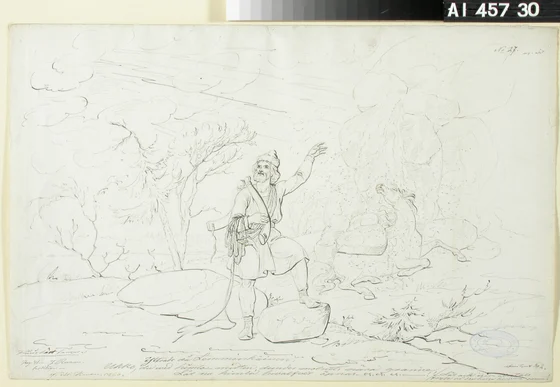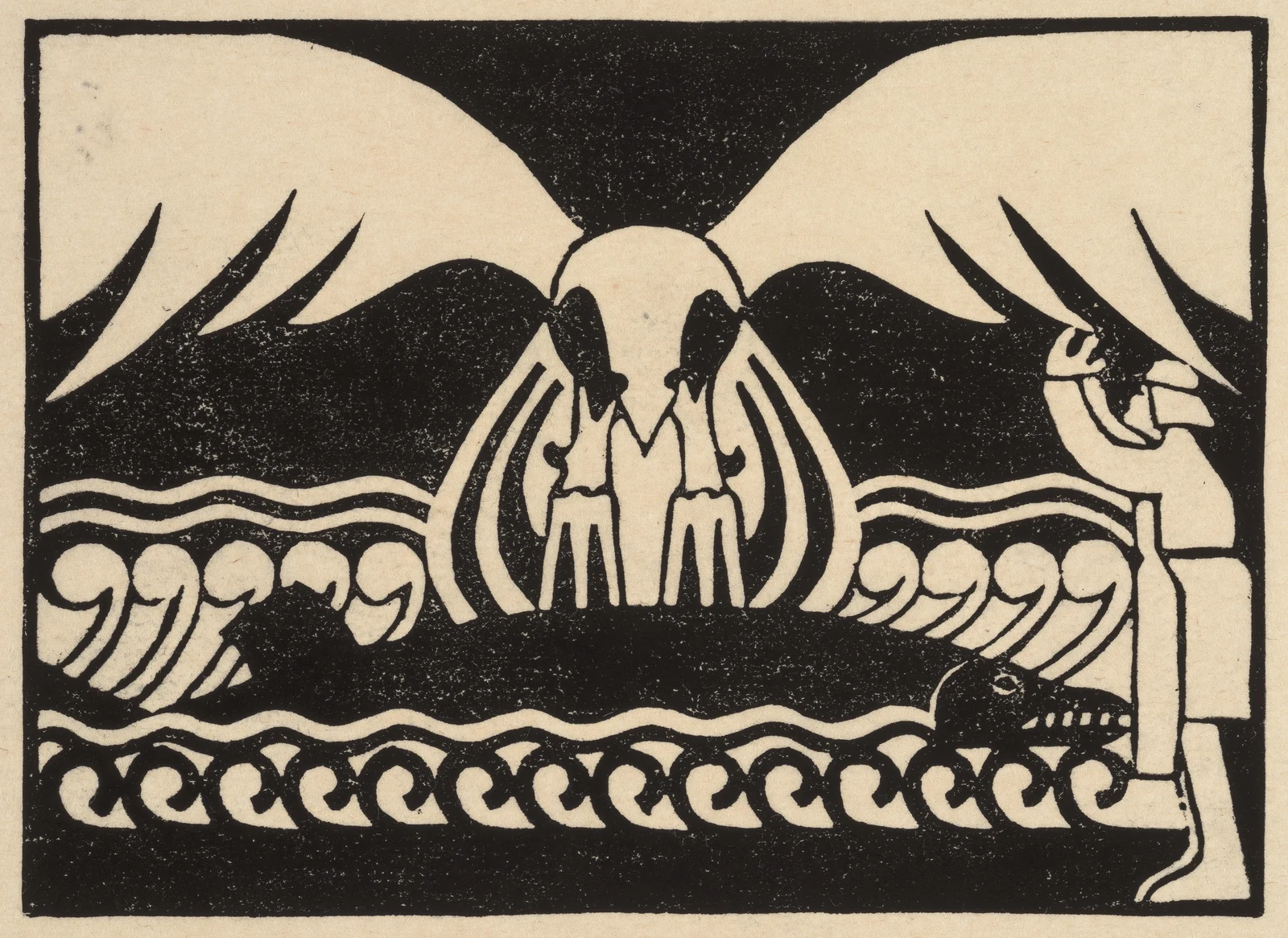
Ilmarinen’s forged eagle above Tuonela’s pike in Joseph Alanen’s linocut, circa 1918–1919
Joseph Alanen’s The Pike of Tuonela represents the struggle in Kalevala Rune XIX: the giant eagle spreads its wings above the fish while Ilmarinen stands beside the water. This later linocut gives the scene its own graphic form; its monochrome shapes do not establish the eagle’s metal colours or every detail of Crawford’s verse.
Overview
For his third bridal task Ilmarinen forges a giant eagle, giving it iron talons and a beak of steel and copper. He rides between its wing-bones to Tuoni’s river. One wing brushes the water while the other sweeps the heavens. It first saves him from an unnamed water monster before confronting the pike he must capture. Crawford expands its epic scale during the encounter: a beak measuring a hundred fathoms, a mouth as wide as seven streamlets, a tongue as long as seven javelins, and talons compared to five crooked scythes. These are the verse’s comparisons, rather than measured dimensions of a real bird.
The pike drags the eagle down and escapes its first attempts. On the third assault fire shoots from the feathers and lightning flashes from its eyes; talons braced against rock and prey finally lift the fish out. The eagle eats its body in a treetop, leaving only the head for the disappointed smith. It then rises violently into the upper sky, breaking the rainbow and dislodging the moon’s horns before disappearing beyond the sun-land. This ending is cosmic flight, not a narrated return to metal or a human transformation.
Origins & earliest records
Kalevala, Runes XIX, John Martin Crawford’s English translation (1888), after Elias Lönnrot’s edited epic. Publication dates document selected versions, not the beginning of the underlying oral songs.
Records & interpretation
Complete relevant Rune XV or XIX and connected XIII–XIV task context read. English translation details are attributed; source singer and direct Finnish variant are not invented.
Selected bibliography
Documented works and useful reading. This is not a list of every appearance.
- 01
Kalevala, Runes XIX
Selected English epic episode; complete relevant encounter and outcome read.
Family & connections
A source-supported family tree or inspiration record has not yet been compiled for this profile. Related reading below indicates a connection in subject matter, not a proven lineage or creative influence.
References
Sources supporting this profile. Linked pages have their own scope and editorial standards.
- Primary epic translationCrawford, Kalevala, Runes XIXResearch access: 2026-10-05
Image credits
Historical illustrationIlmarinen’s forged eagle above Tuonela’s pike in Joseph Alanen’s linocut, circa 1918–1919
Joseph Alanen’s The Pike of Tuonela represents the struggle in Kalevala Rune XIX: the giant eagle spreads its wings above the fish while Ilmarinen stands beside the water. This later linocut gives the scene its own graphic form; its monochrome shapes do not establish the eagle’s metal colours or every detail of Crawford’s verse.