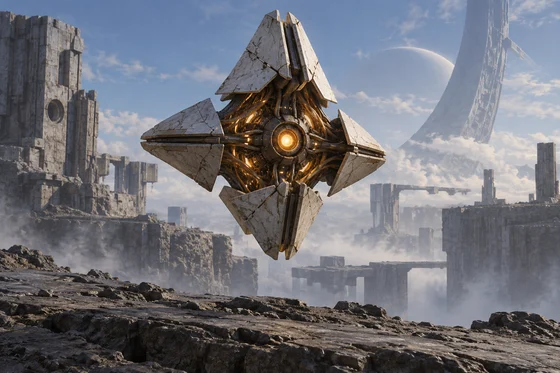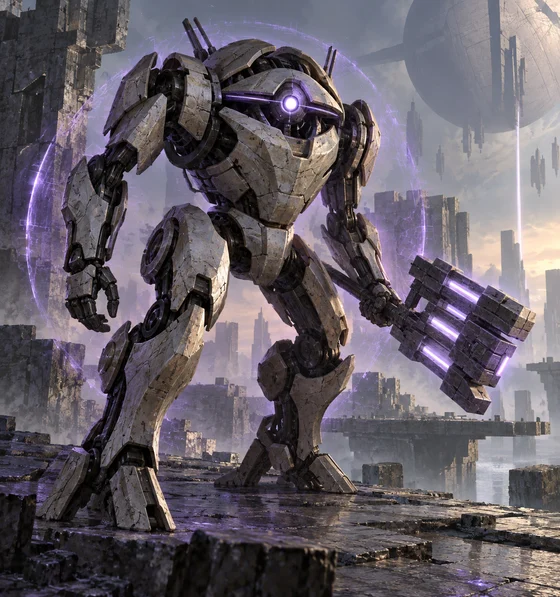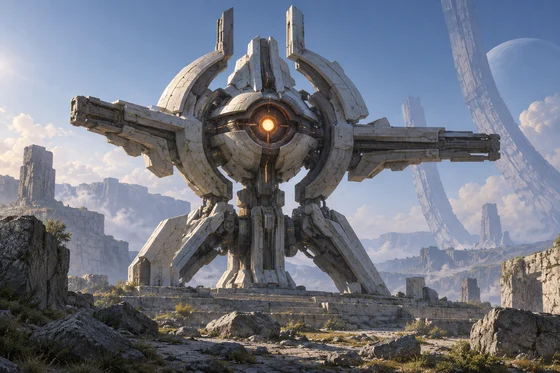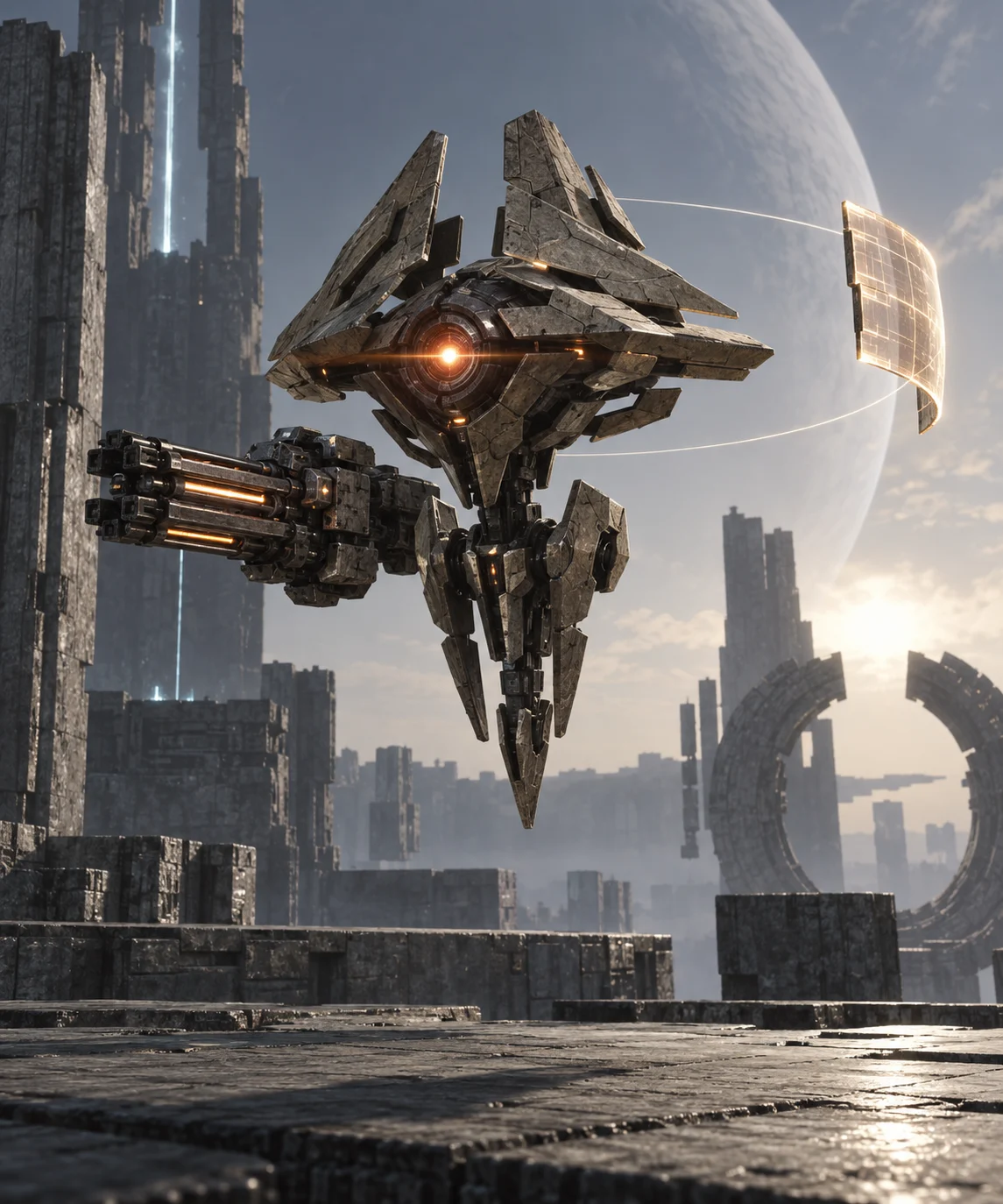
Modern illustration of Hydra (Destiny)
AI-generated interpretation of the accepted account; undescribed appearance, colours, clothing, pose and surroundings are imagined. Not historical artwork or ethnographic evidence. Unofficial interpretation.
Overview
The Hydra combines a mobile strongpoint with a rapid data-processing role. The original Grimoire contrasts its physical slowness with its ability to handle information supplied by other Vex. Its segmented hovering body is protected by a rotating energy barrier, while its heavy Aeon Maul weapon delivers explosive fire. Rather than charging like a Minotaur or maneuvering like a Harpy, it can hold a firing position and make the surrounding battlefield hazardous. Its name belongs to Destiny’s classification of Vex forms; the frame does not possess the regenerating severed heads of a traditional Hydra.
The shield arrangement differs across releases. Destinypedia describes the ordinary original-game defense as a single circling barrier and the sequel form as three smaller shield sections, changing the opportunities for a clear shot. Destruction can leave a dangerous exploding head, so apparent defeat does not immediately make the nearby space safe. Named Hydras serve as prominent Vex Minds and can have special mechanics, but the normal unit description should not absorb every boss ability. The network-processing role is directly supported by the original card; uncited claims about a tail broadcasting commands or immense numerical sizes are not required for this account.
First appearances & development
Hydras appear in Destiny (2014) and return in Destiny 2 (2017). Their processor role comes from the original enemy card, while the shield comparison uses a reference’s release-specific encounter descriptions. Named Vex Minds are contextual examples within the frame category, not evidence for unrelated Hydra species or a continuous individual across games.
Canon & continuity
The inspected Bungie Grimoire transcription supplies the slow-body/fast-processor distinction. Destinypedia provides the Aeon Maul, shield and death-blast descriptions with separate original and sequel sections. Uncited reference claims about command signals and exact huge dimensions are excluded. The mythological name is a comparison, not a claimed canonical genealogy.
Selected bibliography
Documented works and useful reading. This is not a list of every appearance.
- 01
Destiny
Original Hydra Grimoire description and original encounter form.
- 02
Destiny 2
Recurring enemy type; selected sequel encounter details are reference-mediated.
Family, evolution & connections
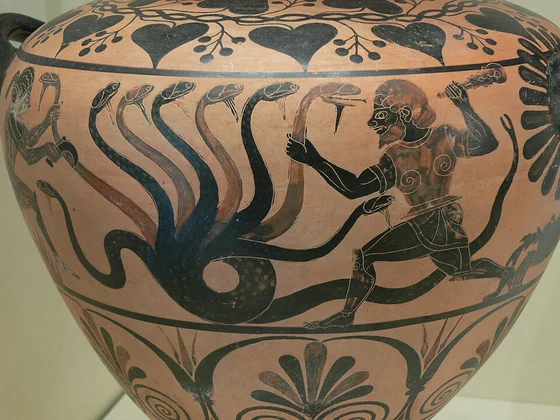
Lernaean Hydra
Library 2.5.2 describes the Hydra at Lerna with nine heads, one immortal. Destroying a head produces two replacements, and Iolaus helps burn the neck-roots to prevent regrowth. These details belong to that particular mythographic account. The link to Hydra (Destiny) is a name comparison, not an asserted adaptation or shared history.
References
Sources supporting this profile. Linked pages have their own scope and editorial standards.
- Primary workHydra (Destiny) — original Grimoire transcriptionResearch access: 2026-10-05
- ReferenceHydra (Destiny) — Destinypedia reference accountResearch access: 2026-10-05
Image credits
AI-generated interpretationModern illustration of Hydra (Destiny)
AI-generated interpretation of the accepted account; undescribed appearance, colours, clothing, pose and surroundings are imagined. Not historical artwork or ethnographic evidence. Unofficial interpretation.