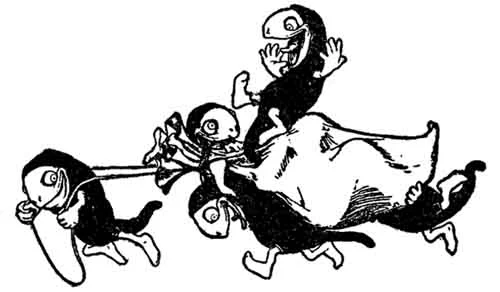
Hobyahs carrying the captured girl in a bag, Batten
Actual grotesque small creatures carry a bagged child; primary caption directly names the abduction. Artist-specific round heads and details distinguished from text.
Overview
A family lives in a house made from hempstalks. The Hobyahs approach at night announcing their intention to tear it apart, eat the old couple and carry off their little girl. Turpie, the family’s small dog, barks and drives them away. The old man mistakes this protective noise for a nuisance and progressively mutilates the dog, eventually taking away its ability to defend the house. The monsters then fulfil their threats and hang the abducted girl in a bag at their home.
Each Hobyah strikes the bag and demands to be looked at before the group sleeps through the day. A passing man hears the girl crying, removes her and puts his large dog in her place. When the monsters return to inspect the bag that night, the replacement dog consumes them. The ending says that no Hobyahs remain. This is the story’s closing claim, not a historical extinction report. Jacobs’s source note attributes the printed account to S. V. Proudfit in the American Folk-Lore Journal, describing it as current in a family deriving from Perth. Batten’s grotesque illustrations are artistic interpretations; the text itself provides little fixed anatomy.
Origins & earliest records
The inspected Jacobs collection cites American Folk-Lore Journal volume III, page 173, and a Perth-derived family transmission. The profile’s European region reflects that attributed Scottish provenance while its collection in America remains explicit. Jacobs’s 1894 book is a later literary witness, not the oral starting date.
Records & interpretation
The evidence comprises a family tale, its published source attribution and later illustration. No remains or zoological description accompany the narrative’s claim that a dog destroyed all Hobyahs. Their repeated cries and daytime sleep are textual traits, rather than field observations.
In the literature
“for the Hobyahs slept in the daytime”
The Hobyahs; The captive girl's bag is hung in the creatures' home
The narrator explicitly locates their sleep in daytime.
Selected bibliography
Documented works and useful reading. This is not a list of every appearance.
- 01
More English Fairy Tales
Complete “The Hobyahs” and its source note inspected. Preface acknowledges rewritten and combined sources.
- 02
More English Fairy Tales — The Hobyahs
Joseph Jacobs, More English Fairy Tales; first publication1894, selected Gutenberg14241 witness explicitly Fourteenth Impression, undated. Jacobs’s preface acknowledges rewriting, combined sources and altered incidents. Exact heading/anchor used; no invented print pagination.
Family & connections
A source-supported family tree or inspiration record has not yet been compiled for this profile. Related reading below indicates a connection in subject matter, not a proven lineage or creative influence.
Located primary passages
Specific passages supporting details in this entry, grouped by their published witness.
More English Fairy Tales — The Hobyahs
Joseph Jacobs, More English Fairy Tales; first publication1894, selected Gutenberg14241 witness explicitly Fourteenth Impression, undated. Jacobs’s preface acknowledges rewriting, combined sources and altered incidents. Exact heading/anchor used; no invented print pagination.
- Hobyahs repeatedly threaten a hempstalk house but flee when Turpie barks. The old man progressively mutilates the noisy dog, finally removing its head; the Hobyahs then destroy the house, eat the adults and carry the girl away in a bag.
The Hobyahs; Repeated attacks and destruction of the household
- The creatures hang the bag and sleep during daylight. A passerby hears the girl, replaces her with his large dog and takes her home. At night the Hobyahs open the bag and the dog eats them; the story explains their absence by this ending.
The Hobyahs; Bag substitution and destruction of the Hobyahs
Complete selected tale and its source note read. Jacobs’s edited narrative is distinct from direct oral transcription. No song or ritual-formula excerpts; no invented print page or earliest date.
Primary source witness
Joseph Jacobs, More English Fairy Tales; first publication1894, selected Gutenberg14241 witness explicitly Fourteenth Impression, undated. Jacobs’s preface acknowledges rewriting, combined sources and altered incidents. Exact heading/anchor used; no invented print pagination.
- Jacobs cites American Folk-Lore JournalIII p173 and contributor S. V. Proudfit, identifying the account as current in a family deriving from Perth. This is a reported transmission chain, not direct evidence that the edited text was collected in Scotland.
Notes and References, LXIX The Hobyahs; Jacobs's source note
This verifies what Jacobs reports and changes; listed earlier works and informant claims are not independently verified by this note alone.
References
Sources supporting this profile. Linked pages have their own scope and editorial standards.
- Primary textJacobs, More English Fairy Tales: The Hobyahs and editorial noteResearch access: 2026-10-05
- ReferenceUniversity of Pennsylvania Online Books Page: Joseph Jacobs bibliographic listResearch access: 2026-10-05
Image credits
Historical illustrationHobyahs carrying the captured girl in a bag, Batten
Actual grotesque small creatures carry a bagged child; primary caption directly names the abduction. Artist-specific round heads and details distinguished from text.