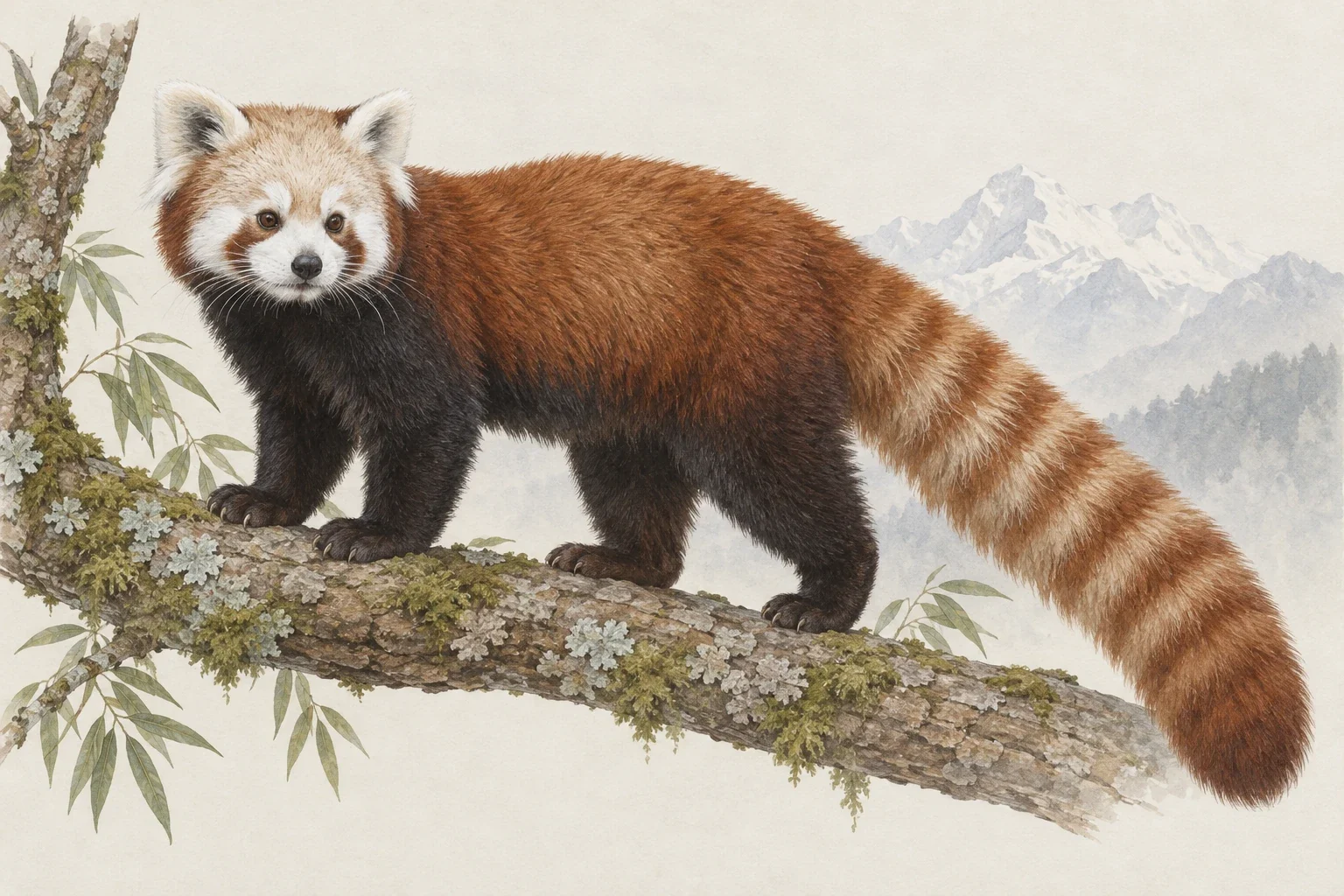
Himalayan red panda - AI-generated scientific interpretation.
Modern AI-generated scientific illustration. Diagnostic external features follow selected sources; pose, individual pattern and fine details are interpretive. Not photography or independent anatomical evidence.
Overview
The Himalayan red panda has a reddish coat, dark legs and belly, a pale marked face and a bushy ringed tail. The arboreal body combines balance and insulation in cool forest.
Smithsonian describes bamboo feeding, climbing and use of a modified wrist bone to grasp stems. Its account combines forms historically treated as subspecies, so broad husbandry details do not identify any individual’s ancestry.
Hu and colleagues’ 2020 genomic study supports Himalayan and Chinese red pandas as separate phylogenetic species. Locality and ancestry matter: coat colour alone cannot reliably identify a lineage. The illustration’s pale face is a grounded emphasis, without replacing genetic identification.
Origins & earliest records
Ailuridae is within Carnivora. Bamboo feeding and a grasping wrist do not make it a bear or a close giant-panda relative.
Evidence & interpretation
Indexed primary abstract supports the split; direct PubMed yielded a footer and was stopped. Smithsonian supports broader form and feeding. No divergence date inferred.
Selected bibliography
Documented works and useful reading. This is not a list of every appearance.
- 01
Genomic evidence for two phylogenetic species and long-term population bottlenecks in red pandas
Indexed abstract; direct page did not expose abstract.
- 02
Red panda
Selected bibliography; institutional account and study limits retained.
Family, evolution & connections
Taxonomic classification
A hierarchy of classified groups, not a chain of direct ancestors.
Source note: A. fulgens sensu stricto under two-species interpretation; A. styani separate.
- ClassMammalia
- OrderCarnivora
- FamilyAiluridae
- GenusAilurus
- SpeciesAilurus fulgens
References
Sources supporting this profile. Linked pages have their own scope and editorial standards.
- ResearchGenomic evidence for two phylogenetic species and long-term population bottlenecks in red pandasResearch access: 2026-10-10
- InstitutionalRed pandaResearch access: 2026-10-10
Image credits
AI-generated scientific interpretationHimalayan red panda - AI-generated scientific interpretation.
Modern AI-generated scientific illustration. Diagnostic external features follow selected sources; pose, individual pattern and fine details are interpretive. Not photography or independent anatomical evidence.