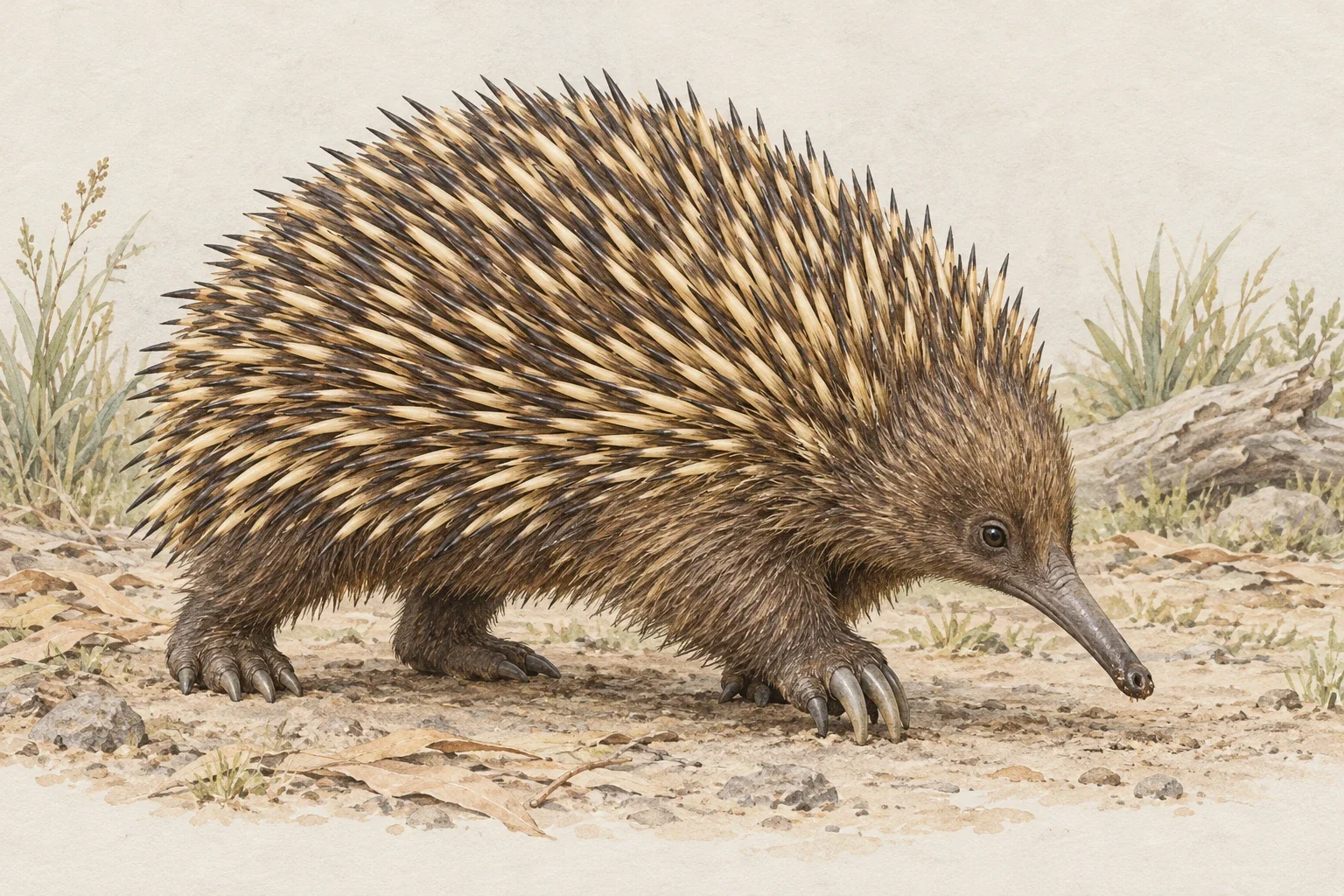
Short-beaked echidna - AI-generated scientific interpretation.
Modern AI-generated scientific illustration. Diagnostic external features follow selected sources; pose, individual pattern and fine details are interpretive. Not photography or independent anatomical evidence.
Overview
The short-beaked echidna has a rounded spine-covered back, short digging legs and a slender tubular snout. Fur fills the spaces between stout spines. The snout and claws help it reach insects, which a sticky tongue collects.
Australian Museum describes habitats from woodland and heath to grassland and dry country. Its current account covers Australia including Tasmania; the museum’s older natural-history treatment also records lowland New Guinea. Geographic populations should not be treated as a single uniform local ecology.
Egg laying and milk feeding occur in the same life cycle. A young animal initially develops in the mother’s temporary pouch, then occupies a nursery burrow as its spines develop. Its monotreme relationship to the platypus concerns ancestry and reproduction, while their adult feeding structures differ substantially.
Origins & earliest records
A living monotreme in Tachyglossidae, rather than a hedgehog or a porcupine. The egg-laying condition is a retained mammalian reproductive pattern, not evidence that this living species has remained unchanged through geological time.
Evidence & interpretation
The museum account supports anatomy and development and identifies collection specimen AM M.6641. The older museum publication supplements New Guinea distribution; its outdated count of other echidna species is not adopted.
Selected bibliography
Documented works and useful reading. This is not a list of every appearance.
- 01
Short-beaked Echidna
Selected bibliography; institutional account and study limits retained.
- 02
Short-beaked Echidna: Australian Natural History treatment
Selected bibliography; institutional account and study limits retained.
Family, evolution & connections
Taxonomic classification
A hierarchy of classified groups, not a chain of direct ancestors.
Source note: Current museum species classification used; historical broad echidna statements are bounded.
- ClassMammalia
- OrderMonotremata
- FamilyTachyglossidae
- GenusTachyglossus
- SpeciesTachyglossus aculeatus
References
Sources supporting this profile. Linked pages have their own scope and editorial standards.
- InstitutionalShort-beaked EchidnaResearch access: 2026-10-10
- InstitutionalShort-beaked Echidna: Australian Natural History treatmentResearch access: 2026-10-10
Image credits
AI-generated scientific interpretationShort-beaked echidna - AI-generated scientific interpretation.
Modern AI-generated scientific illustration. Diagnostic external features follow selected sources; pose, individual pattern and fine details are interpretive. Not photography or independent anatomical evidence.