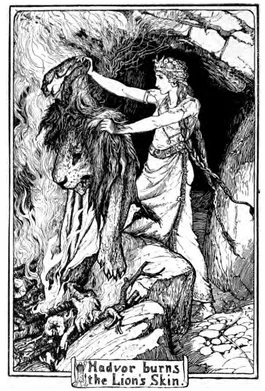
Hadvor burns the lion skin that held Hermod’s daytime enchantment, Henry Justice Ford, 1894
Hadvor holds Hermod’s discarded lion skin over the fire outside his cave. The lion head belongs to the removed skin, rather than a living lion at this moment; burning it releases him from the alternating lion and human forms.
Overview
Hermod and the royal daughter Hadvor grow up together and secretly promise marriage. When the king’s new queen demands that he marry her own daughter, he refuses. She condemns him to a deserted island, where he must be a lion by day and a man by night, constantly remembering Hadvor and his loss. His release requires Hadvor herself to burn the lion skin. Before vanishing, Hermod pronounces a counter-spell: his freedom will turn the queen into a rat and her daughter into a mouse, fighting in the royal hall until he kills them.
Hadvor eventually reaches the island with help from Olof and a dream visitor. Hiding beneath a low couch in his cave, she hears the arriving lion shake itself and then hears Hermod speaking as a man about his past. Only after he sleeps does she burn the skin left outside. The two reunite, but freedom from the lion form does not solve their escape: a helpful witch lends a boat and protects them from the hostile giant’s whale form. On reaching court, Hermod fulfils his counter-spell’s last action against the fighting rodents; their dead bodies become those of the two witches. He marries Hadvor and receives the kingdom. The lion interval is an imposed alternating condition, not a freely chosen hunting transformation.
Origins & earliest records
The Yellow Fairy Book (London: Longmans, Green, and Co., 1894), edited by Andrew Lang, prints Hermod and Hadvor as an Icelandic tale in footnote 32. The names and episode belong to this literary retelling, which supplies no named oral narrator.
Records & interpretation
The full tale follows the enchantment, underground visits, island rescue, whale battle, rat-and-mouse ending and royal succession. Forms explicitly connected by dialogue or the narrated outcome remain together; unrelated figures with similar anatomy remain separate.
Selected bibliography
Documented works and useful reading. This is not a list of every appearance.
- 01
The Yellow Fairy Book: Hermod and Hadvor
Complete selected narrative through Hermod’s marriage and Olof’s final marriage. This Hermod is not identified with the Eddic rider to Hel.
Family & connections
A source-supported family tree or inspiration record has not yet been compiled for this profile. Related reading below indicates a connection in subject matter, not a proven lineage or creative influence.
References
Sources supporting this profile. Linked pages have their own scope and editorial standards.
- Primary literary retellingLang 1894: complete Hermod and HadvorResearch access: 2026-10-05
Image credits
Historical illustrationHadvor burns the lion skin that held Hermod’s daytime enchantment, Henry Justice Ford, 1894
Hadvor holds Hermod’s discarded lion skin over the fire outside his cave. The lion head belongs to the removed skin, rather than a living lion at this moment; burning it releases him from the alternating lion and human forms.