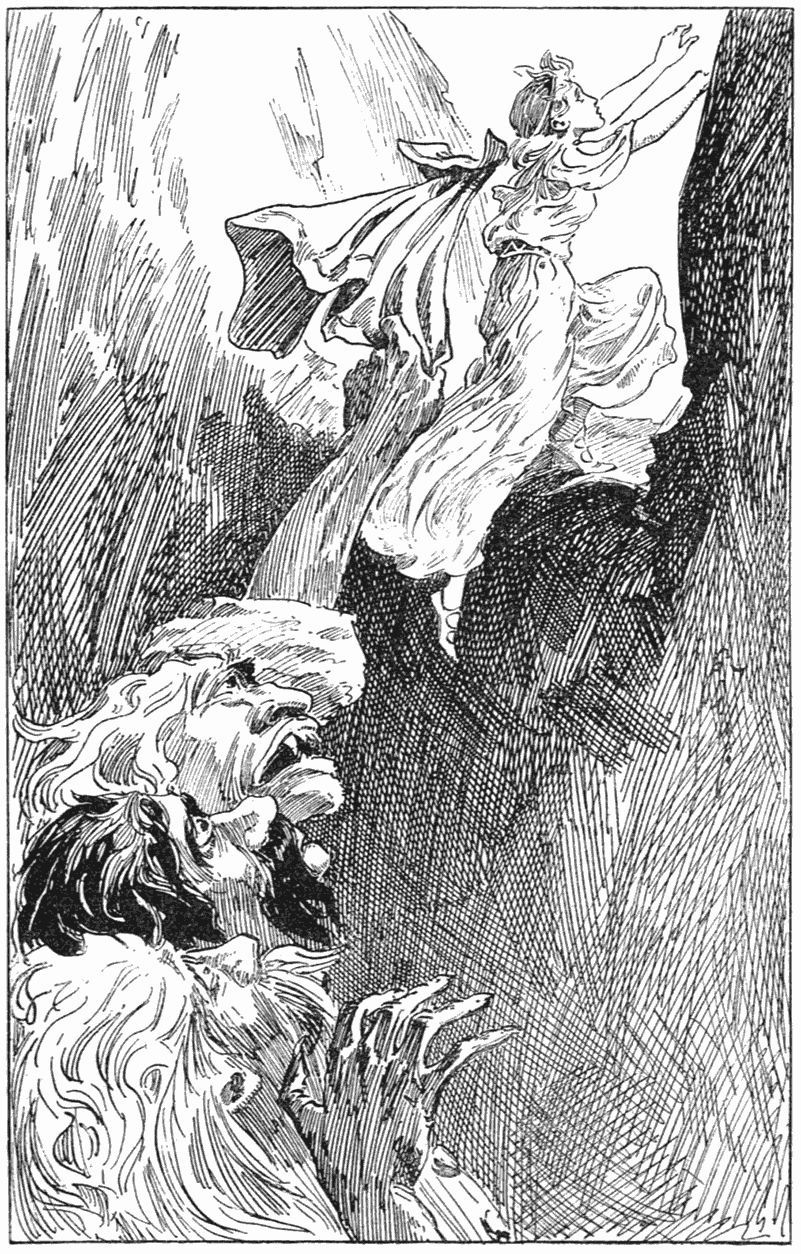
A three-headed giant looks up from the grave while Hadvör climbs out above him; he holds the cloak slipping from her shoulders.
Mason’s three-headed giant in Hadvör’s grave escape, Hall’s1897 retelling. This is an illustration of that edition’s scene, rather than Lang’s1894 wording.
Overview
Olof warns that the new queen intends to marry Hadvor to her three-headed brother from the underworld, disguised as a handsome prince. His attempted ascent through the castle floor is defeated; the queen next discovers his dead body at the palace gate. She transforms that body into a handsome youth and silences Hadvor by a spell, enabling the accusation that the princess murdered a worthy suitor. As punishment, Hadvor is placed alive in his grave mound. The prince becomes a giant again there, accompanied by two dogs; his death at the gate has not ended his ability to act.
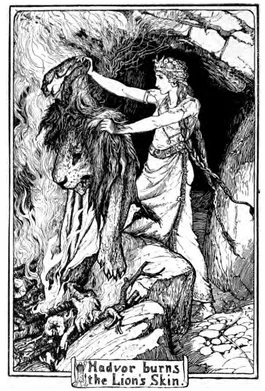
Following Olof’s advance warning, Hadvor makes assistance to him conditional upon information about Hermod. The giant explains that shoes made from the soles of his feet can carry her over land and sea. He then lets her stand on his shoulders to leave the mound but tries to drag her back by her cloak. She escapes because the garment rests loosely. Later the island witch identifies him as a new danger: he has become a great whale and waits to attack their boat. Hadvor and Hermod summon help during the pursuit; another huge whale and fifteen smaller ones meet him in battle. The water turns bloody, the assisting whales disappear and the fugitives reach shore. The tale establishes these successive identities, but does not give a separately observed final corpse or human-shaped sea form.
Origins & earliest records
The Yellow Fairy Book (London: Longmans, Green, and Co., 1894), edited by Andrew Lang, prints Hermod and Hadvor as an Icelandic tale in footnote 32. The names and episode belong to this literary retelling, which supplies no named oral narrator.
Records & interpretation
The full tale follows the enchantment, underground visits, island rescue, whale battle, rat-and-mouse ending and royal succession. Forms explicitly connected by dialogue or the narrated outcome remain together; unrelated figures with similar anatomy remain separate.
Selected bibliography
Documented works and useful reading. This is not a list of every appearance.
- 01
The Yellow Fairy Book: Hermod and Hadvor
Complete selected narrative through Hermod’s marriage and Olof’s final marriage. This Hermod is not identified with the Eddic rider to Hel.
Family & connections
A source-supported family tree or inspiration record has not yet been compiled for this profile. Related reading below indicates a connection in subject matter, not a proven lineage or creative influence.
References
Sources supporting this profile. Linked pages have their own scope and editorial standards.
- Primary literary retellingLang 1894: complete Hermod and HadvorResearch access: 2026-10-05
Image credits
Historical story illustrationA three-headed giant looks up from the grave while Hadvör climbs out above him; he holds the cloak slipping from her shoulders.
Mason’s three-headed giant in Hadvör’s grave escape, Hall’s1897 retelling. This is an illustration of that edition’s scene, rather than Lang’s1894 wording.