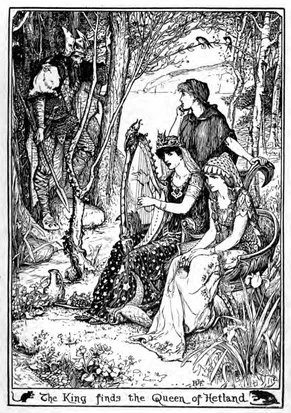
The false Hetland queen plays a harp beside her daughter and Olof, Henry Justice Ford, 1894
The seated harpist is the impostor who claims to be the queen of Hetland. Her daughter sits beside her and Olof stands behind them. This is her beautiful human guise before Hermod’s counter-spell turns her into a rat.
Overview
The widowed king is seeking the queen of Hetland the Good when mist brings him to three women in a woodland clearing. The most richly dressed sits on a golden chair with a harp and claims that pirates killed her husband and drove her from Hetland. Accepting that account, the king marries her. The maid Olof later identifies this queen and her daughter as witches wearing beautiful forms and explains that she herself was taken from her parents to serve them. Her green cloak protects her from their harm. The apparent widow’s royal story is therefore the impostor’s claim, not confirmed historical biography.
The queen’s coercion begins with Hermod’s refusal to marry her daughter. She imposes the alternating lion curse and also plans Hadvor’s marriage to her underground giant brother. When that plan fails, she changes the brother’s corpse into a handsome prince and magically prevents Hadvor from defending herself, securing the princess’s live burial. Hermod’s counter-spell takes effect when he is released: the queen and daughter become a rat and mouse perpetually fighting in the hall. The court cannot drive them away. Hermod returns and kills them; the resulting bodies expose both witches. Mother and daughter are distinguished by their rat and mouse forms, while this profile centres the mother whose deception and decisions drive the tale.
Origins & earliest records
The Yellow Fairy Book (London: Longmans, Green, and Co., 1894), edited by Andrew Lang, prints Hermod and Hadvor as an Icelandic tale in footnote 32. The names and episode belong to this literary retelling, which supplies no named oral narrator.
Records & interpretation
The full tale follows the enchantment, underground visits, island rescue, whale battle, rat-and-mouse ending and royal succession. Forms explicitly connected by dialogue or the narrated outcome remain together; unrelated figures with similar anatomy remain separate.
Selected bibliography
Documented works and useful reading. This is not a list of every appearance.
- 01
The Yellow Fairy Book: Hermod and Hadvor
Complete selected narrative through Hermod’s marriage and Olof’s final marriage. This Hermod is not identified with the Eddic rider to Hel.
Family & connections
A source-supported family tree or inspiration record has not yet been compiled for this profile. Related reading below indicates a connection in subject matter, not a proven lineage or creative influence.
References
Sources supporting this profile. Linked pages have their own scope and editorial standards.
- Primary literary retellingLang 1894: complete Hermod and HadvorResearch access: 2026-10-05
Image credits
Historical illustrationThe false Hetland queen plays a harp beside her daughter and Olof, Henry Justice Ford, 1894
The seated harpist is the impostor who claims to be the queen of Hetland. Her daughter sits beside her and Olof stands behind them. This is her beautiful human guise before Hermod’s counter-spell turns her into a rat.