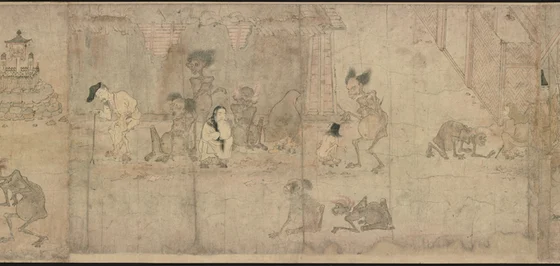
A sourced illustration has not yet been added. This gap is included in the coverage record.
Overview
Hearn’s 1903 essay begins with dried crabs sent to him from Chōshū. Their backs bear raised and hollow areas resembling distorted human faces. He relates these specimens to a legend about the Heiké, or Taira, warriors defeated at Dan-no-Ura: their spirits assumed crab shapes, and the faces on the shells were interpreted as preserving the fury or agony of the battle.
His account distinguishes two kinds sold around Akamagaséki, also called Shimonoséki. The smaller Heiké-gani are associated with ordinary samurai. Larger crabs called Taishō-gani, “Chieftain-crabs,” or Tatsugashira, “Dragon-helmet,” are associated with commanders and their elaborate helmets. These are distinctions in his reported naming and legend, not a modern taxonomic determination from the specimens.
Hearn asks a Japanese acquaintance to draw both kinds. Although he vouches for the crab drawings, he challenges the further sketch that interprets a shell pattern as a helmet. This disagreement matters: the bodily ridges are observed, while the warrior’s face and headgear are readings of their shape. The legend supplies a collective posthumous identity, not an individual biography for every crab, and does not describe a new battle fought by the crabs. Hearn’s opening cultural generalizations are not adopted as biological explanation.
Origins & earliest records
Japanese traditions and religious literature as mediated by Lafcadio Hearn
Records & interpretation
Complete named essay and all associated notes read in the retained edition.
Selected bibliography
Documented works and useful reading. This is not a list of every appearance.
- 01
Kottō: Being Japanese Curios, with Sundry Cobwebs
Heike-gani: complete essay and notes; Macmillan, New York and London.
Family & connections
A source-supported family tree or inspiration record has not yet been compiled for this profile. Related reading below indicates a connection in subject matter, not a proven lineage or creative influence.
Primary records and illustrations
Lafcadio Hearn, Kottō (1903)
Named essay. Heike-gani
Complete hearn-kotto-Heike-gani.txt read, including all subsections and notes. Full edition55473.html. Hearn-mediated names, claims and uncertainties explicitly scoped; no original-language scripture verification or art reuse claimed.
References
Sources supporting this profile. Linked pages have their own scope and editorial standards.
- Historical primary essay and reported traditionHearn, Kottō (1903), Heike-ganiResearch access: 2026-10-05
Image credits
A sourced illustration has not yet been added. This gap is included in the coverage record.