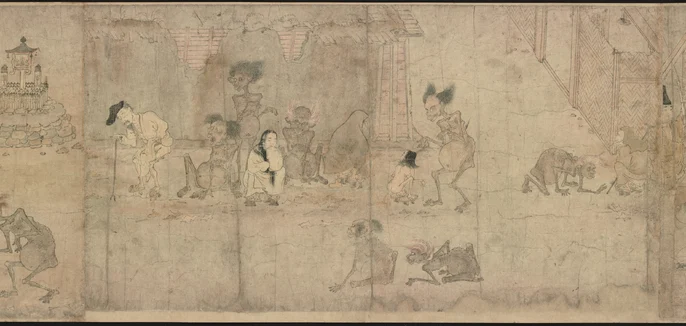
Emaciated hungry ghosts among human figures in a twelfth-century Japanese Hungry Ghosts Scroll
A supplied section of the twelfth-century Hungry Ghosts Scroll depicts lean, swollen-bellied spirits among human figures. This earlier Buddhist painting is an independent representation of gaki, distinct from Hearn’s 1903 exposition and its many source-specific categories. The painter is not identified.
Overview
Hearn’s “Gaki” identifies the Japanese term with Sanskrit preta and places these beings in a state of hungry spirits. His exposition distinguishes spirits confined to their own realm from those dwelling among human beings and sometimes seen. It also distinguishes those who obtain no nourishment, those restricted to impure substances and those able to consume discarded food or offerings. These are categories in the sources he summarizes, rather than a single fixed body shared by every gaki.
He cites the Shōbō-nen-jō-kyō for thirty-six principal classes while acknowledging innumerable further varieties. Examples include needle-mouthed and cauldron-bodied spirits, consumers of particular substances, and spirits whose suffering is relieved only while they hear Buddhist teaching. He connects different conditions with earlier actions, including misuse of religious offerings. This is a historical account of religious moral causation, not a judgment about people experiencing poverty, hunger or disease.
The essay gives Yoku-shiki-gaki a capacity for attractive human appearances, changing sex and size and entering very small openings. It also discusses insect forms, expressly stating that not every insect is a gaki. Hearn’s comparisons between particular descriptions and insect behaviour are partly his own interpretation. His examples of fevers once attributed to possessing spirits document older explanations rather than medical causes.
The essay moves between paraphrased religious material, an attributed tree-spirit tale and Hearn’s personal reflections about matter and rebirth. Those strands should not be flattened into a uniform statement of all Buddhist teaching. Hearn says his quoted descriptions are abridged; this profile records his 1903 mediation, not an independently checked translation of the complete scripture or the earliest attestation of hungry spirits.
Hearn revisits one category in Mosquitoes, in Kwaidan (1904). Watching insects breed in the water-vessels of a Buddhist cemetery beside his garden, he suggests that some might be dead people reborn as Jiki-ketsu-gaki, blood-drinking hungry spirits. He ends by imagining his own possible rebirth in a graveyard vessel and the opportunity to bite acquaintances. The framing shifts from his observations of ordinary mosquitoes to a reported religious possibility and finally a personal joke; it does not identify a particular dead person in an observed insect. His historical discussion of insect control and his tentative species identification are not evidence for supernatural anatomy or present-day practical guidance.
In the earlier essay “Incense,” published in In Ghostly Japan (1899), Hearn describes Jiki-kō-ki as incense-eating spirits who come unseen to consume the smoke. He identifies them as the fourteenth of thirty-six classes of gaki and attributes their hunger to having manufactured or sold bad incense for profit in a former life. This is a specific category in his religious exposition, distinct from the blood-drinking spirits he later imagines in mosquitoes. His account contrasts their invisible feeding with a different legend in which special incense makes a remembered human form visible; it does not give all gaki the power to appear in smoke.
Origins & earliest records
Japanese traditions and religious literature as mediated by Lafcadio Hearn
Records & interpretation
Complete named essay and all associated notes read in the retained edition.
Selected bibliography
Documented works and useful reading. This is not a list of every appearance.
- 01
Kottō: Being Japanese Curios, with Sundry Cobwebs
Gaki: complete essay and notes; Macmillan, New York and London.
- 02
Kwaidan: Stories and Studies of Strange Things
Insect Studies, Mosquitoes: whole essay and note read; PG1210 transcription, no scanned pagination assumed
- 03
In Ghostly Japan — Incense
Complete essayI–V and notes1–6; relevant narrative and hungry-spirit notice inV. Hosted transcriptionchapter3 lacks original pagination; NDL000006423509 confirmsBostonLittleBrown1899.
Family & connections
A source-supported family tree or inspiration record has not yet been compiled for this profile. Related reading below indicates a connection in subject matter, not a proven lineage or creative influence.
Primary records and illustrations
Lafcadio Hearn, Kottō (1903)
Named essay. Gaki
Complete hearn-kotto-Gaki.txt read, including all subsections and notes. Full edition55473.html. Hearn-mediated names, claims and uncertainties explicitly scoped; no original-language scripture verification or art reuse claimed. Additional complete Mosquitoes essay in Kwaidan1904 read with note: Jiki-ketsu-gaki cemetery-insect possibility distinguished from personal closing joke; retained kwaidan-mosquitoes.txt/1210.html. Source https://www.gutenberg.org/cache/epub/1210/pg1210-images.html#chap20 Additive complete-source comparison: Hearn1899 IncenseI–V/all6notes, hearn-ghostly-incense.txt30254characters. FinalJiki-ko-ki notice identifies14thof36classes, invisibleincense-feeding/badincensemakers; separatefromvisibleLadyLiincenseapparition. Existing5paragraphsandworksretained.
References
Sources supporting this profile. Linked pages have their own scope and editorial standards.
- Historical primary essay and reported traditionHearn, Kottō (1903), GakiResearch access: 2026-10-05
- Historical essay and reported beliefHearn, Kwaidan, MosquitoesResearch access: 2026-10-05
- Historical English essay and comparative narrativesHearn, In Ghostly Japan, Incense, complete essay and notesResearch access: 2026-10-05
Image credits
Historical manuscript illustrationEmaciated hungry ghosts among human figures in a twelfth-century Japanese Hungry Ghosts Scroll
A supplied section of the twelfth-century Hungry Ghosts Scroll depicts lean, swollen-bellied spirits among human figures. This earlier Buddhist painting is an independent representation of gaki, distinct from Hearn’s 1903 exposition and its many source-specific categories. The painter is not identified.