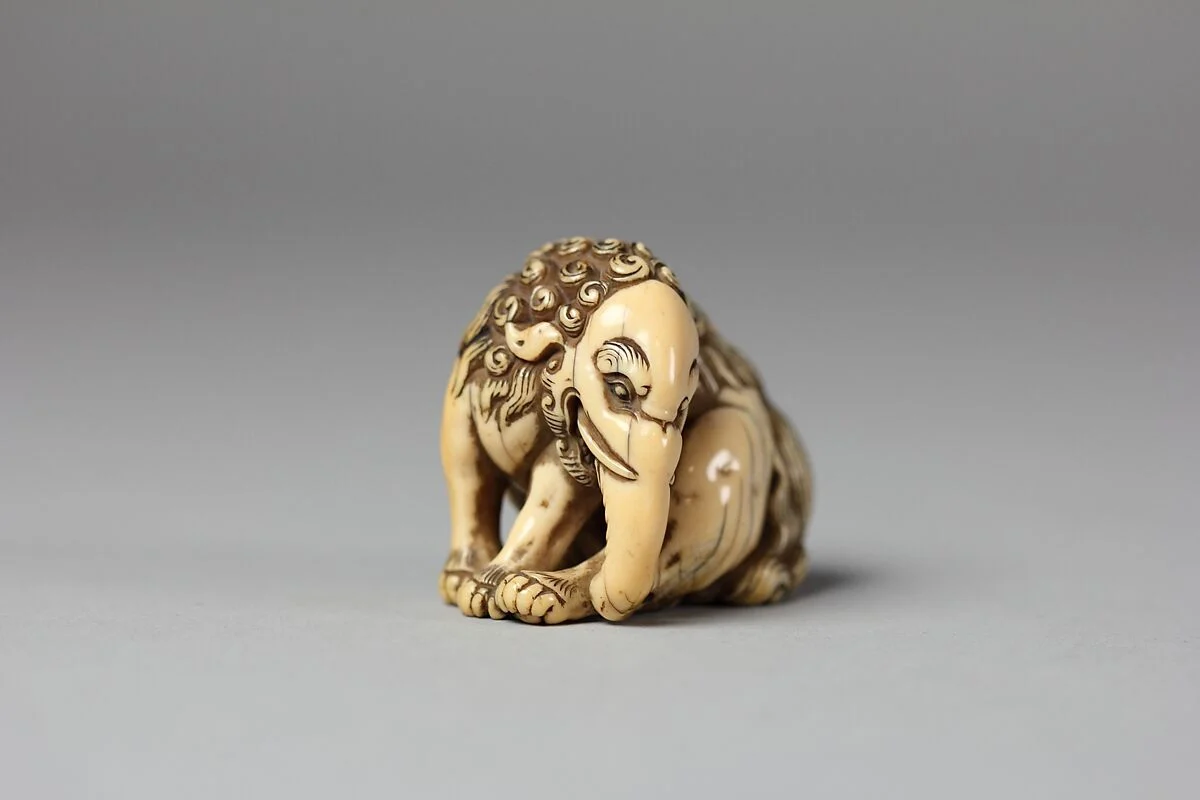
Seated Baku ivory netsuke with trunk, tusks and curled mane, Japan, nineteenth century
This nineteenth-century Japanese netsuke represents Baku with a trunk, tusks and curled mane. It is an independent artistic witness to the dream-eater tradition, rather than an illustration of Hearn’s literary encounter or a demonstration of every feature in the older book he quotes.
Overview
Hearn calls the creature Baku or Shirokinakatsukami and describes its function as eating dreams. An unnamed old book in his possession gives the male a horse’s body, lion’s face, elephant trunk and tusks, rhinoceros forelock, cow’s tail and tiger’s feet. The female is said to differ, but the difference is not explained. This elaborate composite is one cited description, not a universal anatomical standard.
He discusses protective pictures and name characters placed on lacquered pillows, together with an invocation asking the Baku to consume a bad dream. His old book also quotes a story associated with the Shōsei-Roku, involving Kōtei and a speaking beast, followed by a list of threatening portents. Hearn himself separates much of that Chinese demon material from the Japanese dream-eater discussion. He additionally uses the name Hakutaku without resolving its relationship to Baku; the profile preserves that ambiguity instead of treating the names as securely interchangeable.
The essay ends with Hearn’s literary first-person encounter. A Baku comes through his window and hears a nightmare in which his own corpse attacks him and is destroyed with an axe. Rather than eating it, the creature calls it fortunate: the axe signifies Buddhist teaching destroying the self. It then leaves by soundless leaps across moonlit roofs, compared to a great cat. This ending is Hearn’s imaginative philosophical treatment, distinguishable from the customs he reports earlier. It is not a recorded eyewitness observation or proof that the Baku invariably refuses frightening dreams.
Origins & earliest records
Japanese traditions and religious literature as mediated by Lafcadio Hearn
Records & interpretation
Complete named essay and all associated notes read in the retained edition.
Selected bibliography
Documented works and useful reading. This is not a list of every appearance.
- 01
Kottō: Being Japanese Curios, with Sundry Cobwebs
The Eater of Dreams: complete essay and notes; Macmillan, New York and London.
Family & connections
A source-supported family tree or inspiration record has not yet been compiled for this profile. Related reading below indicates a connection in subject matter, not a proven lineage or creative influence.
Primary records and illustrations
Lafcadio Hearn, Kottō (1903)
Named essay. The Eater of Dreams
Complete hearn-kotto-The_Eater_of_Dreams.txt read, including all subsections and notes. Full edition55473.html. Hearn-mediated names, claims and uncertainties explicitly scoped; no original-language scripture verification or art reuse claimed.
References
Sources supporting this profile. Linked pages have their own scope and editorial standards.
- Historical primary essay and reported traditionHearn, Kottō (1903), The Eater of DreamsResearch access: 2026-10-05
Image credits
Historical sculpture photographSeated Baku ivory netsuke with trunk, tusks and curled mane, Japan, nineteenth century
This nineteenth-century Japanese netsuke represents Baku with a trunk, tusks and curled mane. It is an independent artistic witness to the dream-eater tradition, rather than an illustration of Hearn’s literary encounter or a demonstration of every feature in the older book he quotes.