Hedley Kow, Batten’s fantastic shape-changing creature
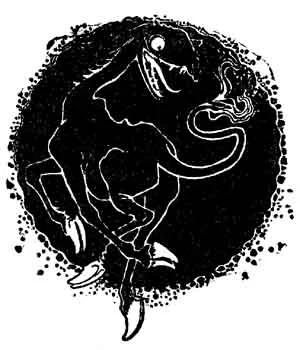
Actual circular title-page vignette explicitly captioned Hedley Kow; black horned form with long curling appendages is this artists interpretation, not the episodes universal anatomy.
Overview
A poor woman finds a black roadside pot and discovers it apparently filled with gold. She ties her shawl to the pot and drags it home while imagining how the fortune will improve her life. At successive pauses her burden becomes a lump of silver, then iron, then a large stone. Instead of despairing, she explains each transformation as a practical improvement: fewer worries about theft, something easy to sell, or just the object she needed to prop open her door.
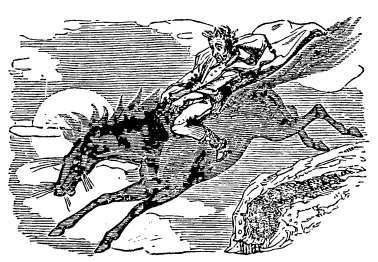
At her gate the stone suddenly squeals and grows to the size of a great horse, with four lanky legs, long ears and a flourishing tail. It kicks away laughing like a mocking child. The woman remains delighted that she has encountered the Hedley Kow personally. Jacobs’s source note attributes the story to Balfour’s Northumberland informant and records separate reported appearances as a donkey and a wisp of straw. A cited Henderson episode likewise makes a bundle of straw become unbearably heavy and then move away laughing. These are variable appearances of a local trickster, rather than a fixed species description. The spelling Kow should not be silently interpreted as an ordinary cow.
Origins & earliest records
Jacobs prints a story supplied through Balfour by a South Northumberland woman who attributed it to her mother’s acquaintance. His note also points to Henderson’s earlier local notice. These layers establish collection and circulation, while leaving the dates of alleged encounters and the tradition’s oral beginnings unresolved.
Records & interpretation
The transforming pot and moving straw are reported narrative manifestations. Jacobs provides an informant chain and an earlier printed comparison, but no animal specimen. The complete literary episode is stronger evidence for the trickster’s narrative character than for any single permanent body.
In the literature
“laughing like a naughty mocking boy”
The Hedley Kow; The stone-shaped treasure changes at the woman's gate
Its final prank leaves the woman pleased rather than frightened.
Selected bibliography
Documented works and useful reading. This is not a list of every appearance.
- 01
More English Fairy Tales
Complete “The Hedley Kow” and its source note inspected. Preface acknowledges rewritten and combined sources.
- 02
More English Fairy Tales — The Hedley Kow
Joseph Jacobs, More English Fairy Tales; first publication1894, selected Gutenberg14241 witness explicitly Fourteenth Impression, undated. Jacobs’s preface acknowledges rewriting, combined sources and altered incidents. Exact heading/anchor used; no invented print pagination.
Family & connections
A source-supported family tree or inspiration record has not yet been compiled for this profile. Related reading below indicates a connection in subject matter, not a proven lineage or creative influence.
Located primary passages
Specific passages supporting details in this entry, grouped by their published witness.
More English Fairy Tales — The Hedley Kow
Joseph Jacobs, More English Fairy Tales; first publication1894, selected Gutenberg14241 witness explicitly Fourteenth Impression, undated. Jacobs’s preface acknowledges rewriting, combined sources and altered incidents. Exact heading/anchor used; no invented print pagination.
- An errand-running old woman finds a pot of gold and drags it home. It changes to silver, iron and a stone; she welcomes each change as useful. At her gate it leaps into a large horse-like, long-eared creature and departs laughing. She identifies the Hedley Kow and remains delighted.
The Hedley Kow; Changing roadside treasure and final revelation
Complete selected tale and its source note read. Jacobs’s edited narrative is distinct from direct oral transcription. No song or ritual-formula excerpts; no invented print page or earliest date.
Primary source witness
Joseph Jacobs, More English Fairy Tales; first publication1894, selected Gutenberg14241 witness explicitly Fourteenth Impression, undated. Jacobs’s preface acknowledges rewriting, combined sources and altered incidents. Exact heading/anchor used; no invented print pagination.
- Jacobs attributes the telling to Mrs. M. of South Northumberland through Mrs. Balfour. Her mother reportedly knew the person involved and claimed to have seen the Kow as a donkey and a wisp of straw. These sightings remain reported claims, not the narrator's verified observation.
Notes and References, LIII The Hedley Kow; Named transmission and reported sightings
This verifies what Jacobs reports and changes; listed earlier works and informant claims are not independently verified by this note alone.
References
Sources supporting this profile. Linked pages have their own scope and editorial standards.
- Primary textJacobs, More English Fairy Tales: The Hedley Kow and editorial noteResearch access: 2026-10-05
- ReferenceUniversity of Pennsylvania Online Books Page: Joseph Jacobs bibliographic listResearch access: 2026-10-05
Image credits
Historical illustrationHedley Kow, Batten’s fantastic shape-changing creature
Actual circular title-page vignette explicitly captioned Hedley Kow; black horned form with long curling appendages is this artists interpretation, not the episodes universal anatomy.