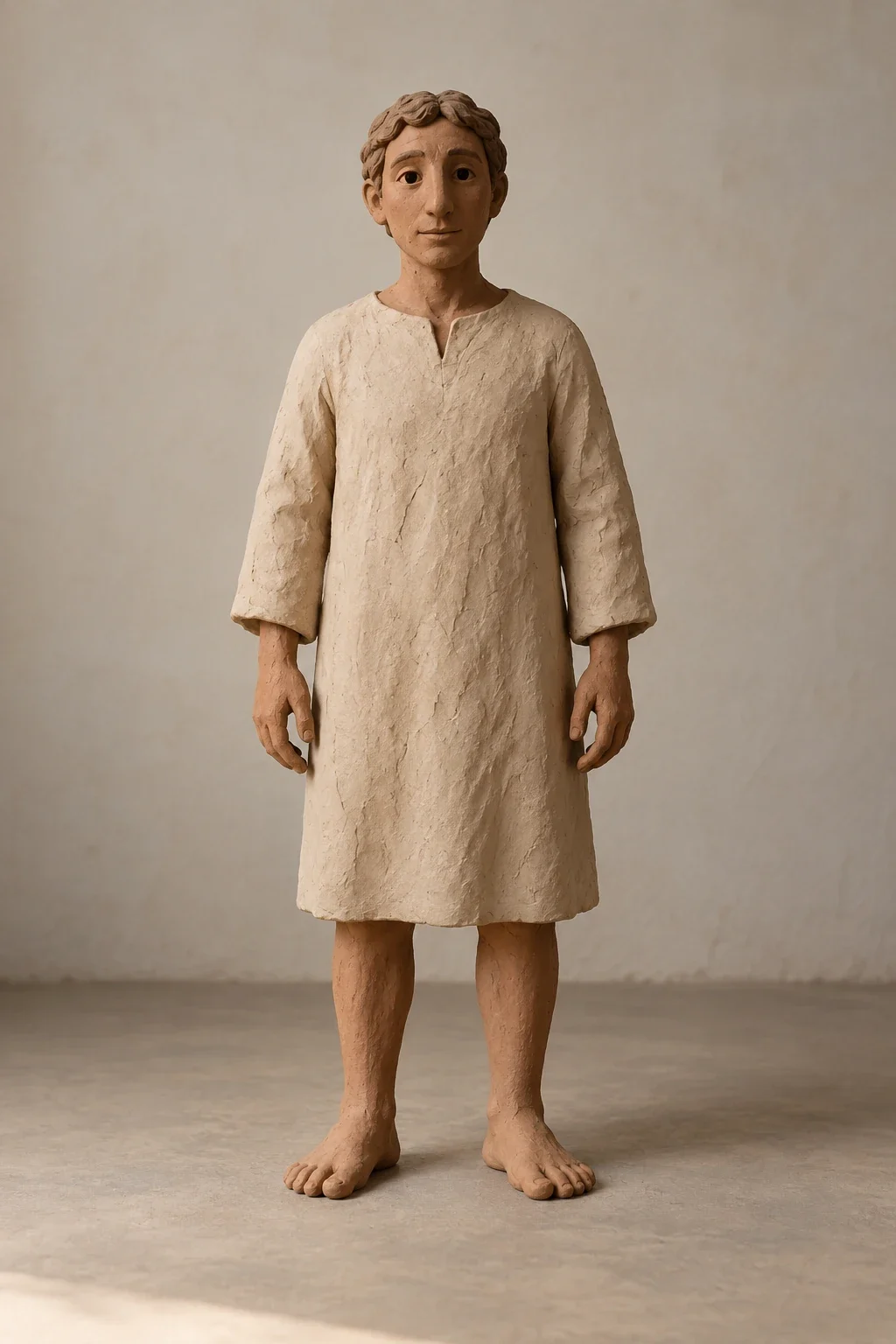
AI-generated modern interpretation of the collected artificial-figure theme. Face, tunic, proportions, colour, room and lighting are imagined; this is not an authenticated depiction of a particular historical person or sacred image.
No sacred lettering, game anatomy or claimed ethnographic portrait. Historical source metadata does not authenticate this illustration.
Overview
The Jewish Encyclopedia’s medieval-legend section brings together reports of human-shaped figures made from clay or wood and activated through a written divine name. Its opening description emphasizes growth and mechanical obedience, but the following stories do not give every figure one identical career. A maidservant attributed to Solomon ibn Gabirol is returned to her constituent materials when her maker must demonstrate that she is artificial. These are reports preserved by a historical reference work, not verified instances of creating human life or a uniform statement of Jewish belief.
The account assigned to Elijah of Chelm concerns a figure that grows until its maker fears the consequences of its power. Removing the written name causes it to become dust. The article cites Azulai for this report and connects it with a later question about whether such a being could count toward a prayer quorum. That question adds a religious and communal dimension beyond bodily strength, but the encyclopedia’s summary does not supply a general ruling on every artificial being. Its claim about Chelm’s priority remains the survey’s historical assertion, not independently established first evidence.
The Prague story attributed to Judah Löw instead follows a weekday servant. Its maker normally removes the activating name before Sabbath so that it will rest. On one occasion he forgets, pursues the figure and removes the name outside the synagogue just before Sabbath begins. The servant breaks apart, and its remains are said to survive in the synagogue attic. The article places this report beside later printed references and a nineteenth-century poem. It does not make that collected legend an early Talmudic account or prove that the reported events occurred.
A contrasting story concerns Davidl Jaffe of Dorhiczyn, assigned approximately to 1800. This servant is intended to heat ovens on Sabbath after receiving its instructions on Friday. A small error in an order reportedly leads to a town-wide fire. Its assigned task differs directly from the Prague figure’s required rest. Keeping those outcomes separate preserves the historical collection’s variety: a command-following servant, a feared growing figure and a subject of religious discussion cannot be compressed into one universal species with a fixed anatomy or purpose.
Origins & earliest records
Selected medieval-legend section of GOLEM in The Jewish Encyclopedia, signed J. J. and D. E., identifying Joseph Jacobs and Judah David Eisenstein. Volume VI, 1904, pp. 36–37 are recorded as website/edition metadata; the original scan was not independently verified.
Records & interpretation
The complete successful online article and its entire medieval section, bibliography and signatures were read. The selected section distinguishes Chelm, Prague and Jaffe and names its historical references. Those underlying books, responsa and poems were not separately read. The authors’ suggested Vergil connection is not treated as proven derivation.
Selected bibliography
Documented works and useful reading. This is not a list of every appearance.
- 01
The Jewish Encyclopedia, GOLEM: In Medieval Times and Golem of Hohe Rabbi Löw
Website/edition metadata gives pp. 36–37. Full article header also credits the Executive Committee and Ludwig Blau for other material. Older narrative citations are mediated through the encyclopedia, not independently collated.
Family, evolution & connections
Golem (Dragon Quest)
The Jewish Encyclopedia collects distinct accounts of artificial human figures attributed to different makers, including differing commands and Sabbath roles. The shared Golem name permits comparison with a separately catalogued fictional subject. These historical reports do not establish one universal body or a particular game creator’s source.
Golem (Dragon Age)
The Jewish Encyclopedia collects distinct accounts of artificial human figures attributed to different makers, including differing commands and Sabbath roles. The shared Golem name permits comparison with a separately catalogued fictional subject. These historical reports do not establish one universal body or a particular game creator’s source.
Iron Golem (Minecraft)
The Jewish Encyclopedia collects distinct accounts of artificial human figures attributed to different makers, including differing commands and Sabbath roles. The shared Golem name permits comparison with a separately catalogued fictional subject. These historical reports do not establish one universal body or a particular game creator’s source.
Copper Golem (Minecraft)
The Jewish Encyclopedia collects distinct accounts of artificial human figures attributed to different makers, including differing commands and Sabbath roles. The shared Golem name permits comparison with a separately catalogued fictional subject. These historical reports do not establish one universal body or a particular game creator’s source.
References
Sources supporting this profile. Linked pages have their own scope and editorial standards.
- Historical reference work collecting attributed narrativesJewish Encyclopedia: complete GOLEM article and attributed medieval accountsResearch access: 2026-10-24
Image credits
Modern interpretation of artificial human figures in the historical collectionAI-generated modern interpretation of the collected artificial-figure theme. Face, tunic, proportions, colour, room and lighting are imagined; this is not an authenticated depiction of a particular historical person or sacred image.
No sacred lettering, game anatomy or claimed ethnographic portrait. Historical source metadata does not authenticate this illustration.