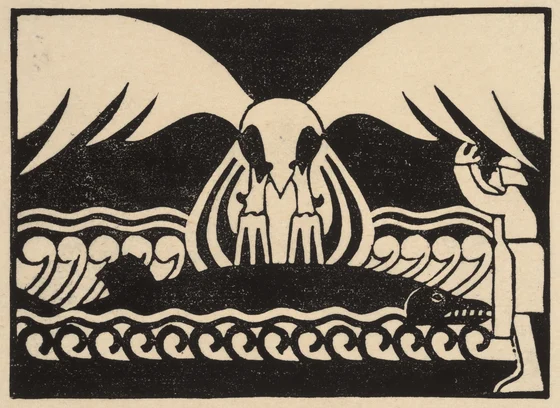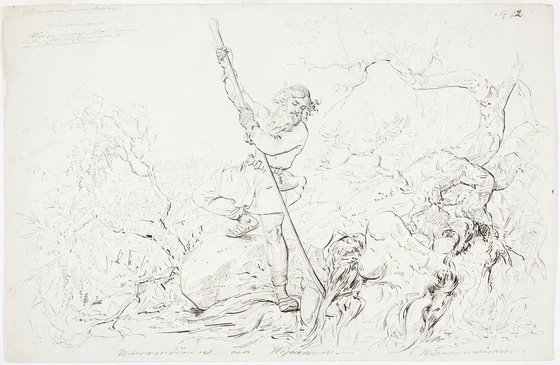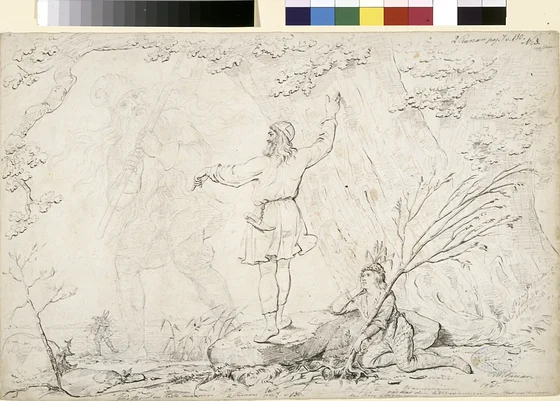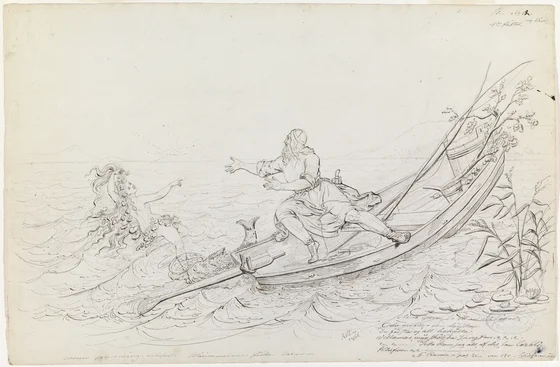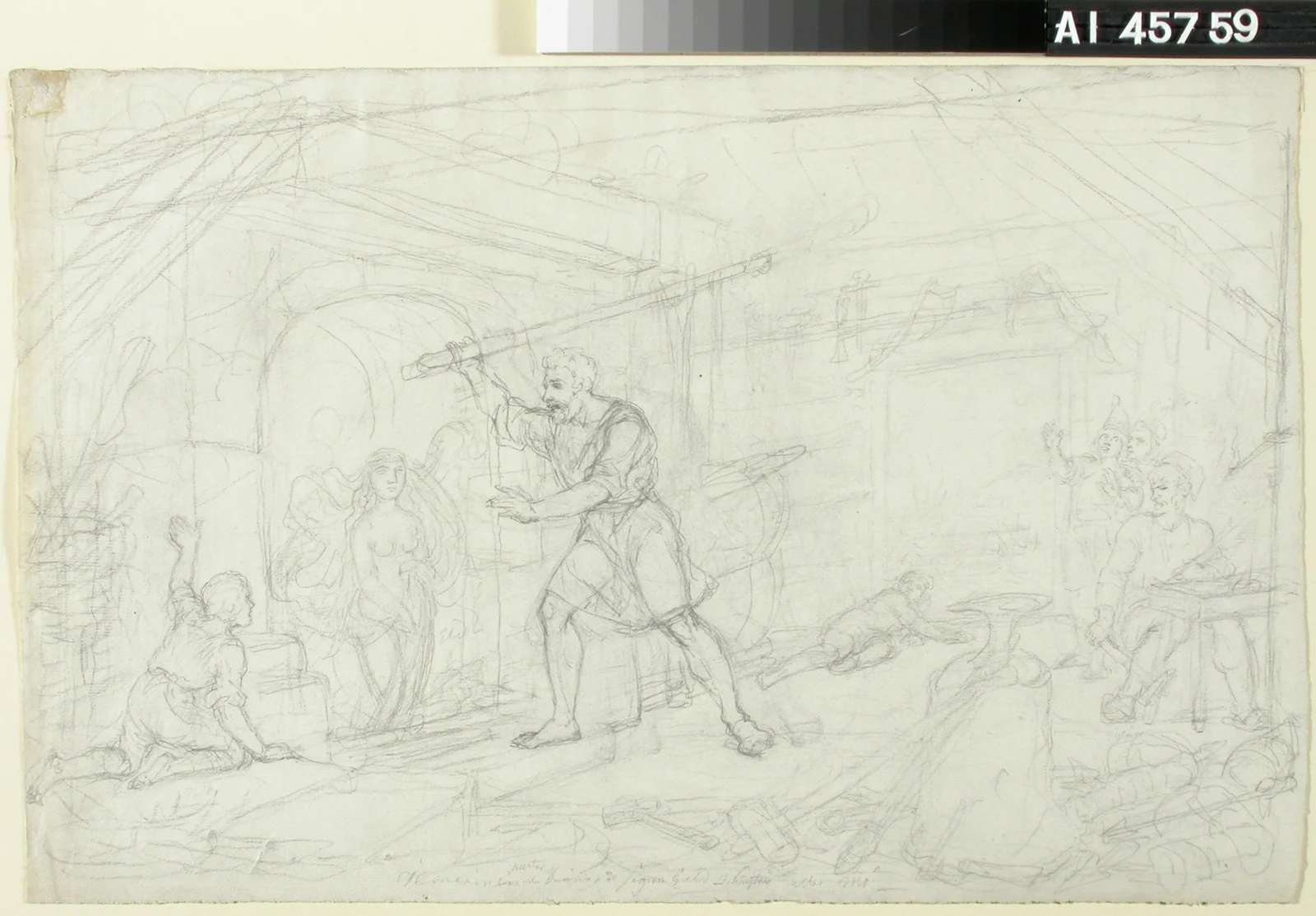
Ilmarinen forging the inert golden maiden, Robert Wilhelm Ekman sketch (1859)
Actual pencil-sketch pixels inspected: Ilmarinen raises a hammer beside a maiden-shaped figure and the forge; other workshop figures at sides. Precise museum title Kultaneidon taonta identifies forging the golden maiden. Standing sculptural posture is artistic composition; no claim that the metal image walks, speaks or functions as a living automaton. Individual multimedia licence CC0. Returned signed-original URL and stable source/download API retained.
Overview
After losing his wife, Ilmarinen attempts to forge a companion from gold and silver in Crawford’s Rune XXXVII. A metallic lamb and then a colt emerge from the furnace, but he rejects both and returns them to the fire. The third creation is a beautiful golden-haired, silver-headed maiden. He fashions feet, arms, ears, mouth and eyes, yet none performs its living function: she cannot walk, embrace, hear, speak or see.
He washes the image and shares his bed with it beneath skins and blankets, but the side touching the metal becomes icy. Hoping Väinämöinen will accept it, he takes it to him; Väinämöinen refuses and advises remelting it into ornaments. His closing warning opposes choosing a metal image as a bride. The episode is a failed creation of life, not an autonomous robot or a woman secretly transformed into metal. The recommended remelting is not subsequently narrated as an accomplished act.
Origins & earliest records
Elias Lönnrot’s compiled New Kalevala (1849), selected John Martin Crawford English translation (1888). Crawford preface dated October 1887, not the imprint year.
Records & interpretation
Complete selected rune read. Compiled epic and translator language distinguished from unmodified oral archival performance.
Selected bibliography
Documented works and useful reading. This is not a list of every appearance.
- 01
Kalevala, Rune XXXVII
Exact observed chapter anchor and complete rune; no separately identified archival singer.
Family & connections
A source-supported family tree or inspiration record has not yet been compiled for this profile. Related reading below indicates a connection in subject matter, not a proven lineage or creative influence.
References
Sources supporting this profile. Linked pages have their own scope and editorial standards.
- Primary translated compiled epicKalevala, Rune XXXVII (Crawford, 1888)Research access: 2026-10-05
Image credits
Historical illustrationIlmarinen forging the inert golden maiden, Robert Wilhelm Ekman sketch (1859)
Actual pencil-sketch pixels inspected: Ilmarinen raises a hammer beside a maiden-shaped figure and the forge; other workshop figures at sides. Precise museum title Kultaneidon taonta identifies forging the golden maiden. Standing sculptural posture is artistic composition; no claim that the metal image walks, speaks or functions as a living automaton. Individual multimedia licence CC0. Returned signed-original URL and stable source/download API retained.