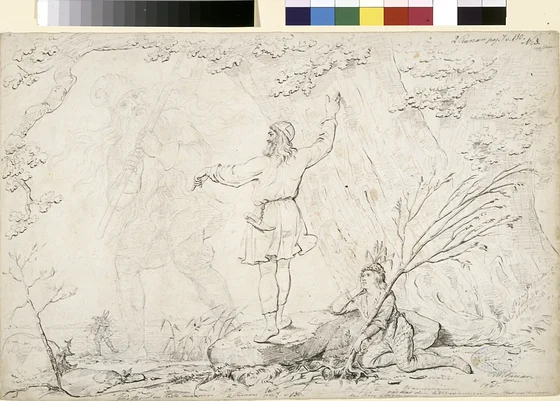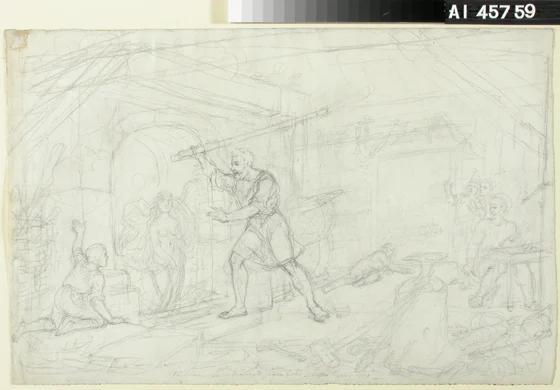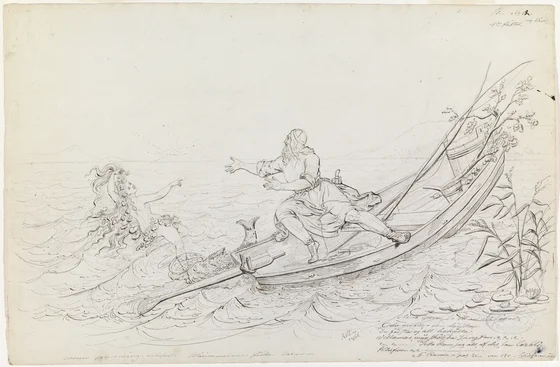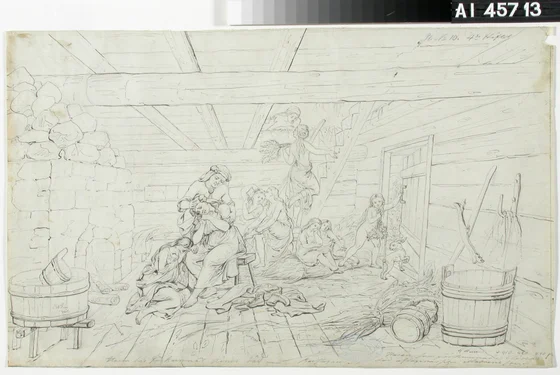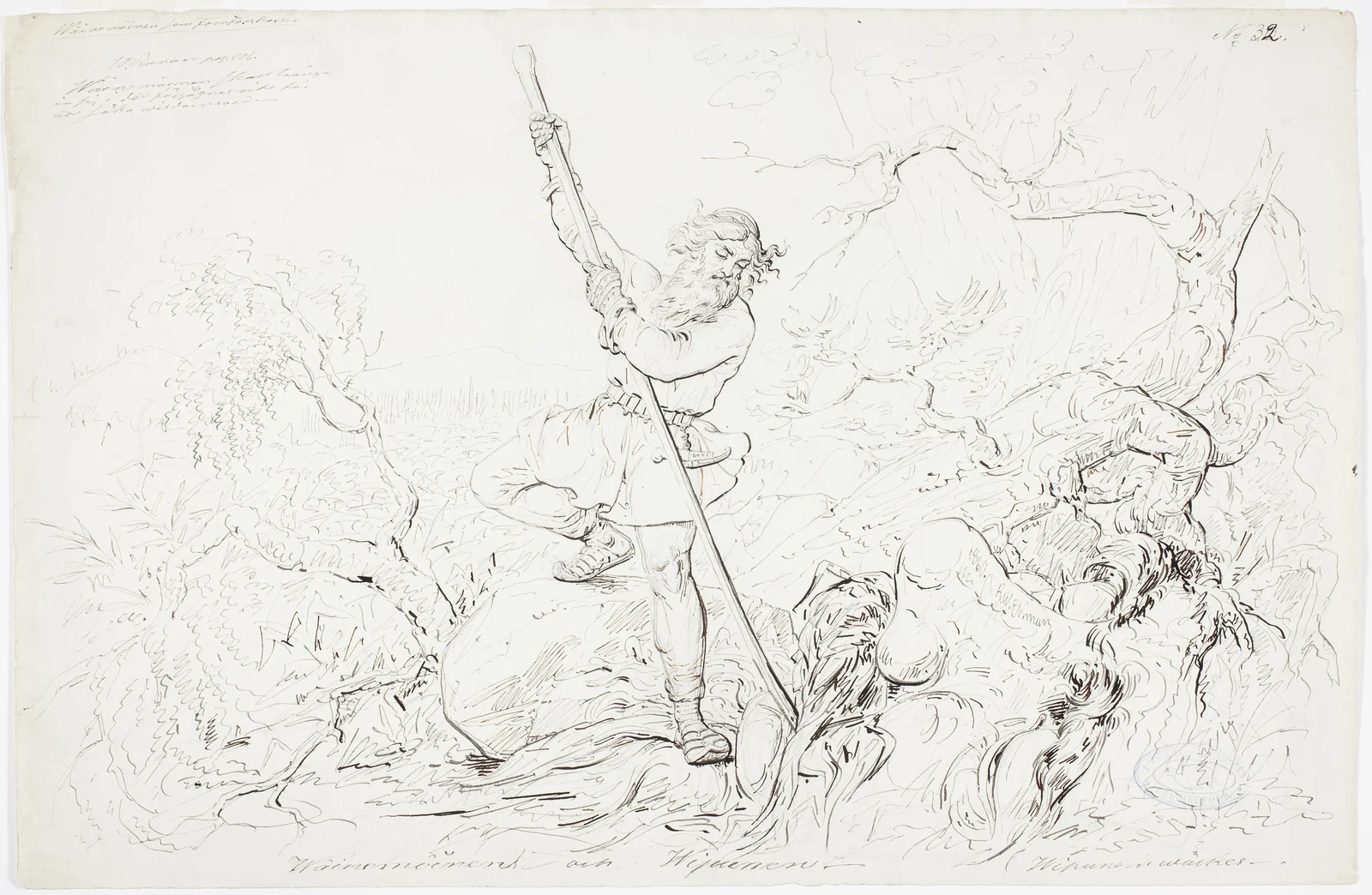
Antero Vipunen beneath Väinämöinen, Robert Wilhelm Ekman (1860)
Actual full pencil drawing inspected: giant bearded head lies at lower right amid trees; Väinämöinen braces an iron staff near its mouth. Exact museum title Väinämöinen and Vipunen and RuneXVII source agree. Other background heads are illustration detail, not additional beings assigned to the profile. Individual multimedia licence CC0. Returned signed-original URL and stable source/download API retained.
Overview
In Crawford’s Rune XVII, the ancient Wipunen or Antero Vipunen lies so long that trees grow from his body: aspen on shoulder, birch at temples, alder at chin, willows in beard, fir from mouth and oak from forehead. Ilmarinen says that he died long ago, but Väinämöinen seeks the missing words needed to complete a boat. He crosses needles, sword edges and axe edges in metal shoes, cuts away the trees and forces the mouth open with an iron staff.
The awakened giant bites through iron but not the staff’s steel. Väinämöinen stumbles inside and is swallowed with his armor. A magically made boat lets him explore the interior without provoking much response; a furnace constructed from his clothing and limbs instead causes intolerable pain, smoke from nostrils and fire from mouth. Vipunen tries to expel the occupant through lengthy incantations, treating him as an affliction of uncertain origin.
Väinämöinen refuses to leave until he receives the ancient knowledge. Vipunen then sings creation, magic and cosmic origins for days: heavenly bodies listen, rivers cease flowing and waterfalls pause. Having obtained the required words, Väinämöinen asks him to open his mouth and leaves with his blessing. Vipunen is compelled to teach rather than killed in the encounter. Crawford’s English religious and demon terminology is the translation’s wording, not a direct transcript of one archival singer.
Origins & earliest records
Elias Lönnrot’s compiled New Kalevala (1849), selected John Martin Crawford English translation (1888). Crawford preface dated October 1887, not the imprint year.
Records & interpretation
Complete selected rune read. Compiled epic and translator language distinguished from unmodified oral archival performance.
Selected bibliography
Documented works and useful reading. This is not a list of every appearance.
- 01
Kalevala, Rune XVII
Exact observed chapter anchor and complete rune; no separately identified archival singer.
Family & connections
A source-supported family tree or inspiration record has not yet been compiled for this profile. Related reading below indicates a connection in subject matter, not a proven lineage or creative influence.
References
Sources supporting this profile. Linked pages have their own scope and editorial standards.
- Primary translated compiled epicKalevala, Rune XVII (Crawford, 1888)Research access: 2026-10-05
Image credits
Historical illustrationAntero Vipunen beneath Väinämöinen, Robert Wilhelm Ekman (1860)
Actual full pencil drawing inspected: giant bearded head lies at lower right amid trees; Väinämöinen braces an iron staff near its mouth. Exact museum title Väinämöinen and Vipunen and RuneXVII source agree. Other background heads are illustration detail, not additional beings assigned to the profile. Individual multimedia licence CC0. Returned signed-original URL and stable source/download API retained.