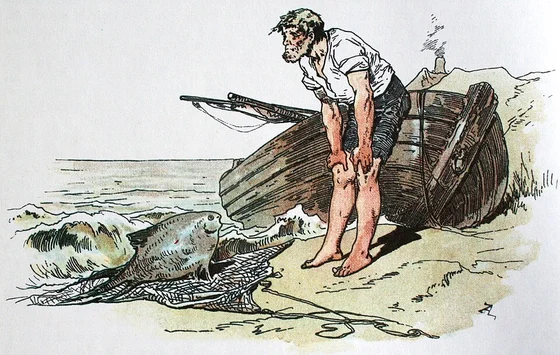
Golden fish addresses the fisherman, Otto Ubbelohde,1909
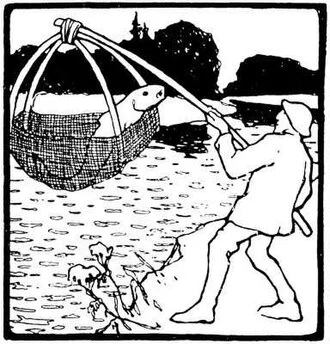
Actual fish in the water beside the fisherman and basket; exact Gold-Children tale, distinct from the later human sons scene.
Overview
A fisherman catches a fish made entirely of gold. In exchange for release, it offers a splendid castle and a cupboard supplying abundant meals, but insists that he reveal the source to nobody. Pressure from his wife leads him to disclose it, and the household returns to poverty. A second catch, release and broken promise repeat the rise and loss.
At the third capture the fish recognises that it keeps returning to the same hands and changes its offer. Its divided body is assigned to the wife, horse and earth, producing two golden children, two golden foals and two golden lilies. The lilies later reflect the sons' fortunes: one droops when a witch petrifies him and revives when he is rescued. The fish's fate differs sharply from the returning enchanted flounder in another Grimm tale.
Origins & earliest records
The entirely golden fish appears in Grimm's tale85, Die Goldkinder, selected through Margaret Hunt's1884 translation. The story gives a traceable literary account of repeated secrecy bargains and a final divided-body blessing. It is distinct from tale19's enchanted flounder and should not be dated as the beginning of all wish-granting fish stories or classified as a natural goldfish.
Records & interpretation
Speech, a fully golden body, disappearing riches and the final paired children, foals and lilies are directly recorded in the primary narrative. Those offspring and plants connect the fish's gift to later episodes without supplying a named species or ancestry. This is wonder-tale evidence; it is not biological evidence of metallic bodies, reproductive transformation or plants monitoring human health.
In the literature
“cut me into six pieces”
Tale 85, The Gold-Children; The fish’s instructions on its third capture · Margaret Hunt
The third encounter changes the earlier castle bargain into a paired birth and plant sequence.
Selected bibliography
Documented works and useful reading. This is not a list of every appearance.
- 01
Household Tales, tale 85: The Gold-Children
Specific numbered primary tale inspected. English translation terms and literary transmission remain distinct from oral origin.
- 02
Household Tales — The Gold-Children
Margaret Hunt historical English translation (1884); Project Gutenberg5314. Exact numbered tale and observed HTML anchor used; no inferred printed page or earliest oral date.
Family & connections
A source-supported family tree or inspiration record has not yet been compiled for this profile. Related reading below indicates a connection in subject matter, not a proven lineage or creative influence.
Located primary passages
Specific passages supporting details in this entry, grouped by their published witness.
Household Tales, tale 85: The Gold-Children
Margaret Hunt historical English translation (1884); Project Gutenberg5314. Exact numbered tale and observed HTML anchor used; no inferred printed page or earliest oral date.
- A speaking golden fish promises a castle and endlessly supplied food cupboard in return for release and secrecy. Twice the fisherman discloses the source to his questioning wife, and each disclosure removes the wealth.
Tale 85, The Gold-Children; Repeated release bargain and broken secrecy
- On its third capture the fish directs the fisherman to cut it into six pieces: two for his wife, two for his horse and two buried. These produce two golden children, two golden foals and two golden lilies; the children explain that the lilies will show their health.
Tale 85, The Gold-Children; Third capture and six-part blessing
Complete golden-fish capture/bargain/birth sequence read; later gold-children adventures are outside this enrichment. Original narrative curse causes and modern species identities are not inferred; prose only, no song or ritual-formula excerpts.
References
Sources supporting this profile. Linked pages have their own scope and editorial standards.
- Primary textHunt's Household Tales — 85 The Gold-ChildrenResearch access: 2026-10-05
Image credits
Historical illustrationGolden fish addresses the fisherman, Otto Ubbelohde,1909
Actual fish in the water beside the fisherman and basket; exact Gold-Children tale, distinct from the later human sons scene.