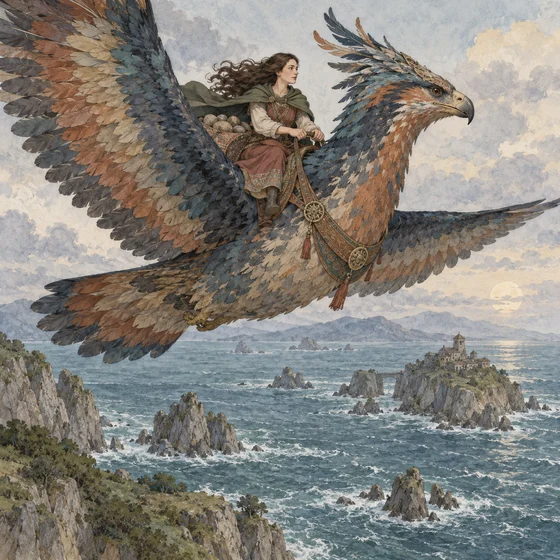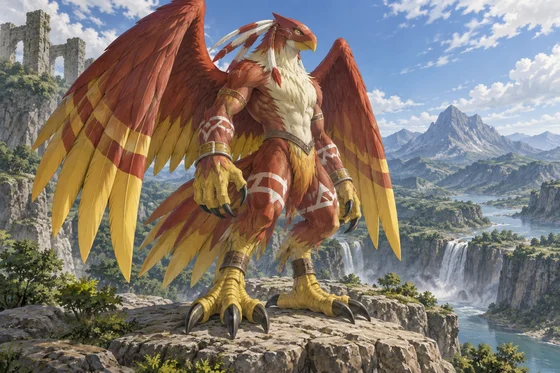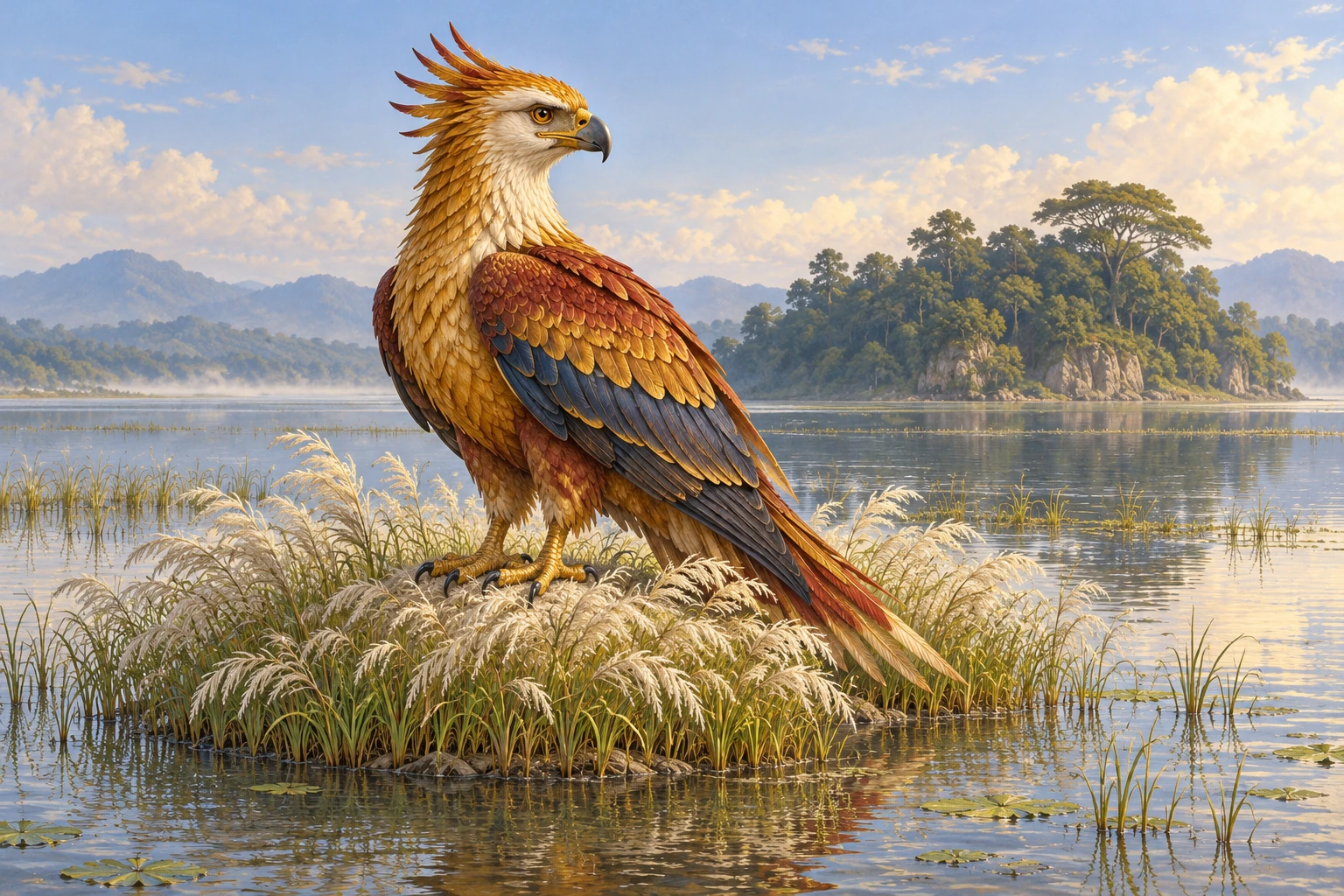
AI-generated interpretation of the bird king’s resting place in Kākāti-Jātaka 327. The text supplies plumage, wings and a bed of eraka grass in a lake. Face, crest, feather colours, size, proportions, grass species, pose and scenery are imagined; no fixed religious iconography or Final Fantasy design is claimed.
The selected text is a brief transmitted narrative, not the fuller Kunāḷa account to which its editor refers.
Overview
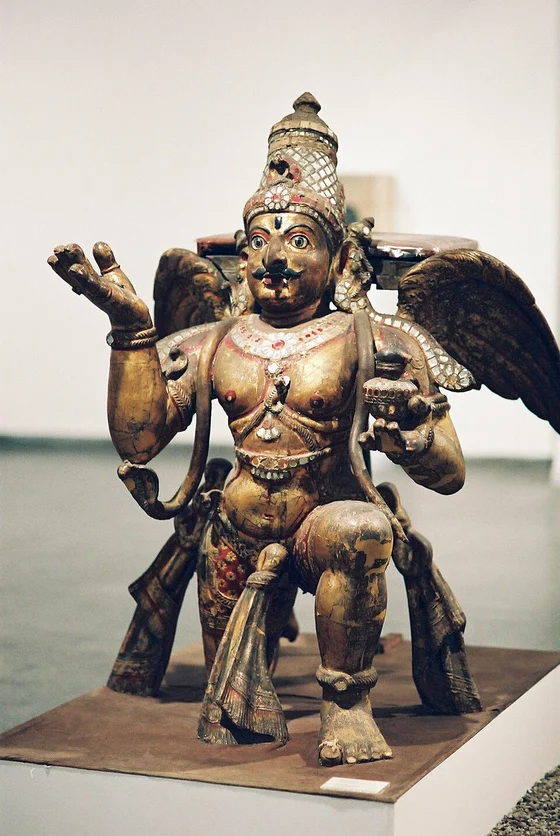
In the Kākāti-Jātaka’s brief past-life narrative, a Garuḍa king visits the ruler of Benares disguised as a man and plays dice with him. The visitor falls in love with Kākāti, the king’s chief queen, and carries her away to the dwelling place of the Garuḍas. The text explicitly identifies a particular bird king, rather than presenting every Garuḍa as the same individual. It gives him both a human disguise for his visits and plumage and wings for travel. The story does not specify his colour, exact size or a fixed mixture of human and avian anatomy.
The king of Benares sends his musician Naṭakuvera to find the missing queen. Naṭakuvera discovers the Garuḍa resting on eraka grass in a lake. As the bird prepares to leave, the musician conceals himself among his feathers and is carried to the Garuḍas’ home. There he becomes Kākāti’s lover. He then rides back on the bird’s wing. The island’s remoteness therefore fails to prevent another relationship: the bird king himself unknowingly provides the route by which the musician reaches the queen and returns to Benares.
At the next dice game, Naṭakuvera brings his lute and sings of Kākāti. Four stanzas turn the performance into a dialogue. The Garuḍa asks how the musician crossed the waters to the island and its Simbal grove; Naṭakuvera answers that the bird carried him. The Garuḍa recognises his mistake, returns Kākāti to the king and makes no further visits. The surrounding Jātaka frame addresses a monk troubled by desire, and the final identification makes that monk Naṭakuvera in the former birth and the Buddha the king of Benares. The edition calls this narrative a brief summary, referring readers to the Kunāḷa Birth for a fuller form. Its footnote also compares the Tibetan Suśroṇī tale; that editorial relationship does not erase the different characters, journeys and endings of the selected witnesses.
Origins & earliest records
Kākāti-Jātaka, No. 327, in the Cowell-edited Jātaka, Volume III, pp. 60–62.
Records & interpretation
Complete transmitted No. 327 read, including frame, past-life summary, four stanzas, ending, identification and all four footnotes. The fuller Kunāḷa Birth is referenced, not newly read.
Selected bibliography
Documented works and useful reading. This is not a list of every appearance.
- 01
The Jātaka, or Stories of the Buddha’s Former Births, Volume III
No. 327, Kākāti-Jātaka, pp. 60–62. Preface assigns pp. 1–150 to Francis. Hosted later Pali Text Society/Luzac reprint retains the historical translation; exact reprint year not verified.
Family, evolution & connections
Garuda (Final Fantasy)
The shared Garuda name permits comparison with the particular bird king in Kākāti-Jātaka 327. This tale concerns human disguise, island transport and deception exposed by a musician’s song. It does not establish shared fictional identity or a documented developer source.
Suparṇa, bird king of the Suśroṇī tale
The historical editor of Kākāti-Jātaka 327 explicitly compares the Tibetan Suśroṇī tale. The Benares dice visits, musician’s feather-concealed journey and sung exposure form a related but distinct narrative, not a shared individual biography.
Garuda
Kākāti-Jātaka 327 names a particular Garuḍa king with a human disguise, wings and plumage. This source-specific bird king is placed beside the broader Garuda entry without identifying him with every other bearer of that name.
Garudamon
This Garuḍa king provides one historical narrative context for comparison with the fictional name Garudamon. The Jātaka gives him a human disguise, dice-playing visits, a remote dwelling and an unwitting passenger; it ends with his returning Kākāti to Benares. The comparison carries no claim that the Digimon shares these actions, relationships, religious identity or abilities, and no claim of documented creator consultation.
References
Sources supporting this profile. Linked pages have their own scope and editorial standards.
- Historical primary narrative translationKākāti-Jātaka, No. 327 — complete historical English textResearch access: 2026-10-25
Image credits
Modern interpretation of a historical narrativeAI-generated interpretation of the bird king’s resting place in Kākāti-Jātaka 327. The text supplies plumage, wings and a bed of eraka grass in a lake. Face, crest, feather colours, size, proportions, grass species, pose and scenery are imagined; no fixed religious iconography or Final Fantasy design is claimed.
The selected text is a brief transmitted narrative, not the fuller Kunāḷa account to which its editor refers.