A sourced illustration has not yet been added. This gap is included in the coverage record.
Overview
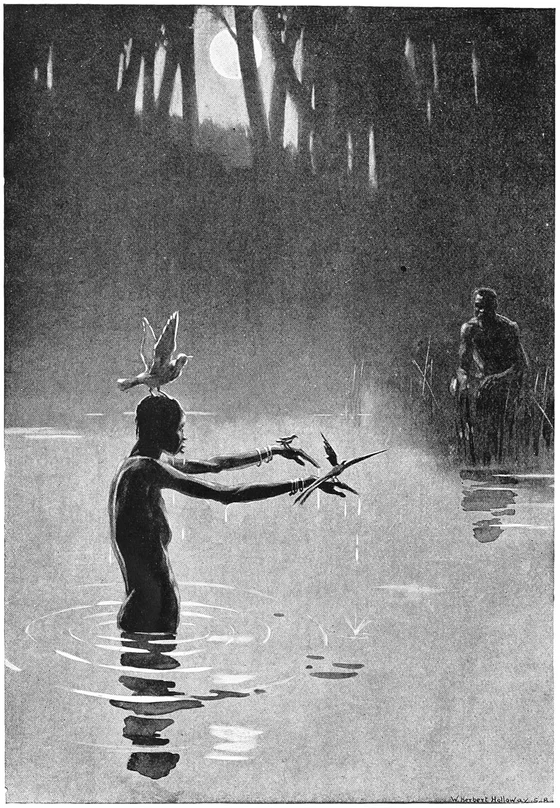
Tombi-ende’s jealous sisters bury her in an ochre pit. An enormous frog hears her surviving voice and asks what happened, then swallows her safely and leaps out of the pit. It travels at night, tells birds that it carries the princess and releases her during daytime rests. Croaking produces ready-cooked porridge for her. They head toward her grandmother rather than the dangerous home. At arrival the frog asks for clean mats and releases Tombi-ende into the rejoicing household.
After a feast in its honour it disappears. The princess’s brother later escorts her home through drought, and a huge stranger demands her in return for conjuring water. Once they drink, he reveals an ogre body. The frog emerges from the new fountain, swallows the whole ogre and stays underwater until its enemy drowns. It returns while the water dries and the ogre is left beneath the fig tree’s roots.
Tombi-ende insists that the frog accompany her home. Her father initially wants to kill it, but she declares that it saved her life twice. At those words it becomes a tall, handsome prince in warrior dress with white ostrich plumes. He explains that the defeated ogre once bewitched him and that winning a maiden’s love restored him. He offers cattle for marriage and becomes her husband. This actual disenchantment distinguishes him from Uselesele, whose separately attributed Callaway tale ends with a still-frog ruler.
Origins & earliest records
Sarah F. Bourhill and Beatrice L. Drake collected and arranged the English tale for children. No individual contributor is named for the episode. The chapter’s community label is retained separately from the colonial generalizations of the preface.
Records & interpretation
Complete XVI. The Fairy Frog, printed pp. 187–197, read through the final resolution.
Selected bibliography
Documented works and useful reading. This is not a list of every appearance.
- 01
Fairy Tales from South Africa
XVI. The Fairy Frog, pp. 187–197; complete English arrangement, unnamed individual contributor.
Family & connections
A source-supported family tree or inspiration record has not yet been compiled for this profile. Related reading below indicates a connection in subject matter, not a proven lineage or creative influence.
Located primary passages
Specific passages supporting details in this entry, grouped by their published witness.
Primary source witness
Sarah F. Bourhill (Mrs. E. J. Bourhill) and Beatrice L. Drake (Mrs. J. B. Drake), Fairy Tales from South Africa, London: Macmillan, 1908; selected original title page and complete headed tales in PG75833. Arranged for children; introduction pp.v–xi attributes principally Swazi, also Zulu and border-region contributions, with Shining Princess attributed to Mapoch. Individual narrators for these selected tales unnamed. Historical colonial framing is not current community consensus.
- The frog rescues buried Tombi-ende by swallowing and transporting her, repeatedly letting her out to rest and eat. He delivers her to her grandmother, accepts a feast and disappears. This temporary protective containment differs from consuming and killing the ogre later.
- He returns when the princess and brother face a water-bargaining ogre, swallows it and remains underwater until it drowns. The spring then dries and the ogre is buried among the tree roots. The text gives a death here rather than merely disappearance.
- When Tombi-ende defends him against her father, the frog becomes a prince and explains that the same defeated ogre had cursed him. He says his own father is a great chief and marries Tombi-ende. Her love is the stated release condition, rather than a kiss described in another frog-prince version.
Selected historical arrangement, not unmediated original-language oral testimony. Individual contributor not named; no separate manuscript inspected. Original facsimile not visually inspected in this batch.
References
Sources supporting this profile. Linked pages have their own scope and editorial standards.
- Collected historical tale in an English literary retellingBourhill and Drake — XVI. The Fairy FrogResearch access: 2026-10-05
Image credits
A sourced illustration has not yet been added. This gap is included in the coverage record.