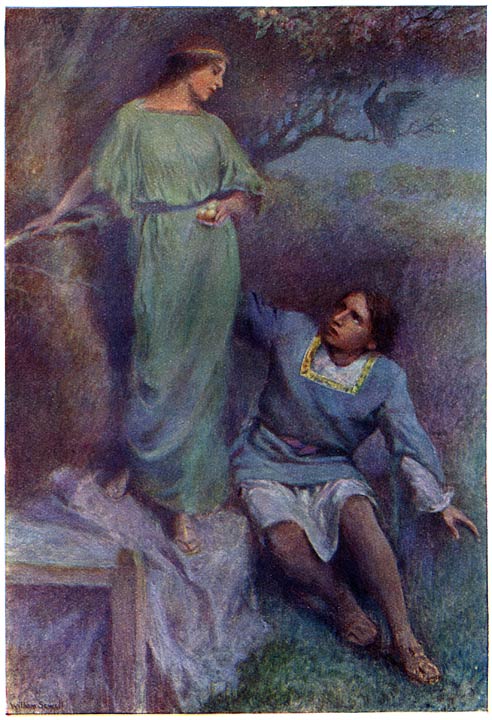
A sourced illustration has not yet been added. This gap is included in the coverage record.
Overview
The dragon rides a horse that advises him about pursuit and can catch the queen’s ordinary mounts even after a delay. It belongs to a family kept by an old woman in the mountains. She possesses twelve horses, including a neglected-looking one in a corner that is said to be the best and able to travel above the clouds. The prince earns his choice and insists on taking that apparently diseased animal.
After grooming, the chosen horse shines like pure gold and flies like a bird to the dragon’s castle. The prince and queen escape upon it. Its pursuing brother admits that the speed will kill it, and the prince’s horse instead counsels rebellion against the rider. When the dragon is thrown and killed, the queen mounts the freed brother and the pair of horses carries them home. The neglected appearance changes through grooming; the text does not identify the horses as enchanted human princes.
Origins & earliest records
Woislav M. Petrovitch, Hero Tales and Legends of the Serbians, Chapter XIV.IX, printed pp. 275–280. First publication August 1914; inspected imprint lists November 1916 and December 1921 reprints. Earlier oral and Serbian-language witnesses remain separate research questions.
Records & interpretation
Entire selected tale read in two consecutive bounded sections, including the final horse exchange and the dragon’s death. Narrated forms belong to this witness; actual illustrations have not yet been visually matched.
In the literature
“the horse flying like a bird”
Chapter XIV IX, p.279; first flight on chosen horse · Woislav M. Petrovitch
The dragon’s horse can delay departure yet catch ordinary mounts. The dragon explains that an apparently diseased horse among an old woman’s twelve is the best and can rise above clouds. After earning his choice the prince takes that rejected-looking animal; grooming makes it shine as though its skin were gold, and it flies like a bird. The comparison does not prove literal gold anatomy.
Selected bibliography
Documented works and useful reading. This is not a list of every appearance.
- 01
Hero Tales and Legends of the Serbians, XIV.IX: The Golden Apple-tree and the Nine Peahens, pp. 275–280
Primary selected text and imprint read. No unpublished narrator or earliest origin date inferred.
- 02
Hero Tales and Legends of the Serbians
Woislav M. Petrovitch, Hero Tales and Legends of the Serbians, London: George G. Harrap; selected December1921 reprint of first August1914 edition, November1916 reprint recorded. Complete Chapter XIV IX The Golden Apple-tree and the Nine Peahens, pp.267–280, independently read in original English prose rendering; original Serbian source not independently inspected.
Family, evolution & connections
Two flying horses explicitly called brothers
Chapter XIV IX, p. 280.
Scroll sideways to see all branches. With a keyboard, focus the tree and use the arrow keys.
- Stated brotherhood (grouping, not ancestor)
- Dragon-king’s pursuing horse
Direct speech and narration identify the two horses as brothers. Root groups siblings and does not represent an invented parent. No shared father or mother is named; their ownership and riders are separate relations.
Dragon-king’s horse and the prince’s reward horse
The pursuing horse addresses the other as brother, and the narration twice confirms brotherhood. Their shared parent is not named; the older woman’s stable does not establish maternity.
Located primary passages
Specific passages supporting details in this entry, grouped by their published witness.
Hero Tales and Legends of the Serbians
Woislav M. Petrovitch, Hero Tales and Legends of the Serbians, London: George G. Harrap; selected December1921 reprint of first August1914 edition, November1916 reprint recorded. Complete Chapter XIV IX The Golden Apple-tree and the Nine Peahens, pp.267–280, independently read in original English prose rendering; original Serbian source not independently inspected.
- The dragon’s horse can delay departure yet catch ordinary mounts. The dragon explains that an apparently diseased horse among an old woman’s twelve is the best and can rise above clouds. After earning his choice the prince takes that rejected-looking animal; grooming makes it shine as though its skin were gold, and it flies like a bird. The comparison does not prove literal gold anatomy.
Chapter XIV IX, pp.275–279; hidden quality and selected mount
- The dragon’s horse explicitly calls the prince’s mount brother, and the latter tells it to cast off the rider. It does so, killing the dragon; the mounts then carry prince and queen together to her realm. Shared parent names are not given, and the reward mount is not called the transforming mare’s foal.
Specific tale; first work1914 distinguished from selected1921 reprint. Original Serbian source and individual oral narrator not independently established. No sacred formula excerpted.
References
Sources supporting this profile. Linked pages have their own scope and editorial standards.
- Primary textPetrovitch: The Golden Apple-tree and the Nine Peahens, complete taleResearch access: 2026-10-05
Image credits
A sourced illustration has not yet been added. This gap is included in the coverage record.