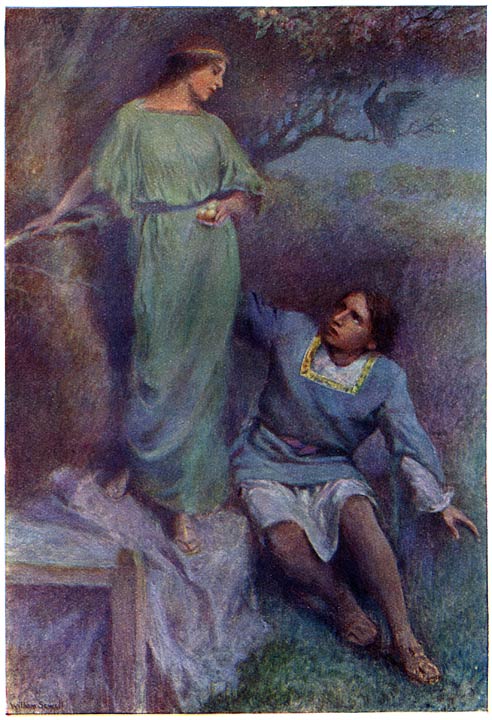
A sourced illustration has not yet been added. This gap is included in the coverage record.
Overview
The prince’s new wife forbids entry to the twelfth cellar. Inside it he nevertheless finds a cask bound with three iron hoops and hears a plea for water. Each supplied drink breaks another hoop; with the third, the cask comes apart and a great dragon flies free. He abducts the queen and keeps her in his castle. The prince’s first escape attempt fails because the dragon’s speaking horse quickly overtakes the pair.
The dragon discloses the source of his extraordinary horse to the captive queen, enabling the prince to obtain an even better brother from the same stable. During the final pursuit, the dragon’s mount cannot maintain its brother’s speed. The fugitive horse urges it to throw off the rider; the mount does so, and the dragon strikes a rock and dies. Unlike Baš Čelik in the adjoining tale, this dragon has no stated external bird holding its life.
Origins & earliest records
Woislav M. Petrovitch, Hero Tales and Legends of the Serbians, Chapter XIV.IX, printed pp. 273–280. First publication August 1914; inspected imprint lists November 1916 and December 1921 reprints. Earlier oral and Serbian-language witnesses remain separate research questions.
Records & interpretation
Entire selected tale read in two consecutive bounded sections, including the final horse exchange and the dragon’s death. Narrated forms belong to this witness; actual illustrations have not yet been visually matched.
In the literature
“a great dragon struggled out”
Chapter XIV IX, p.273; release · Woislav M. Petrovitch
The forbidden twelfth cellar holds a cask bound by three iron hoops. Each drink breaks a hoop; after the third, a dragon emerges and carries off the queen. The story later calls him the dragon-king. This separate tale’s dragon is not silently identified with Baš Čelik merely because both prisoners are released through water.
Selected bibliography
Documented works and useful reading. This is not a list of every appearance.
- 01
Hero Tales and Legends of the Serbians, XIV.IX: The Golden Apple-tree and the Nine Peahens, pp. 273–280
Primary selected text and imprint read. No unpublished narrator or earliest origin date inferred.
- 02
Hero Tales and Legends of the Serbians
Woislav M. Petrovitch, Hero Tales and Legends of the Serbians, London: George G. Harrap; selected December1921 reprint of first August1914 edition, November1916 reprint recorded. Complete Chapter XIV IX The Golden Apple-tree and the Nine Peahens, pp.267–280, independently read in original English prose rendering; original Serbian source not independently inspected.
Family & connections
A source-supported family tree or inspiration record has not yet been compiled for this profile. Related reading below indicates a connection in subject matter, not a proven lineage or creative influence.
Located primary passages
Specific passages supporting details in this entry, grouped by their published witness.
Hero Tales and Legends of the Serbians
Woislav M. Petrovitch, Hero Tales and Legends of the Serbians, London: George G. Harrap; selected December1921 reprint of first August1914 edition, November1916 reprint recorded. Complete Chapter XIV IX The Golden Apple-tree and the Nine Peahens, pp.267–280, independently read in original English prose rendering; original Serbian source not independently inspected.
- The forbidden twelfth cellar holds a cask bound by three iron hoops. Each drink breaks a hoop; after the third, a dragon emerges and carries off the queen. The story later calls him the dragon-king. This separate tale’s dragon is not silently identified with Baš Čelik merely because both prisoners are released through water.
- The dragon initially catches the couple on a speaking horse and grants one pardon because the prince released him. Later his own horse warns it cannot catch the new mount, pursues at his insistence, then accepts its brother’s advice and throws him onto a rock, killing him. The ultimate defeat is a mount’s rejection, not the prince cutting out an external soul.
Chapter XIV IX, The Prince finds his Wife / final chase, pp.275–280
Specific tale; first work1914 distinguished from selected1921 reprint. Original Serbian source and individual oral narrator not independently established. No sacred formula excerpted.
References
Sources supporting this profile. Linked pages have their own scope and editorial standards.
- Primary textPetrovitch: The Golden Apple-tree and the Nine Peahens, complete taleResearch access: 2026-10-05
Image credits
A sourced illustration has not yet been added. This gap is included in the coverage record.