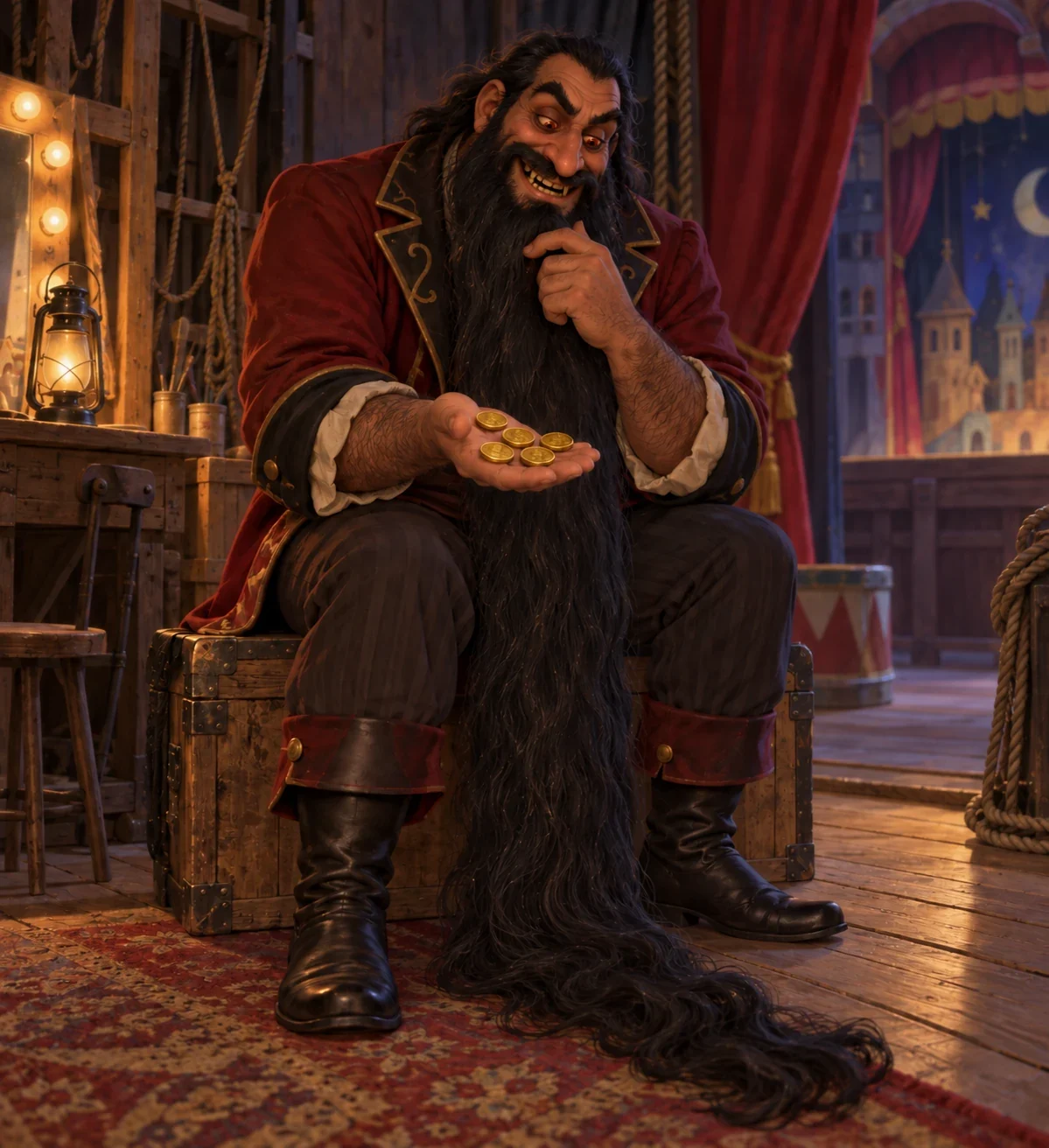
Imagined Fire Eater prepares five gold pieces for Geppetto.
Unofficial AI interpretation. Fire Eater prepares five gold pieces for Geppetto. Selected action and defining details follow the original narrative; portrait, precise age, clothes and surrounding scene are imagined, without an adaptation likeness claim. Full-frame display derivative; no upscaling.
Overview
Fire Eater is the Director of the Marionette Theater in the retained translation of The Adventures of Pinocchio. His entrance interrupts the puppets’ enthusiastic recognition of Pinocchio. The narrator gives him a terrifying appearance: a pitch-black beard reaching from chin to feet, an oven-wide mouth, yellow fang-like teeth and eyes compared with glowing red coals. His large hairy hands carry a whip made from green snakes and black cats’ tails. These are details of a literary figure and descriptive comparisons, not a zoological ancestry or a reason to import a different screen villain’s design.
His first threat is severe. Pinocchio is to provide fuel for the fire on which his lamb is cooking. Yet the director is explicitly said to be less bad than he looks, and pity changes his response to the frightened Marionette. Rather than weeping when unhappy, he sneezes, a peculiar habit that Harlequin recognises as a hopeful sign. Hearing about Pinocchio’s living father makes him consider the suffering he would cause. The account must preserve both the actual threat and this change of feeling; neither an entirely harmless showman nor an unrelieved monster matches the selected scenes.
Pity for one puppet does not immediately settle the crisis. Fire Eater orders Harlequin burned in Pinocchio’s place, and Pinocchio must plead for his friend. Addressing the director as an excellency momentarily flatters him but does not itself secure release. The decisive appeal is Pinocchio’s offer to take the threatened place himself. Fire Eater softens, sneezes again, opens his arms and praises the boy’s bravery. Pinocchio climbs the long beard to kiss his nose, and Harlequin is pardoned. The theater’s Marionettes celebrate, while the director accepts a partly cooked dinner and still warns them about future trouble.
The next day his concern becomes material assistance. He asks about Geppetto’s name and trade, hears that the wood carver sold his only coat for a schoolbook, and gives Pinocchio five gold pieces for his father. Their later theft does not change the purpose of that gift or turn Fire Eater into the Fox and Cat’s accomplice. The original episode supplies a theater position, a striking body and contradictory behaviour, but no established royal office, ancient origin, permanent alliance or later career. The profile therefore ends with the assistance actually narrated and distinguishes his name from any inference that he performs a documented fire-eating act.
First appearances & development
Carlo Collodi’s original The Adventures of Pinocchio. Selected narrative episodes establish this character; undocumented real-life models, modern screen continuity and unrelated traditional beings are excluded.
Canon & continuity
Original narrative.
Selected bibliography
Documented works and useful reading. This is not a list of every appearance.
- 01
The Adventures of Pinocchio
Carol Della Chiesa translation.
Family & connections
A source-supported family tree or inspiration record has not yet been compiled for this profile. Related reading below indicates a connection in subject matter, not a proven lineage or creative influence.
References
Sources supporting this profile. Linked pages have their own scope and editorial standards.
- PrimaryThe Adventures of PinocchioResearch access: 2026-10-11
- CatalogueGutenberg: The Adventures of PinocchioResearch access: 2026-10-11
Image credits
Unofficial modern AI interpretationImagined Fire Eater prepares five gold pieces for Geppetto.
Unofficial AI interpretation. Fire Eater prepares five gold pieces for Geppetto. Selected action and defining details follow the original narrative; portrait, precise age, clothes and surrounding scene are imagined, without an adaptation likeness claim. Full-frame display derivative; no upscaling.