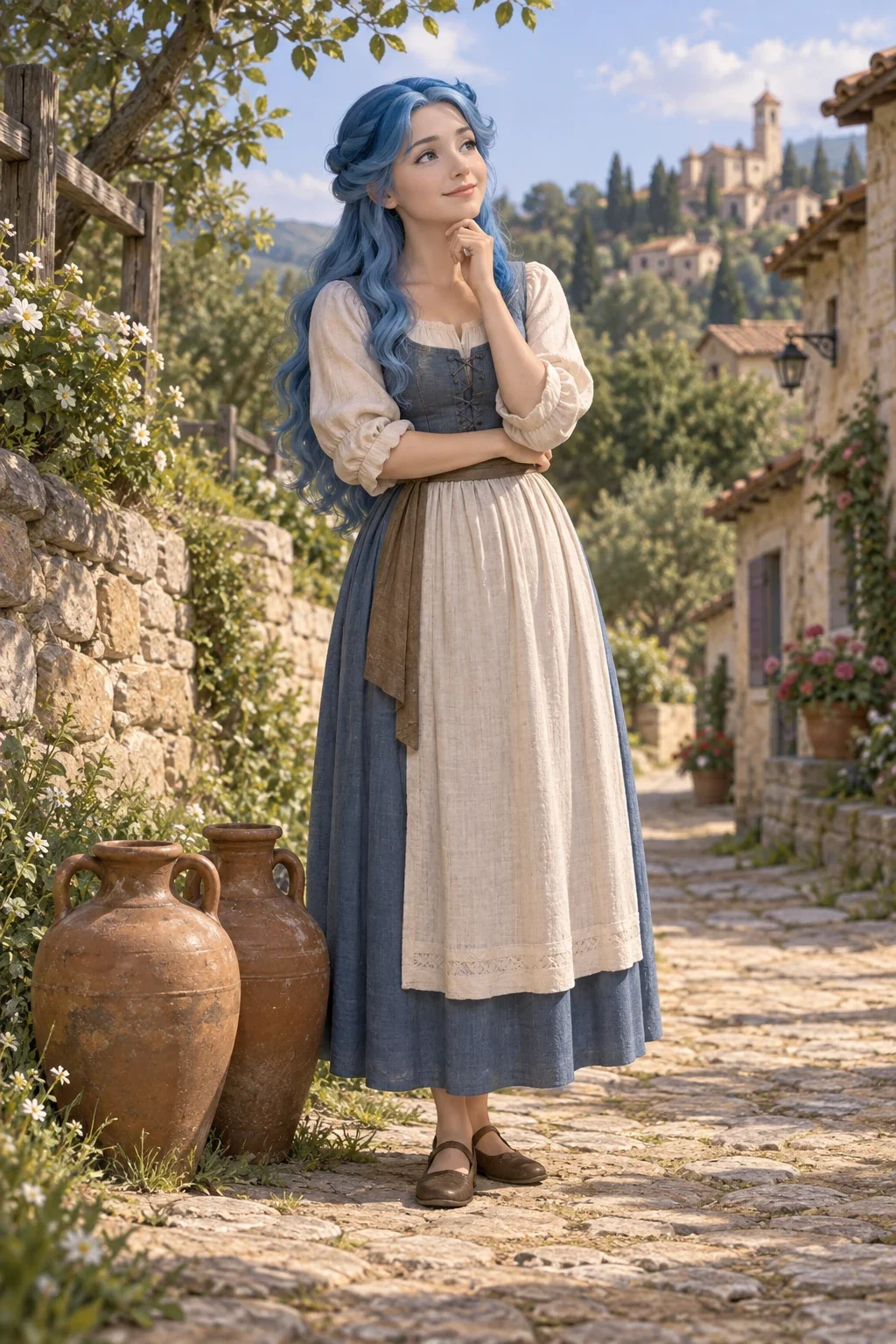
Imagined The adult Fairy with azure hair pauses beside two water jugs.
Unofficial AI interpretation. The adult Fairy with azure hair pauses beside two water jugs. Selected action and defining details follow the original narrative; portrait, precise age, clothes and surrounding scene are imagined, without an adaptation likeness claim. Full-frame display derivative; no upscaling.
Overview
The Fairy with Azure Hair is the recurring benefactor who rescues and guides Pinocchio in the original novel. Her first appearance is a maiden at a window, with azure hair, a wax-white face, closed eyes and a faint voice. She initially speaks as though the household is dead, yet later watches the endangered Marionette with pity and summons help. The narration identifies her as a kind Fairy who has lived near the forest for more than a thousand years. That statement establishes a fantastical character within the tale, not a historical Italian supernatural tradition or a human biography.
Her rescue is organised through other speaking beings rather than achieved by a single universal spell. A Falcon and the richly dressed Poodle carry out commands, and Pinocchio is brought to a room with mother-of-pearl walls. The Fairy calls doctors and persists in offering medicine when he resists it. Sugar, threats and his own fear complicate the treatment. His subsequent account of the lost coins produces lies and a growing nose, so instruction and correction remain part of her relationship with him. These episodes do not establish a complete catalogue of powers or a rule that she prevents every danger before it happens.
After Pinocchio believes she has died, he later recognises her in a little woman carrying water jugs. She offers food in return for help carrying the water home, and the shared voice, eyes and azure hair lead him to identify her. She admits that she has changed from the little girl he knew into a grown woman, while refusing to explain the secret of that growth. Pinocchio welcomes the change because he can call her mother rather than sister. She encourages obedience, truthfulness, work and school, and accepts the maternal role. The profile keeps the maiden and adult appearances distinct instead of giving her one fixed child or adult age.
Her influence continues through intermediaries and signs. A blue-coated little Goat recalls her colour, while a later report from the Snail says she is ill and without money; that report prompts Pinocchio to give away his clothes savings. The last dream shows the Fairy smiling and praising the care he has given his old father. He then wakes transformed into a human boy. The sequence connects reward to kindness without requiring an invented mechanical explanation of her magic. Wings, a wand, a crown and a famous screen gown are not specified by these selected passages and are not treated as defining anatomy or possessions. The account remains within Collodi’s original narrative and the retained translation.
First appearances & development
Carlo Collodi’s original The Adventures of Pinocchio. Selected narrative episodes establish this character; undocumented real-life models, modern screen continuity and unrelated traditional beings are excluded.
Canon & continuity
Original narrative.
Selected bibliography
Documented works and useful reading. This is not a list of every appearance.
- 01
The Adventures of Pinocchio
Carol Della Chiesa translation.
Family & connections
A source-supported family tree or inspiration record has not yet been compiled for this profile. Related reading below indicates a connection in subject matter, not a proven lineage or creative influence.
References
Sources supporting this profile. Linked pages have their own scope and editorial standards.
- PrimaryThe Adventures of PinocchioResearch access: 2026-10-11
- CatalogueGutenberg: The Adventures of PinocchioResearch access: 2026-10-11
Image credits
Unofficial modern AI interpretationImagined The adult Fairy with azure hair pauses beside two water jugs.
Unofficial AI interpretation. The adult Fairy with azure hair pauses beside two water jugs. Selected action and defining details follow the original narrative; portrait, precise age, clothes and surrounding scene are imagined, without an adaptation likeness claim. Full-frame display derivative; no upscaling.