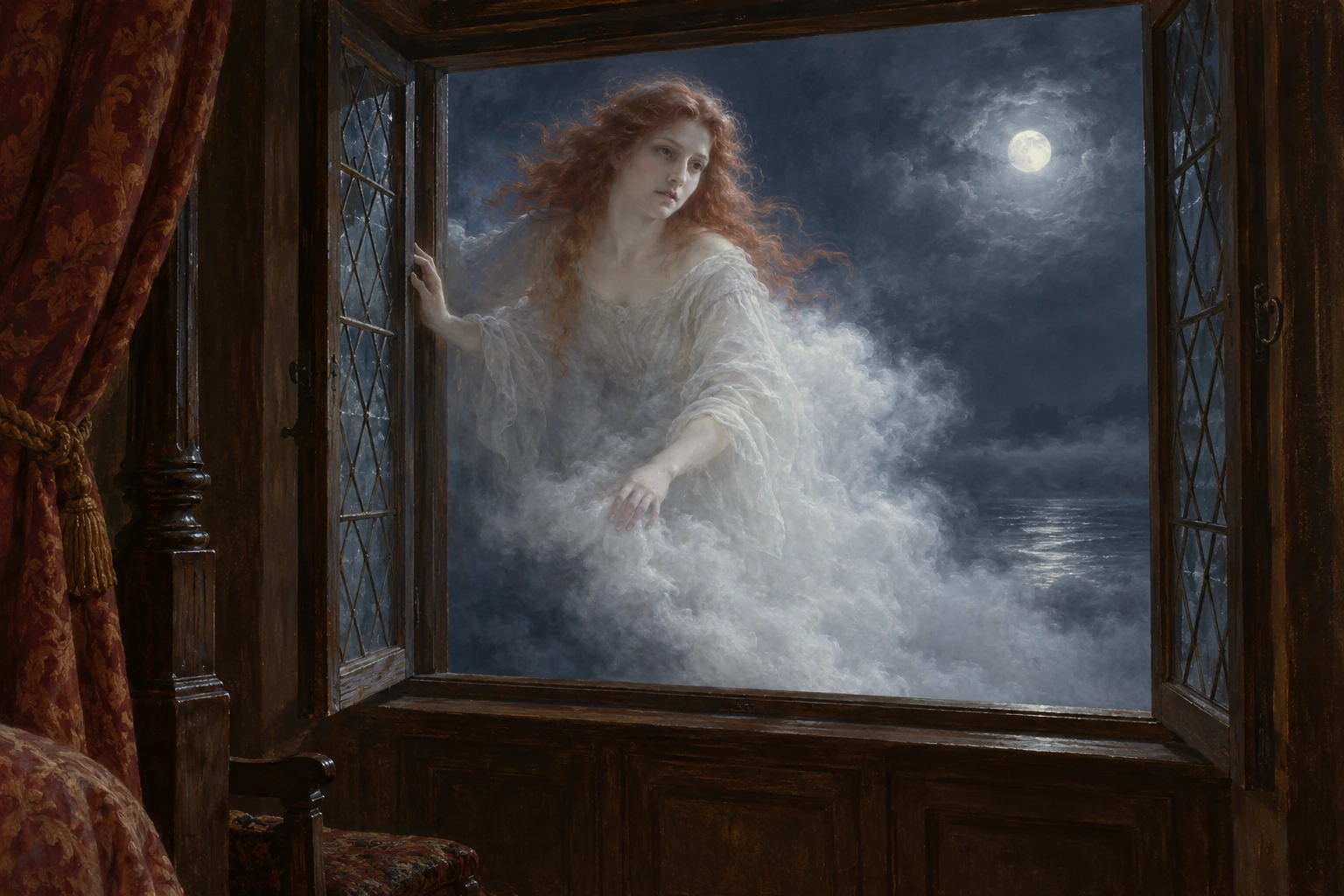
AI-generated interpretation of the apparition reported in Ann Fanshawe’s memoir. White clothing, red hair, moonlight, casement and cloudlike form follow her description; the face, room, garment and mist are artistic choices. The house is not identified, and this image is neither evidence of a haunting nor a Mass Effect scene.
The image interprets the reported sighting, rather than the hostess’s later account of a death and an earlier murder.
Overview
Ann Fanshawe’s memoir describes a disturbing first night at Lady Honor O’Brien’s house during the family’s travels in Ireland. They stay for three nights, but the apparition belongs to the first. About one in the morning a voice wakes the narrator. Drawing her bed curtain, she says she sees by moonlight a woman leaning through the window’s casement, dressed in white, with red hair and a pale, ghastly face. Her body looks to Fanshawe more like a thick cloud than a solid substance.
The retained witness says that the woman calls loudly three times, “A horse”, then vanishes with a sigh compared to wind rather than breath. That unusual wording is preserved without silently replacing it with another cry. Fanshawe tries to wake her husband, who remains asleep during her fright and reacts only after she tells him what happened and shows him the open window. His response is therefore not an independent sighting of the figure. The spouses’ ensuing religious explanation and criticism of Irish superstition belong to their reported worldview, not an explanation adopted for all Irish belief.
At about five, the hostess arrives and says that she has been attending a dying cousin of the O’Brien family, whose ancestors owned the house. He has died at two. She then explains a supposed local pattern: when a member of that family is dying, a woman’s shape appears at the window until the death. In her account, a former owner made the woman pregnant, murdered her in his garden and threw her body into the river beneath the window. This is the hostess’s explanation within the memoir; it does not independently establish either that earlier killing or the apparition’s identity.
Fanshawe says that the couple make little reply and prepare to leave quickly. The episode names neither the castle nor the deceased cousin and supplies no exact year for the encounter. An attached note in the following travel paragraph proposes January against that paragraph’s February wording; it is not a secure date for this night. Croker’s later bibliographic note groups the memoir among accounts of the Irish banshee, although Fanshawe does not use that term in the selected episode. The account thus preserves a particular reported window apparition and family death warning, separate from later retellings and fictional banshee powers.
Origins & earliest records
Ann Fanshawe (1625–1680) memoir body in retained PG6064. Physical printed edition and publication year not yet verified. Croker 1844, p. 100, later cites Memoirs of Lady Fanshaw among Irish banshee accounts; no first oral origin, castle identification or universal tradition inferred.
Records & interpretation
Complete paragraph beginning “From hence we went to the Lady Honor O’Brien’s” through “disposed ourselves to be gone suddenly”, with complete preceding two travel paragraphs and following travel paragraph and chronological note read. Distinguishes narrator’s report, husband’s reaction and hostess’s explanation.
Selected bibliography
Documented works and useful reading. This is not a list of every appearance.
- 01
Memoirs of Lady Fanshawe, Wife of Sir Richard Fanshawe, Bt., Ambassador from Charles II to the Courts of Portugal and Madrid
Complete Lady Honor O’Brien apparition paragraph, with two preceding travel paragraphs and the following travel paragraph and chronological note. Introduction, illustration essay and artwork excluded from narrative source use.
- 02
Fairy Legends and Traditions of the South of Ireland
Printed p. 100 comparative/source note cites Memoirs of Lady Fanshaw, quoted by Scott, among Irish banshee accounts. Pointer only, not memoir episode body.
Family, evolution & connections
Banshee (Mass Effect)
Croker’s later banshee bibliography points to Fanshawe’s memoir. Her specific window-apparition account offers historical namesake context for Mass Effect’s fictional Banshee, not proof of a scene source, shared anatomy or creator consultation. The memoir figure’s appearance and death-warning explanation remain attributed to its narrators.
References
Sources supporting this profile. Linked pages have their own scope and editorial standards.
- Historical memoir narrative in an identified digital witnessFanshawe memoir, complete Lady Honor O’Brien window episodeResearch access: 2026-10-26
- Historical collector’s later classification and citationCroker 1844, p. 100, banshee bibliographic pointer to Fanshawe memoirResearch access: 2026-10-26
Image credits
Modern interpretation of a historical literary accountAI-generated interpretation of the apparition reported in Ann Fanshawe’s memoir. White clothing, red hair, moonlight, casement and cloudlike form follow her description; the face, room, garment and mist are artistic choices. The house is not identified, and this image is neither evidence of a haunting nor a Mass Effect scene.
The image interprets the reported sighting, rather than the hostess’s later account of a death and an earlier murder.