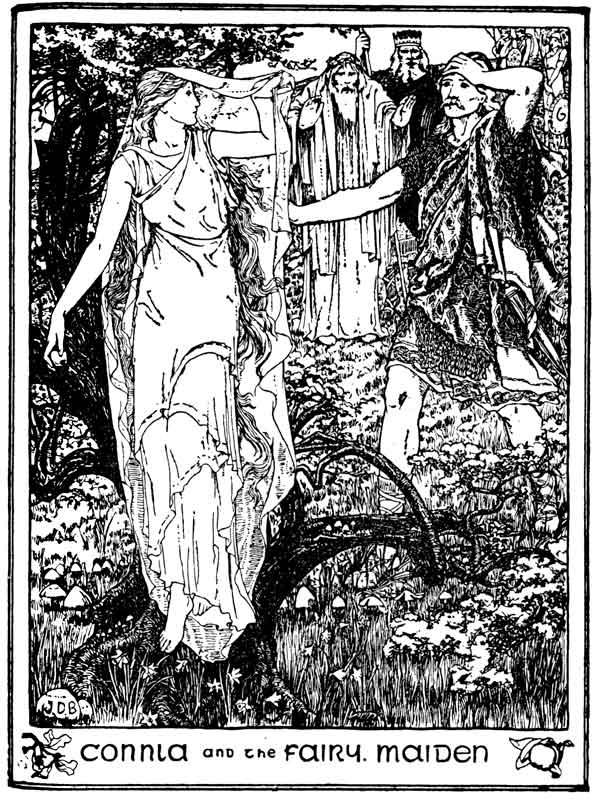
Batten: Connla and the fairy maiden
Printed caption names Connla and the fairy maiden; the white-clothed woman is the named fairy visitor. John Dickson Batten (1860–1932) credited by title page. 1892 first publication; selected impression undated.
Overview
Connla sees a strangely dressed woman whom the surrounding court can hear but cannot see. She describes an ever-living people dwelling in green hills and promises him an unfading life in the realm called Moy Mell in this translation. His father Conn summons the druid Coran, whose spells silence and conceal her. Before disappearing she gives Connla an apple. For a month he consumes nothing else, yet it renews itself as he eats and remains whole. His growing attachment therefore has a material counterpart in an inexhaustible gift, while the text keeps him torn between his own people and the returning visitor.
When she reappears, her speech challenges the druid’s authority and includes a prediction of changing religious power. Connla acknowledges both love for his family and longing for the maiden. She invites him into a crystal canoe, and the court sees the craft travel toward the setting sun until it disappears. The tale does not show his arrival, death or return. Jacobs names an Old Irish text in the Book of the Dun Cow as the underlying witness, describes using Zimmer’s translation and Joyce’s touches, and admits adding the final sentence of her last speech. His larger claims about the story’s historical beginnings and influence are interpretive proposals, not independently verified facts adopted here.
Origins & earliest records
Jacobs’s 1892 collection identifies the Old Irish Echtra Condla in the Book of the Dun Cow and explains its translation and editing chain. The medieval manuscript witness is distinct from the narrative’s royal setting and the unknown oral beginning. Specific claims about second-century composition require independent evidence.
Records & interpretation
Selective visibility, the renewing apple and crystal canoe are literary attestations within the inspected adaptation. Manuscript attribution supports textual transmission, not a physical otherworld or observed immortal population. Religious statements belong to the transmitted speech and its editorial history.
In the literature
“as he ate it grew again and always kept whole”
CONNLA AND THE FAIRY MAIDEN; The month of nourishment from the apple
As she vanishes, the maiden throws Connla an apple. He consumes only it for a month; it continually grows whole again while longing for her increases. She returns at the month’s end, so the initial banishment is temporary rather than her permanent defeat.
Selected bibliography
Documented works and useful reading. This is not a list of every appearance.
- 01
Celtic Fairy Tales: Connla and the Fairy Maiden
Complete selected episode and source note inspected; the preface explicitly admits altering and combining translated sources.
- 02
Celtic Fairy Tales — Connla And The Fairy Maiden
Joseph Jacobs, Celtic Fairy Tales, PG7885 selected undated print/transcription; numbered tale and observed heading anchors used. Earlier collection publication and underlying witness dates do not establish this print’s date. Source notes openly record borrowing and adaptation; no guessed printed pages.
Family & connections
A source-supported family tree or inspiration record has not yet been compiled for this profile. Related reading below indicates a connection in subject matter, not a proven lineage or creative influence.
Located primary passages
Specific passages supporting details in this entry, grouped by their published witness.
Celtic Fairy Tales — Connla And The Fairy Maiden
Joseph Jacobs, Celtic Fairy Tales, PG7885 selected undated print/transcription; numbered tale and observed heading anchors used. Earlier collection publication and underlying witness dates do not establish this print’s date. Source notes openly record borrowing and adaptation; no guessed printed pages.
- Connla sees a maiden who calls herself one of the Hill Folk from an enduring land. The assembled court hears her voice but cannot see her. She invites him to Moy Mell; Coran’s spell temporarily removes her voice and visible presence. Her account of the otherworld remains a character’s statement.
CONNLA AND THE FAIRY MAIDEN; First invitation and selective visibility
- As she vanishes, the maiden throws Connla an apple. He consumes only it for a month; it continually grows whole again while longing for her increases. She returns at the month’s end, so the initial banishment is temporary rather than her permanent defeat.
CONNLA AND THE FAIRY MAIDEN; Self-renewing apple and returning desire
- Connla acknowledges competing affection for family and maiden, then enters her crystal canoe. The court watches it glide toward the setting sun until neither is seen again. Their eventual destination or later return is not narrated as witnessed fact.
Complete selected body and corresponding source note read. Underlying cited manuscripts, periodicals and local physical traces remain indirect. No verse, prayer or ritual formula excerpts; changeling injury is described solely as a historical narrative event.
Primary source witness
Joseph Jacobs, Celtic Fairy Tales, PG7885 selected undated print/transcription; numbered tale and observed heading anchors used. Earlier collection publication and underlying witness dates do not establish this print’s date. Source notes openly record borrowing and adaptation; no guessed printed pages.
- Jacobs credits Zimmer’s translation, notes touches borrowed from Joyce and explicitly adds the last sentence of the maiden’s last speech. Manuscript dates, legendary ruler history and earliest-fairy-tale assertions in his commentary are attributed arguments, not independently verified chronology.
I. CONNLA AND THE FAIRY MAIDEN.; Jacobs’s borrowed translation and added speech
Verifies the compiler’s stated transmission. Historical speculations and exact earliest-attestation claims are not adopted.
References
Sources supporting this profile. Linked pages have their own scope and editorial standards.
- Primary textJacobs, Celtic Fairy Tales: Connla and the Fairy Maiden and source noteResearch access: 2026-10-05
Image credits
Historical illustrationBatten: Connla and the fairy maiden
Printed caption names Connla and the fairy maiden; the white-clothed woman is the named fairy visitor. John Dickson Batten (1860–1932) credited by title page. 1892 first publication; selected impression undated.