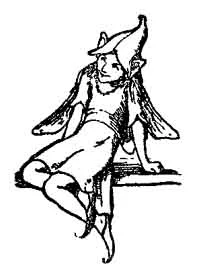
Tiny fairy visitor of My Own Self, Batten
Actual miniature girl seated with pointed cap; primary caption calls her the tiniest wee girl. Exact tale visitor, not a generic fairy replacement.
Overview
The child appears to a widow’s disobedient son while he plays beside the evening fire. She is shorter than a span, with silver hair, green eyes and red cheeks, and identifies herself as My Own Self. The boy cautiously says that this is his name too. Their games include forming animals from ashes and constructing leafy trees, houses and inch-high inhabitants. When she breathes on these figures, they move and speak, making her more than an unusually small human visitor.
A flying cinder burns her foot and produces a piercing scream. Her mother calls from the chimney, then reveals a white face and a long thin arm. Asked who caused the injury, the child uses the boy’s adopted name, which sounds like an admission that she hurt herself. The mother scolds her and drags her out through the chimney; the frightened boy subsequently accepts his own mother’s bedtime instructions. Jacobs’s note places the collecting chain in North Sunderland and says he changed the dialect title Me A’an Sel’. The fairy mother and daughter remain figures in this shared episode, without an invented personal name or a separate population taxonomy.
Origins & earliest records
Jacobs attributes the account to Balfour’s informant Mrs W., a North Sunderland native who said she knew the cottage and heard the story through people acquainted with the widow and boy. That testimony chain is recorded provenance, not independently verified encounter evidence.
Records & interpretation
The animated ash figures, chimney entrance and linguistic misunderstanding are explicit features of the published tale. The informant’s local knowledge is reported by the compiler. No physical fairy body or tested animated model accompanies the narrative.
In the literature
“caught the creature by its ear”
My Own Self; The fairy mother withdraws her crying child through the chimney
The naming trick directs the mother's anger to her daughter rather than the human boy.
Selected bibliography
Documented works and useful reading. This is not a list of every appearance.
- 01
More English Fairy Tales
Inspected complete selected episode “My Own Self” and compiler’s editorial source note.
- 02
More English Fairy Tales — My Own Self
Joseph Jacobs, More English Fairy Tales; first publication1894, selected Gutenberg14241 witness explicitly Fourteenth Impression, undated. Jacobs’s preface acknowledges rewriting, combined sources and altered incidents. Exact heading/anchor used; no invented print pagination.
Family & connections
A source-supported family tree or inspiration record has not yet been compiled for this profile. Related reading below indicates a connection in subject matter, not a proven lineage or creative influence.
Located primary passages
Specific passages supporting details in this entry, grouped by their published witness.
More English Fairy Tales — My Own Self
Joseph Jacobs, More English Fairy Tales; first publication1894, selected Gutenberg14241 witness explicitly Fourteenth Impression, undated. Jacobs’s preface acknowledges rewriting, combined sources and altered incidents. Exact heading/anchor used; no invented print pagination.
- A tiny girl with silver hair and green eyes descends the chimney while the widow's son stays up alone. Each answers that their name is My Own Self. She makes moving animals and miniature settlements from ashes, and her breath animates their little people.
- A cinder accidentally burns the fairy girl's foot. Her mother appears in the chimney to ask who caused it; hearing My Own Self, she assumes her daughter hurt herself, pulls her away by the ear and leaves the boy unpunished. He becomes willing to go to bed early.
My Own Self; Burnt foot and the mother's mistaken interpretation
Complete selected tale and its source note read. Jacobs’s edited narrative is distinct from direct oral transcription. No song or ritual-formula excerpts; no invented print page or earliest date.
Primary source witness
Joseph Jacobs, More English Fairy Tales; first publication1894, selected Gutenberg14241 witness explicitly Fourteenth Impression, undated. Jacobs’s preface acknowledges rewriting, combined sources and altered incidents. Exact heading/anchor used; no invented print pagination.
- Jacobs attributes Balfour's telling to Mrs. W. from North Sunderland, who reportedly saw the cottage and heard from people acquainted with the widow and boy. He explicitly changed Me A'an Sel' to My Own Self; his suggested Odyssey connection remains comparative speculation.
Notes and References, XLVII My Own Self; Jacobs's named source and changed title
This verifies what Jacobs reports and changes; listed earlier works and informant claims are not independently verified by this note alone.
References
Sources supporting this profile. Linked pages have their own scope and editorial standards.
- Primary textJacobs, More English Fairy Tales: My Own SelfResearch access: 2026-10-05
Image credits
Historical illustrationTiny fairy visitor of My Own Self, Batten
Actual miniature girl seated with pointed cap; primary caption calls her the tiniest wee girl. Exact tale visitor, not a generic fairy replacement.