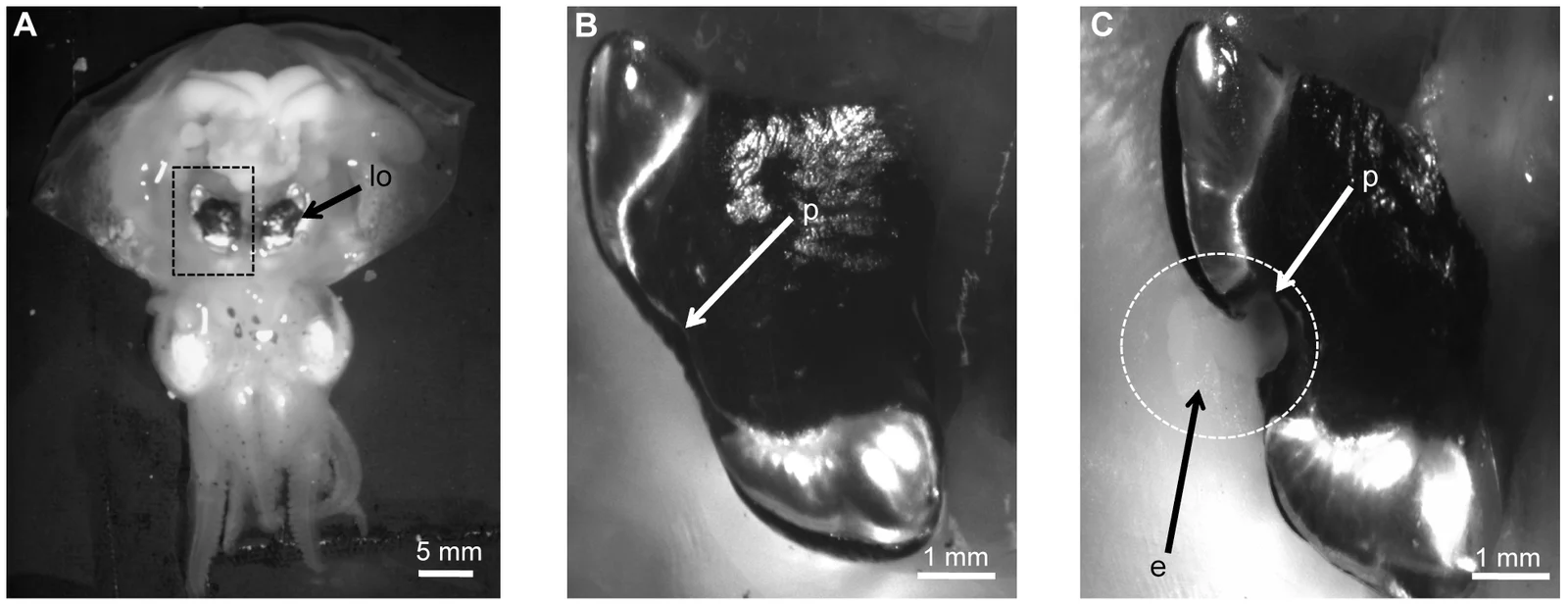
Ventrally dissected adult Euprymna scolopes and two enlarged views of its light organ before and during venting, Schleicher and Nyholm’s 2011 figure 1
Panel A shows a ventrally dissected adult Hawaiian bobtail squid, Euprymna scolopes, with its bilobed light organ marked. Panels B and C show one half of that organ before and during venting; the pale exudate leaves a lateral pore. Scale bars are five millimetres in A and one millimetre in B and C. This is an anatomical research image, not a portrait of an intact living squid.
Overview
Euprymna scolopes is a nocturnal predator whose light-organ bacteria, Vibrio fischeri, provide luminescence used for camouflage. Females also possess an accessory nidamental gland containing a bacterial consortium associated with reproduction. These are separate associations, rather than two interchangeable populations of the same symbiont.
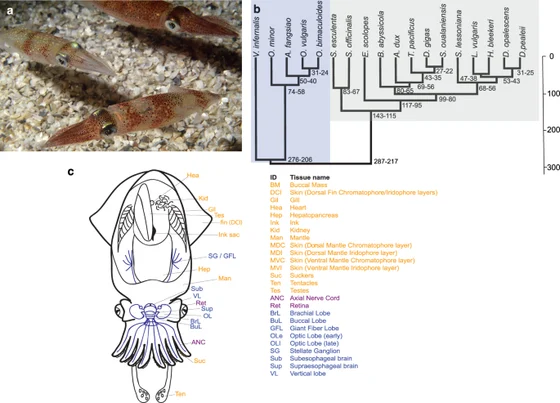
A 2019 genomic study used DNA from one adult male and expression data from multiple tissues. Comparisons found shared genome rearrangements with octopus and different molecular signatures in the two symbiotic organs. Light-organ patterns included duplicated genes associated with light and immunity; the reproductive gland showed enrichment of genes known only from this squid. These findings support hypotheses about organ evolution, rather than proving the functions of every gene or observing the historical origin of either organ.
A later study compared immune-related expression across organs of wild-caught squid and localized the recognition protein EsPGRP2. It detected the protein in light-organ crypts, some reproductive-gland tubules and gill cells. In the reproductive gland, protein-bearing regions often differed from regions occupied by bacteria, although the separation was not absolute. These spatial observations support further investigation of host control over different microbial niches; they do not prove a single regulatory mechanism. The detailed experimental protocols lie in supplementary material not independently inspected for this account. The findings also do not establish medical applications from the squid’s immune proteins.
Origins & earliest records
Account based on Belcaid and colleagues’ primary genomic study.
Evidence & interpretation
Genome assembly, tissue expression and comparative gene organization.
Selected bibliography
Documented works and useful reading. This is not a list of every appearance.
- 01
Symbiotic organs shaped by distinct modes of genome evolution in cephalopods
PNAS 116, 3030–3035. Complete main Results, Discussion and Methods read.
- 02
Maintaining microbiota across diverse symbiotic organs in Euprymna scolopes: Insights into shared immune responses
PNAS 123(1), e2512903122; complete selected EsPGRP2 localization Results and main Methods overview read. Supplementary protocols uninspected.
Family, evolution & connections
Taxonomic classification
A hierarchy of classified groups, not a chain of direct ancestors.
- GenusEuprymna
- SpeciesEuprymna scolopes
Vibrio fischeri
Vijayan and colleagues locate Vibrio fischeri in adult light-organ crypts; the accessory nidamental gland instead houses a mixed bacterial community.
Accessory-nidamental-gland and egg-jelly bacterial consortium
Kerwin and colleagues reduced egg-associated bacteria with an antibiotic cocktail and observed fungal fouling and poorer hatching. Separate challenges with Fusarium keratoplasticum showed protection when the jelly coat remained, but heavy fouling after its removal. Controls under conditions suppressing fungi helped distinguish bacterial protection from antibiotic toxicity. This supports defense in the tested squid system, not guaranteed immunity or a demonstrated identical mechanism in every cephalopod.
References
Sources supporting this profile. Linked pages have their own scope and editorial standards.
- ResearchBelcaid et al. 2019, primary genomic reportResearch access: 2026-10-05
- ResearchVijayan et al., primary organ-localization studyResearch access: 2026-10-05
Image credits
Scientific dissected animal and light-organ photograph compositeVentrally dissected adult Euprymna scolopes and two enlarged views of its light organ before and during venting, Schleicher and Nyholm’s 2011 figure 1
Panel A shows a ventrally dissected adult Hawaiian bobtail squid, Euprymna scolopes, with its bilobed light organ marked. Panels B and C show one half of that organ before and during venting; the pale exudate leaves a lateral pore. Scale bars are five millimetres in A and one millimetre in B and C. This is an anatomical research image, not a portrait of an intact living squid.