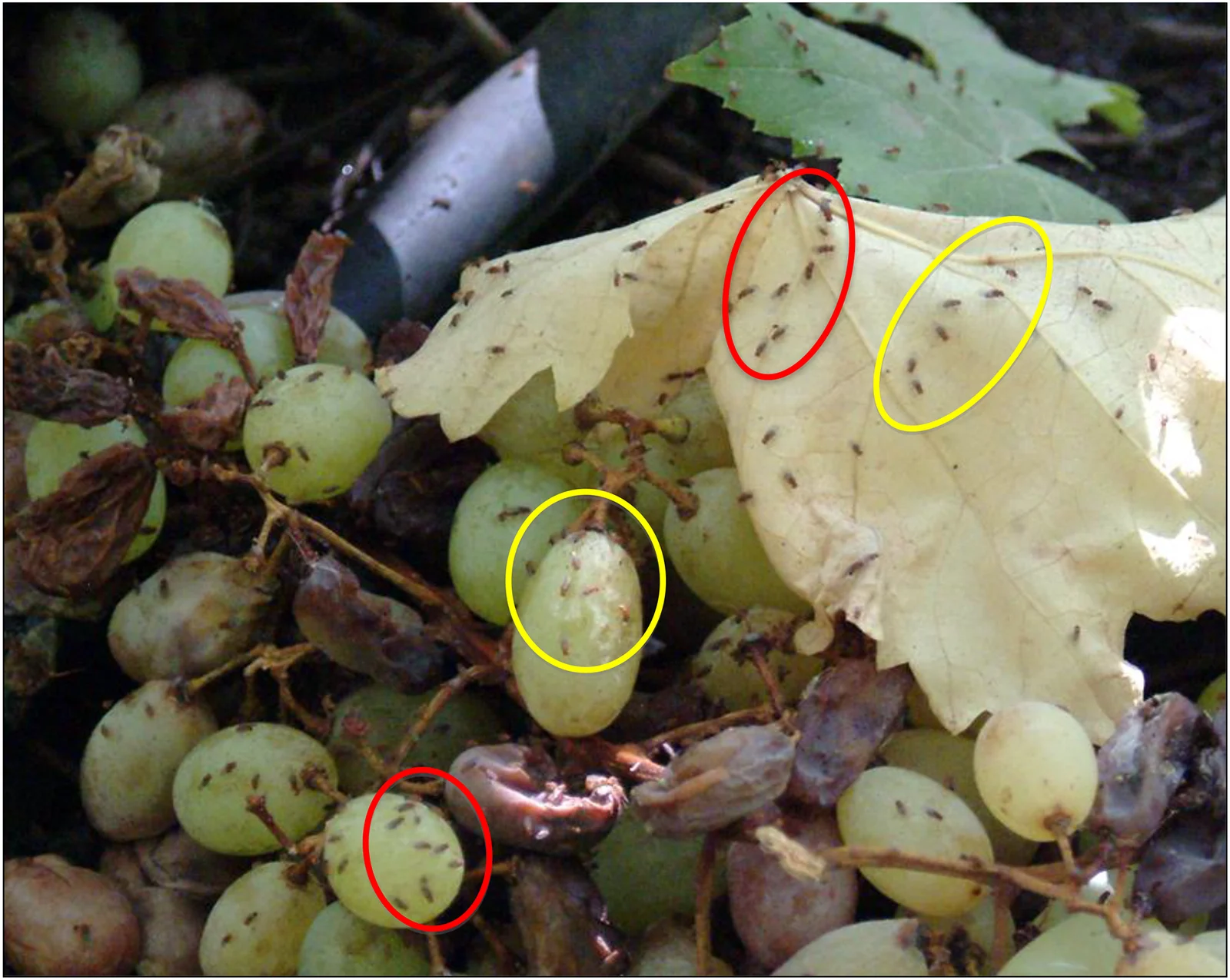
Drosophila melanogaster marked by red ovals and Drosophila simulans by yellow ovals on fallen grapes and dry leaves in a Chilean orchard
The authors identify Drosophila melanogaster groups with red ovals and Drosophila simulans groups with yellow ovals. The flies occupy fallen grapes and dry leaves in a Sultanina grape orchard at Til-Til, Chile. Both species occur in this field photograph; the yellow-marked flies should not be read as D. melanogaster.
Overview
Drosophila melanogaster develops through a crawling larval stage before becoming an adult fly. Berne and colleagues studied second-instar larvae to investigate responses to vertical vibration. Most experiments used the Canton-S laboratory strain, with larvae selected by age and spiracle development. The animals crawled on an agar surface while a controlled device delivered vibrations and a camera recorded their movements. This design addresses a defined laboratory response, rather than measuring every natural disturbance encountered by wild larvae or describing the entire behavioural repertoire of adult flies.
The study classified four responses: continuing forward, pausing, turning and reversing. Pauses and turns also occurred without vibration, while reversal was relatively rare in the unstimulated controls. Increasing vibration frequency or peak acceleration generally increased avoidance within the tested range, but the response was not simply proportional to stimulus strength. Under repeated stimulation, the fraction of larvae reversing declined while weaker responses or continued crawling became more common. Tracking individuals supported the population pattern: once an animal had shifted toward a weaker response, it rarely returned to reversal within the observed sequence.
Brief vibration pulses, continuous stimulation and repeated longer pulses produced different time courses. A model that treated the response as linear and unchanged over time failed to reproduce the observed reduction in avoidance. During continuous vibration, reversal declined toward baseline despite the stimulus remaining present. Responses to successive pulses also weakened. These observations support short-timescale habituation in this assay, rather than demonstrating that the sensory system simply reports the current vibration strength independently of recent history. They do not establish associative learning or an unlimited persistence of the altered response.
The researchers analysed trajectories and body contours to distinguish actions, and used separate larvae for each experiment. They also discussed mutant behaviour and an electrical-circuit analogy as ways to characterize adaptation. Neither analogy establishes the actual cellular mechanism. The paper explicitly cautioned that mutant comparisons lacked rescue experiments with shared genetic backgrounds and that most wild-type observations came from Canton-S. Proposed roles for particular signalling processes and broader survival benefits remained subjects for further study. This separation between recorded movement, fitted response dynamics and molecular hypotheses keeps the experimental evidence narrower than a general claim about fly intelligence.
Origins & earliest records
Canton-S and selected mutant laboratory larvae supplied the behavioural evidence; this does not establish the species geographical origin.
Evidence & interpretation
Tracked crawling under calibrated vibration supports changes in response deployment. Mechanistic explanations and mutant-specific causal attribution require further controls.
Selected bibliography
Documented works and useful reading. This is not a list of every appearance.
- 01
Mechanical vibration patterns elicit behavioral transitions and habituation in crawling Drosophila larvae
eLife 12: e69205. Complete first three Results sections, main Methods and concluding limitations read; later circuit-model/parameter Results not independently reviewed. Creative Commons Attribution licence.
Family & connections
A source-supported family tree or inspiration record has not yet been compiled for this profile. Related reading below indicates a connection in subject matter, not a proven lineage or creative influence.
Look for a taxonomic record and classified relativesReferences
Sources supporting this profile. Linked pages have their own scope and editorial standards.
- ResearchLarval vibration response and habituationResearch access: 2026-10-06
Image credits
Scientific field photograph with two identified speciesDrosophila melanogaster marked by red ovals and Drosophila simulans by yellow ovals on fallen grapes and dry leaves in a Chilean orchard
The authors identify Drosophila melanogaster groups with red ovals and Drosophila simulans groups with yellow ovals. The flies occupy fallen grapes and dry leaves in a Sultanina grape orchard at Til-Til, Chile. Both species occur in this field photograph; the yellow-marked flies should not be read as D. melanogaster.