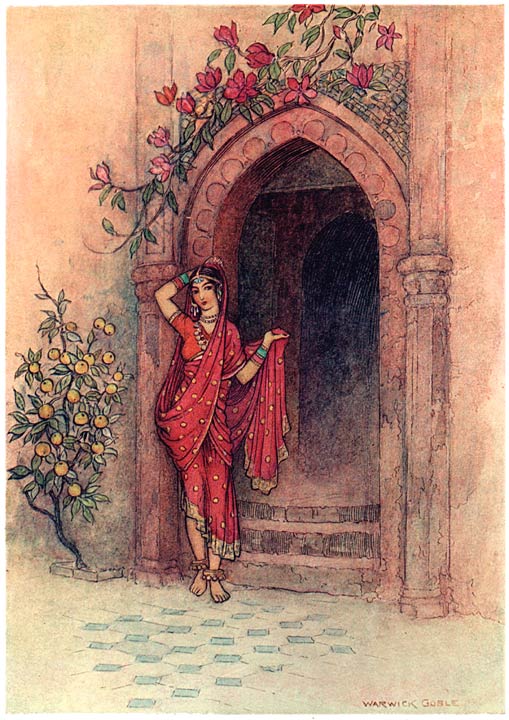
Sahasra Dal’s Rakshasi mother in her beautiful human disguise at the palace door, Warwick Goble, 1912
Goble depicts the devourer in the beautiful human disguise with which she welcomes the Brahman to the empty palace. Her later gigantic form is not shown. This is the individual mother in Day’s Story of the Rakshasas, rather than a general portrait of all Rakshasis.
Overview
A Rakshasi who has devoured a kingdom’s inhabitants welcomes a wandering Brahman to its empty palace. She claims to be his forgotten first wife and later invites his human wife to join them. She bears Sahasra Dal, while the human wife bears Champa Dal a year later. The boys become devoted companions.
After years of concealment, her appetite for raw antelope flesh betrays her to the other wife. She resumes gigantic dimensions, devours the Brahman and his human wife, and pursues Champa Dal. Her own son protects his half-brother by killing her. Her beauty is a disguise, and her son’s conduct differs sharply from hers.
Origins & earliest records
Bengali oral storytelling translated by Lal Behari Day
Records & interpretation
Complete relevant tale, attached notes,1883 preface and1912 edition credits directly read.
Selected bibliography
Documented works and useful reading. This is not a list of every appearance.
- 01
Folk-Tales of Bengal
IV, The Story of the Rakshasas, pp.61–69; complete tale61–88 and notes; first edition1883, illustrationsWarwickGoble
Family, evolution & connections
Sahasra Dal and Champa Dal — Day IV
The Story of the Rakshasas, pp. 66–69.
Scroll sideways to see all branches. With a keyboard, focus the tree and use the arrow keys.
- Unnamed Brahman father
- Champa Dal — mother: unnamed human wife
Explicit shared father and separately identified mothers in the narrator’s account. The unnamed Brahman is the shared father. The Rakshasi’s initial claim to a forgotten childhood wedding is deception; subsequent birth and half-brother statements are explicit. Her affectionate address to the human wife does not establish biological sisterhood. Keshavati marries Champa Dal, not Sahasra Dal.
Sahasra Dal
Day identifies Sahasra Dal as the Rakshasi’s son, born to the Brahman father who also fathers Champa Dal with his human wife. Sahasra later kills his mother to save his half-brother; descent does not determine his allegiance.
The unnamed Brahman father in Day IV
After the Rakshasi’s deceptive claim to an earlier marriage, the narrator describes the Brahman living with two wives and fathering their sons. This records the story’s subsequent household, without accepting the invented childhood wedding as historical fact.
Primary records and illustrations
Lal Behari Day, Folk-Tales of Bengal (Macmillan,1912; first edition1883)
IV. IV, The Story of the Rakshasas, pp.61–69; complete tale61–88 and notes
Complete tale and footnotes read, pluspreface andeditionhistory. Bengali oral informants described collectively, individual teller of this tale not identified. Original paraphrase; no source-image verification claimed.
References
Sources supporting this profile. Linked pages have their own scope and editorial standards.
- Historical translated oral narrative and collector notesLal Behari Day, Folk-Tales of Bengal (1912), IV, The Story of the Rakshasas, pp.61–69; complete tale61–88 and notesResearch access: 2026-10-05
Image credits
Historical illustrationSahasra Dal’s Rakshasi mother in her beautiful human disguise at the palace door, Warwick Goble, 1912
Goble depicts the devourer in the beautiful human disguise with which she welcomes the Brahman to the empty palace. Her later gigantic form is not shown. This is the individual mother in Day’s Story of the Rakshasas, rather than a general portrait of all Rakshasis.